

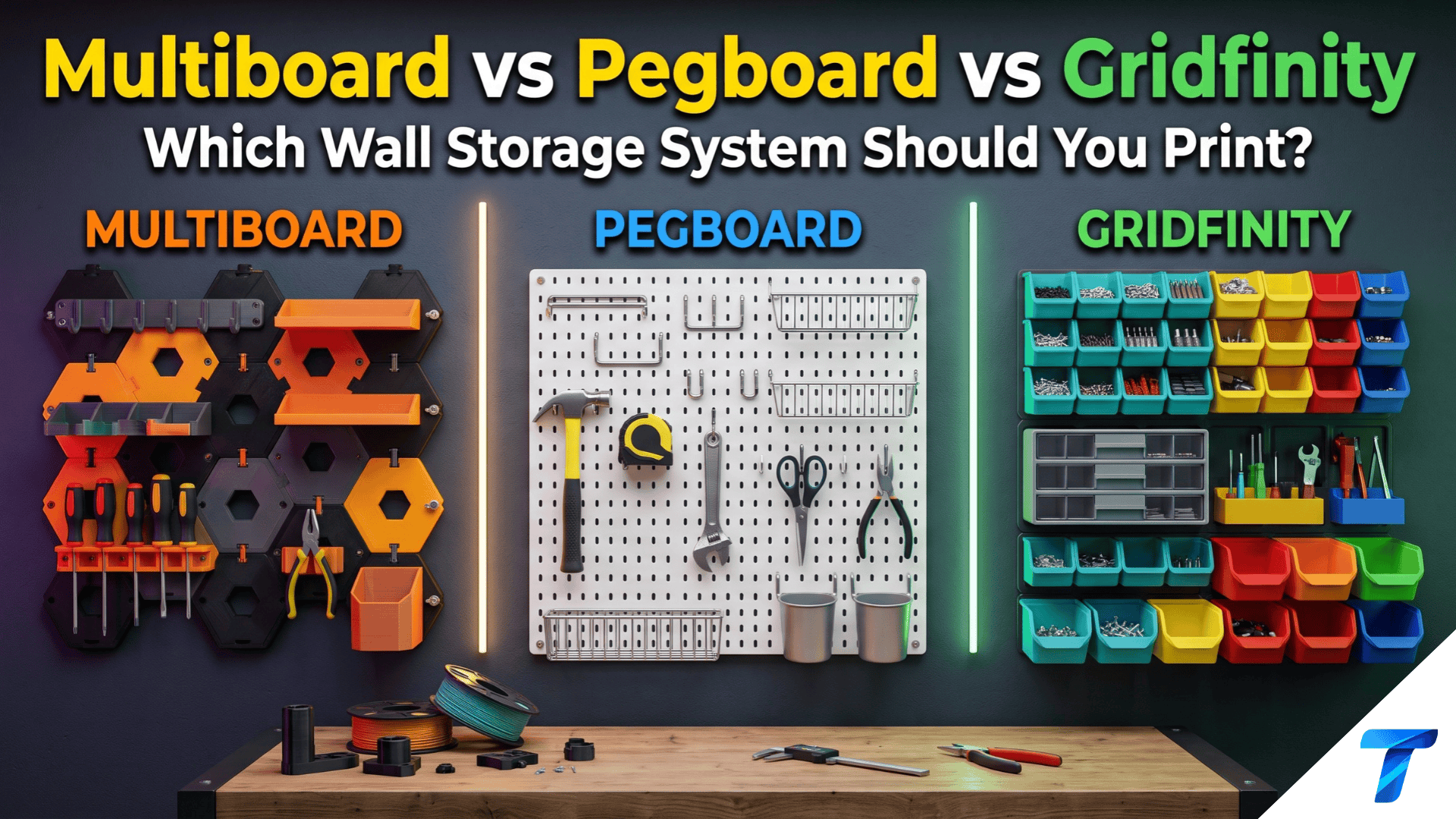

Pick the wrong 3D printed storage system and you will reprint a wall’s worth of panels. The three names people argue about solve different problems. Multiboard is a heavy-duty threaded wall panel. Pegboard is the cheapest and fastest to get running. Gridfinity is a bin standard built for drawers, not walls. This guide shows where each one wins and how to combine them.
Quick Takeaways
- Heavy tools on a wall: Multiboard (now branded MultiBuild) holds the most weight but costs the most filament.
- Light items, fastest start: Pegboard (IKEA Skådis-style or a printed 25 mm board) needs the least filament, and you only print hooks.
- Bins and small parts: Gridfinity is the best bin system, but it is a horizontal standard. On a wall it needs an adapter layer.
- Best hybrid: A strong wall panel plus Gridfinity bins on shelves. OpenGrid is the newest panel that aligns with both.
Which System Is Which?
People compare these three as if they were one category. They are not.
| Multiboard | Pegboard | Gridfinity | |
|---|---|---|---|
| Core idea | Threaded tiles with snaps | Plate with a hole array and hooks | Baseplate plus stackable bins |
| Grid | 25 mm (MU) | 25 mm pitch (metric) | 42 mm cells, 7 mm height units |
| Native orientation | Vertical (wall) | Vertical (wall) | Horizontal (drawer, shelf) |
| Load capacity | High | Low to medium | Bin-dependent, magnets or screws |
| Filament cost | High | Low | Medium |
| Ecosystem | Large, licence-restricted | Huge, mostly free | Huge, open |
| Best for | Power tools, heavy gear | Hand tools, light gear | Screws, bits, small parts |
Multiboard: The Heavy-Duty Wall Panel
Multiboard is a 3D printable panel system from Keep Making. The project has grown into a bin system as well, and is being rebranded to MultiBuild. You will see both names in tutorials, and they are the same ecosystem.
How the Grid Works
Multiboard tiles follow a 25 mm grid called an MU, and most Multibin parts follow a 50 mm cell called a CU, where 2×2 MU equals 1×1 CU. Every hole on a tile is threaded, so you can screw accessories straight in or push in snaps.
The designer moved offset mounts from 8 mm to 6.25 mm so every part sits on grid, because 8 mm does not divide evenly into 25 mm. Check which offset your mounting parts use before you print a full wall. Old and new parts can misalign.
Strengths
- Highest holding strength of the wall options, thanks to threaded and snap-locked connections.
- Gridfinity-style bins (Multibin) now exist inside the same ecosystem.
- 700+ parts, so most hardware problems already have a solution.
Weaknesses
- Filament-hungry: community estimates run roughly 200 to 300 g per panel.
- Licence limits. Some makers have found the licence too restrictive and moved to openGrid.
- Long print times. A full wall means dozens of tiles.
Pegboard: The Cheap, Fast Starter
Pegboard needs the least printing, which is why it is the best entry point. There are two routes:
- Buy IKEA Skådis boards and print only the hooks and holders.
- Print your own boards for custom sizes and colors.
Pegboard Specs That Matter
The metric standard uses 25 mm hole spacing and 6 mm holes, while the inch standard uses 1″ spacing and 1/4″ holes. The two are close but not interchangeable.
Skådis is a different animal. The IKEA board is 5 mm thick (±0.2 mm), and a printed board that comes out 4 mm thick will not fit its accessories. The holes on a printed Skådis-style board can run slightly small as well. The original slot measures 5 mm wide and 15 mm high. Print a test block before committing to a full wall.
Strengths
- Lowest cost per wall area. Hooks use only about 5 to 20 g each.
- Largest library of free accessories.
- Easy installation, with a flat panel and a few screws.
Weaknesses
- Weakest hold. Hooks lever out under heavy loads.
- Hook fit varies between brands and printed boards.
- Limited bin options without adapters.
Gridfinity: The Bin Standard (Not a Wall)
Gridfinity is a standard, not a product. Zack Freedman released it in 2022, and each grid square measures 42 mm x 42 mm, with bin heights in 7 mm increments. A 3U bin stands 21 mm tall, and a 6U bin stands 42 mm.
Why It Struggles on a Wall
Gridfinity was designed for drawers. Bins sit in baseplate sockets and rely on gravity plus optional magnets. The original baseplate uses press-fit pockets for 6 mm x 2 mm neodymium magnets in each cell corner. A bin on a vertical surface needs a mounting layer.
The usual wall setups are:
- Gridfinity shelves attached to a Multiboard or openGrid panel.
- GOEWS (Gridfinity Over-Engineered Wall Storage), a wall system built for Gridfinity.
- Gridfinity baseplates screwed to a French cleat or panel.
Strengths
- The best small-parts bin system available, free and open.
- Parametric generators make custom sizes trivial.
- Quick-swap bins you can carry to the workbench.
Weaknesses
- Not a wall system on its own.
- A 42 mm grid does not divide into a 25 mm panel grid.
- Magnets and baseplates add cost if you go the magnet route.
The Wildcard: openGrid
Any 2026 comparison has to include openGrid. It was built to bridge exactly this gap. It uses a Gridfinity-compatible 28 mm grid and incorporates existing solutions like Multiboard, HSW and GOEWS.
The math is the clever part. Three openGrid units equal 84 mm, which matches two Gridfinity units, so both can share one wall without adapter plates. Lite variants use 30 to 40% less filament than standard panels. It is lighter-duty than Multiboard by design, but for most home workshops that is enough.
Direct Comparison: Load, Filament, Time
| Factor | Multiboard | Pegboard (Skådis style) | Gridfinity | openGrid |
|---|---|---|---|---|
| Primary use | Wall, heavy | Wall, light | Drawer, shelf | Wall + desk |
| Weight capacity | Highest | Low to medium | Bin dependent | Medium |
| Filament per panel | ~200 to 300 g | ~5 to 20 g (hooks only) | ~80 to 120 g (2×4 baseplate) | ~60 to 100 g |
| Print time to start | Days | Hours | Hours to days | Days |
| Difficulty | Medium | Easy | Easy to medium | Medium |
| Licence | Restricted | Mostly free | Open | Open |
| Gridfinity compatible | Via adapters | Via adapters | Native | Native (84 mm super-grid) |
Filament figures are community estimates, not lab measurements. Your infill and wall settings will shift them.
Print Settings That Work
Panels and snaps carry load, so print them stronger than a typical decorative part.
| Setting | Panels/Tiles | Snaps/Connectors | Gridfinity Bins |
|---|---|---|---|
| Material | PETG or PLA+ | PETG | PLA or PETG |
| Layer height | 0.2 mm | 0.16 to 0.2 mm | 0.2 mm |
| Walls | 3 | 3 to 4 | 2 to 3 |
| Infill | 15 to 20% | 20%+ | 10 to 15% |
| Supports | Usually none | Check per part | None |
One Multiconnect-style design recommends at least 3 perimeters and at least 20% infill. Use PETG for anything that flexes or sits near a heat source. PLA can creep under constant load, especially in a warm garage.
Mounting to the Wall
Use studs for heavy loads. Stud spacing in most homes is 400 mm or 600 mm, so plan your panel layout around it. In US construction that is 16 in or 24 in on center. Drywall anchors suit light pegboard loads only.
Real-World Use Cases
Garage tool wall (drills, clamps, chargers). Use Multiboard or openGrid. Threaded snaps handle weight that pegboard hooks cannot.
Craft or hobby corner (scissors, tape, paint). Use Skådis with printed hooks. It is cheap, light and easy to rearrange.
Electronics bench (resistors, screws, bits). Use Gridfinity bins on a shelf above the bench. Print 1×1 and 2×1 bins at 3U for small parts.
Mixed workshop wall. Mount a Multiboard or openGrid panel, then hang Gridfinity shelves off it. Keep heavy tools on hooks and small parts in bins you can lift off and carry.
Renter-friendly setup. Choose Skådis. The panel mounts on a few screws, and the hooks are all you print.
Which Should You Print?
| If you… | Print this |
|---|---|
| Want the cheapest, fastest start | Pegboard (Skådis hooks) |
| Hang heavy tools | Multiboard or openGrid |
| Store small parts | Gridfinity bins |
| Want one system for wall and drawer | openGrid + Gridfinity |
| Hate licence restrictions | openGrid or Gridfinity |
The community consensus is a hybrid approach: Gridfinity for horizontal storage, and Multiboard or OpenGrid for heavy vertical tools.
FAQ
Is Multiboard better than Gridfinity?
They do different jobs. Multiboard is a wall panel for hanging heavy items. Gridfinity is a bin system for drawers and shelves. Most people use both, with Multiboard for hanging and Gridfinity for small parts.
Can you use Gridfinity bins on a wall?
Yes, with an adapter layer. Mount Gridfinity baseplate shelves to a Multiboard or openGrid panel, or use a wall-specific system like GOEWS. Bare Gridfinity baseplates are not designed to hold bins vertically.
Is a 3D printed pegboard cheaper than buying one?
Usually not for the board. An IKEA Skådis board is cheaper than the filament for a printed panel. Print the hooks and holders instead, which cost about 5 to 20 g of filament each. Print the board only for a custom size or color.
What is the strongest 3D printed wall storage system?
Multiboard is the strongest of the common options, thanks to its threaded, snap-locked connections. openGrid is lighter-duty but uses far less filament. Mount either one into studs for heavy tools.


