

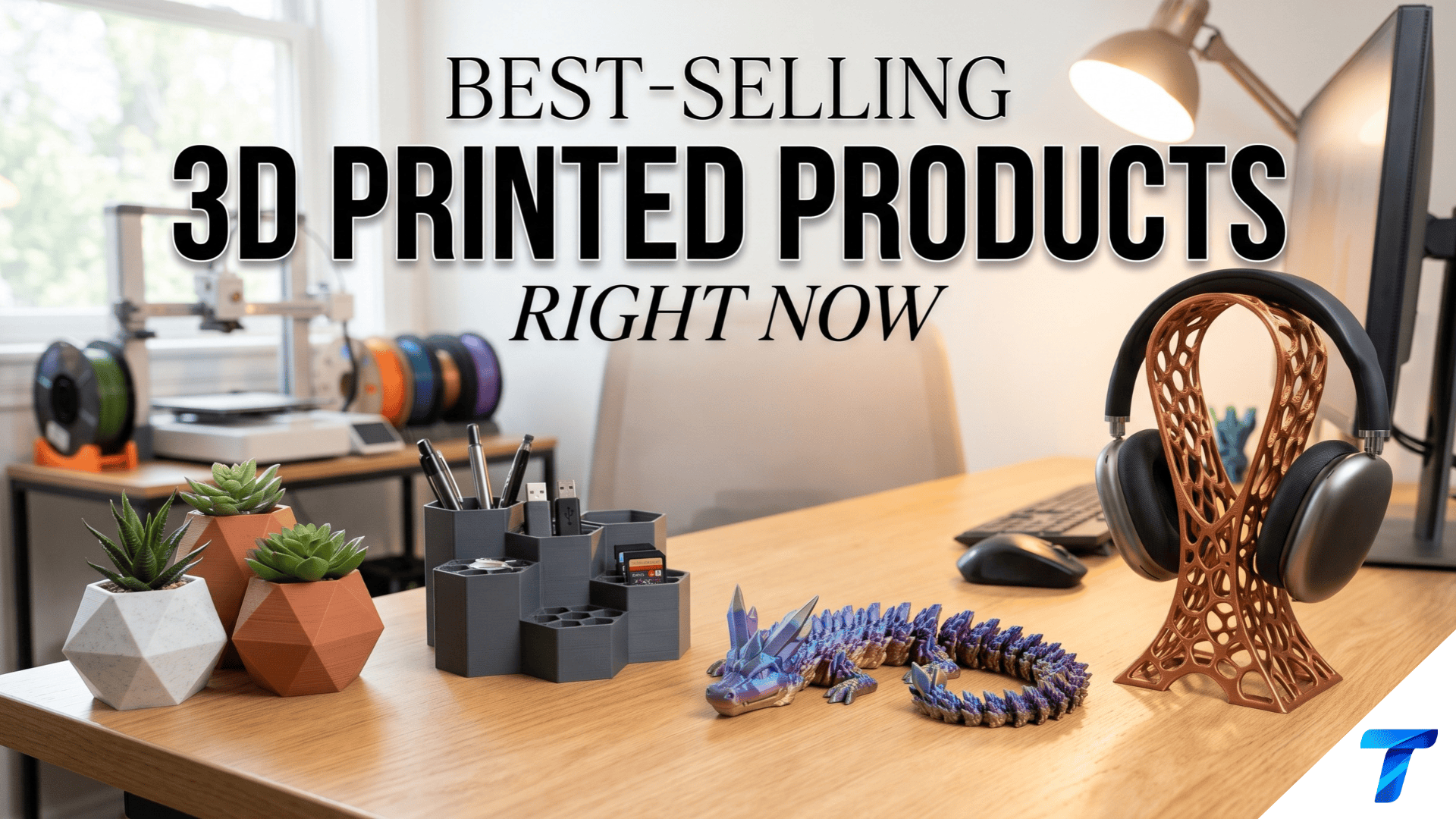

Display stands, cosplay armor and flexi toys sell in volume. Lithophane lamps and custom cookie cutters earn the most per print. Since mid-2025, Etsy has also restricted selling prints made from other people’s files, and that rule decides what you can list.
Quick Takeaways
- Volume leaders: Display stands and wall mounts had 2,648 eBay sales in 30 days to October 1, 2026, ahead of cosplay gear and figures.
- Margin leaders: Lithophane night lights ($30–$120) and custom cookie cutters ($25–$60 for custom shapes) beat generic items on profit per print.
- Legal gate: Etsy has required 3D-printed items to come from the seller’s original design since June 10, 2025. Printing a Printables or Thingiverse file for sale on Etsy, even with a commercial license, no longer qualifies.
- Best strategy: Own a niche, personalize the product and design it yourself. A best-seller is not always the most profitable item.
| Rank | Product | Typical Price | Est. Margin | Competition |
|---|---|---|---|---|
| 1 | Display stands and wall mounts | ~$15 | 50–65% | High |
| 2 | Cosplay helmets and props | $25–$350 | 55–70% | Medium |
| 3 | Statues, busts, miniatures | $15–$60 | 60–75% | Medium |
| 4 | Articulated and fidget toys | $12–$35 | 65–80% | Medium-High |
| 5 | Light-up signs and lamps | ~$40+ | Varies | Low (82 sellers) |
| 6 | Home and workshop organizers | $10–$55 | 60–68% | Medium |
How to Read “Best-Selling” Data
Etsy doesn’t publish unit sales. Every “top 10” list you see is a proxy.
The figures in this guide come from two sources. The first is eBay 30-day sales counts (October 2026). Analysts use them as a demand proxy because Etsy hides its numbers. The second is seller-guide estimates of price ranges and margins. The guide behind those margin figures says its prices, margins and volumes are its own estimates and haven’t been independently verified. Treat them as ranges, not promises.
The market behind them is growing. One forecast values the consumer 3D printing market at USD 1.05 billion in 2025, rising to USD 1.17 billion in 2026. China’s 3D printing equipment output jumped 48.5% year-on-year in the first half of 2026. More cheap printers mean more makers and more competition in every category below.
The Rule That Decides What You Can Sell
Check this before you pick a product.
- Etsy’s Creativity Standards say items made with computerized tools, including 3D printers, “must be produced based on a seller’s original design.”
- Before the change, the wording allowed templated designs, which covered prints from other people’s files.
- Etsy hasn’t explained how it treats a modified third-party design, so remixing a file is not a safe workaround.
- Many popular models are personal-use only, and selling a print requires a commercial license.
Practical result: Design your own models in Fusion 360, Blender or OnShape. Or commission exclusive designs. Other platforms, such as eBay, Amazon Handmade and local markets, have their own rules. Read each one.
The Top Best-Selling 3D Printed Products
1. Display Stands and Wall Mounts
This is the volume king. The category had 2,648 sales from 269 sellers at a $14.99 median price. Think controller holders, headphone hangers, collectible stands and phone docks.
- Material: PLA or PETG
- Layer height: 0.2 mm
- Infill: 15–25%, with 4 walls for load-bearing arms
- Print time: 1–3 hours
Phone stand demand spikes with each new phone release. Name the latest model in your listing and design the cutout before competitors do.
2. Cosplay Helmets, Masks and Armor
Cosplay masks, helmets and armor sold 1,517 units at a $24.99 median price. Premium pieces go far higher. Sellers cite a $50–$350 range, and convention season (roughly March–August) drives the spikes.
- Material: PLA+ for rigid parts, TPU for straps and flexible trim
- Layer height: 0.12–0.2 mm on visible surfaces
- Post-processing: Sanding, filler primer and paint account for most of the labor
This is labor-intensive work, so price accordingly. List in January or February to catch the season.
3. Statues, Busts and Tabletop Miniatures
Statues, busts and painted figures hit 1,439 sales at a $27.99 median price. Miniatures are cheap to make. Material runs about $0.50–$3 per piece and they sell for $5–$25, a 75–85% margin by one seller guide’s estimate.
Resin printers win here for fine detail (0.03–0.05 mm layers). Custom character minis reportedly command $40–$100 from tabletop players.
4. Articulated and Fidget Toys
Print-in-place dragons, octopuses and slugs come off the plate fully movable. The category logged 1,402 sales but had 381 competing sellers and a $11.99 median price. That makes it high-volume and low-price.
Glow-in-the-dark and galaxy colorways reportedly earn 20–30% premiums. Differentiate through color, size and original character design, not price.
| Setting | Recommended Value |
|---|---|
| Layer height | 0.2 mm |
| Walls | 3–4 |
| Infill | 15–100% (small joints print best solid) |
| Material | PLA or PETG |
| Supports | None (print-in-place) |
| Nozzle temp | 200–220 °C (PLA), 230–245 °C (PETG) |
5. Light-Up Signs and Lamps
This category has the best price and the least competition. It posted 1,372 sales from only 82 sellers at a $39.99 median price. The catch: many top sellers use brand logos, which you can’t sell on Etsy without a license.
Design original shapes and custom text. Personalized name signs sell well. Nursery decor searches peak September–November. Use white or translucent PLA with a 0.4 mm wall, and keep LED strips away from the plastic to avoid warping.
6. Home and Workshop Organizers
Organizers recorded 1,166 sales at a $16.99 median price. Drawer inserts, tool holders, battery dispensers and cable clips solve real problems. They’re also the easiest category to customize by hobby. A Gridfinity-style system built for one hobby beats a generic bin.
7. Lithophane Night Lights
The highest margin on this list. Lithophanes sell for $30–$120 at a 70–80% margin, with low-to-medium competition. They peak near Mother’s Day and Christmas. Pet memorials support premium pricing.
Print flat in white PLA at 0.1 mm layers, with 100% infill.
8. Custom Cookie Cutters
October and December reportedly bring 3–5x normal volume. Custom shapes sell for $25–$60, against $8–$15 for generic ones. Use PETG or PLA with food-safe disclaimers. Don’t claim food safety for FDM prints, because layer lines trap bacteria.
9. Home Decor, Planters and Multicolor Showpieces
Skull planters and moon-phase wall art are cited as consistent year-round performers. Multicolor showpieces, such as swirling vases and dioramas, often use three or four colors in one print.
Quick Profit Calculator
Use this before you commit to any product.
Profit per unit = Price − (Filament + Electricity + Platform fee + Packaging + Shipping) − (Print hours × Machine wear rate)

Example (flexi dragon):
Price: $18.00
Filament (40 g @ $20/kg): $0.80
Electricity (1.5 h): $0.05
Etsy fees (~10%): $1.80
Packaging + shipping: $4.00
Machine wear ($0.30/h): $0.45
Profit ≈ $10.90 (≈60%)
Your numbers will differ. Shipping and fees can eat a thin margin fast.
Real-World Use Cases and Scenarios
| Scenario | Best Product | Why It Works |
|---|---|---|
| Side hustle, one printer | Custom name signs and lithophanes | Personalization lifts price |
| Gamer audience | Controller stands, dice towers | Niche buyers pay for fit |
| Local craft fairs | Flexi toys, planters | Impulse buys under $20 |
| Convention season | Cosplay props | $50–$350 spikes |
| Small business clients | Branded display stands | Repeat B2B orders |
Realistic income: One guide says part-time sellers with one or two printers report $500–$2,000/month after 6–12 months of building a shop. Treat that as a ceiling for a new shop, not a typical first month.
Printer note: Demand has shifted toward lower-cost material extrusion systems. A reliable budget FDM printer is enough for most categories above. Add a resin printer only if you target miniatures or jewelry.
What to Avoid
- Licensed characters and logos. These cause takedowns.
- Unlicensed downloads. Check the license before listing anything. Credit the designer publicly, which is often a license requirement.
- Generic, saturated items. Flexi toys have 381 sellers fighting on price.
- Fragile or heavy prints. Breakage and shipping costs erase margin.
FAQ
What is the best-selling 3D printed item right now?
Display stands and wall mounts lead on volume. They had 2,648 eBay sales in 30 days, ahead of every other tracked category. By profit per print, lithophanes and custom cookie cutters do better.
Can I sell 3D prints made from Printables or Thingiverse files on Etsy?
No, not in practice. Etsy requires items to be based on the seller’s original design, and files from Thingiverse, Printables or paid subscriptions don’t qualify even with a commercial license. Design your own or sell on a platform with different rules.
What is the most profitable thing to 3D print?
Niche, personalized items with low competition. One seller guide says a best-seller isn’t always the most profitable, because high demand brings high competition. Lithophanes, custom signs and original miniatures are strong candidates.
How much does it cost to make a typical 3D printed product?
Most items use $0.50–$3 of filament per piece and retail for $12–$50+, according to one 2026 guide. Subtract platform fees, shipping and machine time to get true profit.


