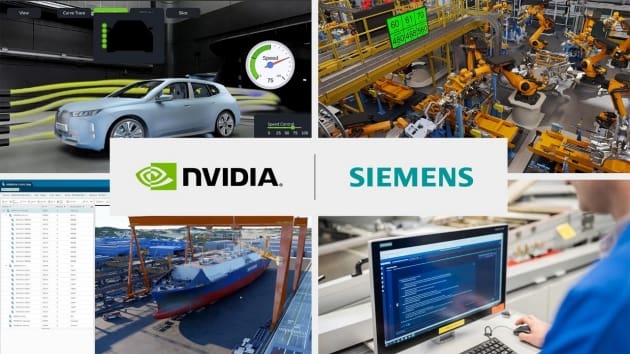
The convergence of artificial intelligence and industrial manufacturing took center stage at CES 2026 when Siemens President and CEO Roland Busch shared the keynote stage with Nvidia CEO Jensen Huang to announce an expanded partnership aimed at transforming manufacturing, production, and supply chain management through AI integration. The collaboration signals how AI’s impact extends far beyond consumer applications into the industrial sector that underpins global economic activity.
Siemens’ position as a leading industrial automation and digitalization provider gives the partnership particular significance. The company’s software and hardware systems manage manufacturing operations across countless factories worldwide, spanning industries from automotive to pharmaceuticals. Integrating Nvidia’s AI platforms into these systems could fundamentally change how products are designed, manufactured, and delivered.
The partnership focuses on what the companies describe as a new industrial revolution driven by AI. Modern manufacturing already incorporates extensive automation and digital tools, but AI promises to add layers of intelligence that enable facilities to optimize themselves continuously, predict equipment failures before they occur, adapt production processes in real-time to changing conditions, and coordinate complex supply chains with minimal human intervention.
Nvidia’s contribution centers on its AI computing platforms and simulation technologies. The company’s GPUs, originally developed for graphics rendering and gaming, have become the standard hardware for training and running AI models. Nvidia’s Omniverse platform enables creation of digital twins, virtual replicas of physical manufacturing facilities where AI can test process changes and predict outcomes before implementing them in the real world.
Siemens brings comprehensive industrial software including PLM (Product Lifecycle Management), MES (Manufacturing Execution Systems), and SCADA (Supervisory Control and Data Acquisition) platforms that already collect enormous amounts of data from manufacturing operations. This data provides the foundation for training AI models that can identify patterns, optimize processes, and make predictions impossible for human operators to achieve.
The announced collaboration encompasses multiple application areas. In manufacturing, AI can optimize production scheduling to maximize throughput while minimizing energy consumption and wear on equipment. Machine learning models trained on sensor data can predict when machinery will require maintenance, allowing scheduled downtime rather than unexpected failures that halt production lines.
Supply chain management represents another major focus. Global supply chains involve countless variables including raw material availability, transportation logistics, demand forecasting, and inventory management. AI systems can process these variables holistically to suggest optimal decisions about sourcing, production volumes, shipping routes, and warehouse operations that human planners would struggle to identify.
Product design and engineering can benefit from AI through generative design approaches where algorithms explore vast possibility spaces to identify configurations that meet performance requirements while minimizing material usage or manufacturing complexity. These AI-designed components can incorporate insights from thousands of previous designs and manufacturing data to create solutions that human engineers might not conceive.
Quality control processes that currently rely on human inspection or simple sensors can be augmented with computer vision systems that detect defects invisible to human eyes or identify subtle patterns indicating future problems. Training these systems on labeled datasets of acceptable and defective products enables automated inspection at speeds and consistency levels humans cannot match.
The broader implications extend to sustainability and resource efficiency. Manufacturing accounts for significant global energy consumption and environmental impact. AI optimization of production processes could reduce waste, minimize energy usage, and identify opportunities for recycling or materials substitution that decrease environmental footprint while potentially reducing costs.
However, implementing AI in industrial settings faces challenges beyond the technology itself. Manufacturing facilities often contain equipment decades old that lacks the sensors and connectivity required for AI integration. Upgrading existing facilities requires substantial capital investment and careful planning to avoid disrupting ongoing operations.
Workforce implications create another consideration. As AI assumes responsibilities currently performed by human workers, companies must manage workforce transitions sensitively while ensuring employees develop skills needed to work alongside AI systems. The industrial revolution metaphor implies transformation as significant as previous technological shifts that fundamentally restructured labor markets.
Cybersecurity concerns intensify as manufacturing systems become more connected and data-driven. AI-managed facilities could become targets for sophisticated attacks aimed at sabotaging production, stealing intellectual property, or causing physical damage. Securing these systems requires comprehensive approaches that protect both IT infrastructure and operational technology.
The partnership announcement during CES keynote positioning indicates both companies view industrial AI as sufficiently important and mature to warrant high-profile promotion. For Nvidia, expanding beyond cloud data centers into industrial computing represents significant growth opportunity in markets with different dynamics and requirements than its current core businesses.
For Siemens, incorporating cutting-edge AI into its industrial portfolio helps maintain competitiveness as manufacturing customers increasingly demand AI capabilities. Companies that can integrate AI successfully will gain competitive advantages through improved efficiency, quality, and agility that competitors cannot match without similar capabilities.
The timeframe for realizing the vision outlined during the keynote remains unclear. Industrial systems operate on longer cycles than consumer technology, with equipment expected to function reliably for years or decades. Transformation will likely occur incrementally as facilities upgrade systems, manufacturers design AI integration into new equipment, and companies develop expertise in deploying and managing AI in industrial contexts.