When you decide to learn robotics, one of the first practical questions you face is which programming language to learn. Unlike web development where JavaScript dominates or mobile apps where Swift and Kotlin rule their respective platforms, robotics employs a diverse ecosystem of programming languages. Different languages serve different purposes within robotics projects, from low-level motor control to high-level artificial intelligence. Understanding this landscape helps you choose where to invest your learning effort and why experienced roboticists often know multiple languages rather than specializing in just one.
The programming language question matters because it directly affects what you can build and how quickly you can build it. Some languages excel at real-time control tasks where microsecond timing matters. Others shine for rapid prototyping of computer vision algorithms. Certain languages integrate seamlessly with popular robotics frameworks and libraries, while others require more manual work to accomplish the same tasks. Your choice of programming language shapes your development experience, influences what resources and communities you can access, and determines which robotics platforms and tools work most naturally for you.
This article explores the major programming languages used in robotics, examining why each has earned its place in the roboticist’s toolkit. You will learn what makes each language suitable for particular aspects of robotics, what tradeoffs they involve, and how to think about which languages to learn based on your goals and the types of robots you want to build. Rather than declaring one language “best,” this exploration reveals how different languages complement each other in the complex, multifaceted field of robotics.
C and C++: The Foundation of Real-Time Control
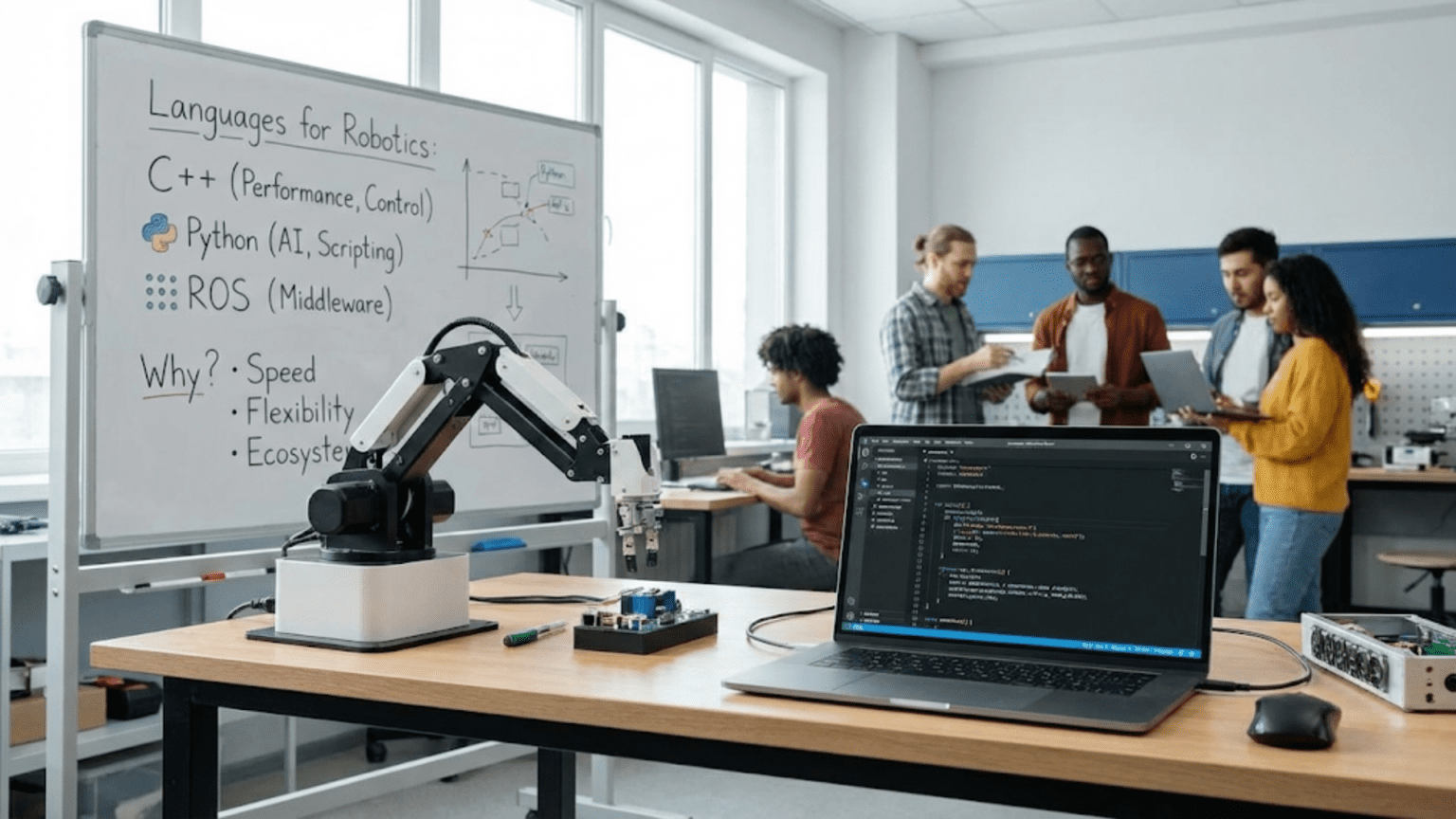
C and C++ represent the foundational languages of robotics, particularly for systems requiring real-time performance and direct hardware interaction. These languages compile to native machine code that executes with minimal overhead, enabling the precise timing control essential for motor coordination, sensor reading, and safety-critical operations. When microseconds matter and predictable execution is crucial, C and C++ deliver the performance and control that higher-level languages struggle to match.
The C language emerged in the early 1970s and remains relevant precisely because it provides thin abstraction over hardware. Writing C code feels close to machine language while remaining portable across different processor architectures. This characteristic makes C ideal for embedded systems like microcontrollers that control robots directly. When you need to read analog sensor values every millisecond, command motor drivers with precise pulse-width modulation timing, or respond to interrupt signals from encoders, C provides the tools to interact with hardware at the necessary level.
C++ extends C with object-oriented programming features, templates, and higher-level abstractions while maintaining the same performance characteristics. This combination of low-level control and high-level organization makes C++ particularly valuable for complex robotics systems. You can write time-critical control loops in bare C style when needed, while organizing larger codebases using classes, inheritance, and other object-oriented patterns that improve maintainability. Professional robotics software often uses C++ precisely because it scales from hardware interaction up to complex system architectures without sacrificing performance.
The Robot Operating System (ROS), the most widely used software framework in robotics research and development, primarily uses C++ for its core libraries and performance-critical components. Learning C++ opens access to the vast ROS ecosystem including visualization tools, simulation environments, and countless packages for navigation, manipulation, perception, and other robotics capabilities. Many robotics positions list C++ proficiency as a requirement specifically because so much professional robotics code builds on ROS and C++.
Real-time operating systems used in safety-critical robotics applications almost universally use C or C++. Industrial robots, autonomous vehicles, and medical robotics systems require guaranteed response times and deterministic behavior that only compiled languages with predictable execution can reliably provide. The aerospace and defense industries, where robotics overlaps with unmanned systems, standardize on C and C++ for flight control and mission-critical software.
However, C and C++ present steep learning curves, especially for beginners. Manual memory management requires careful attention to prevent memory leaks and dangling pointers. The syntax includes many subtle pitfalls that can introduce hard-to-debug errors. Compilation adds a step between writing code and testing it, slowing the development cycle compared to interpreted languages. For beginners, these challenges can feel overwhelming, which explains why many introductory robotics courses start with simpler languages before progressing to C++.
Despite the challenges, investing time to learn C++ pays dividends for serious robotics work. The language dominates professional robotics, and understanding it enables you to read and contribute to major open-source robotics projects. Even if you primarily use higher-level languages for development, understanding C++ helps you appreciate performance implications and interface with lower-level libraries when necessary.
Python: The Language of Rapid Development and AI
Python has become robotics’ second major language, dominating areas where development speed, readability, and access to machine learning libraries matter more than raw execution performance. While C++ handles real-time control and hardware interaction, Python excels at algorithm development, computer vision, machine learning, data analysis, and rapid prototyping. The combination of Python’s clean syntax, extensive libraries, and active community makes it the go-to language for robotics research and high-level application development.
The readable, concise syntax makes Python particularly appealing for beginners and for collaborative projects where code clarity matters. Python emphasizes code readability, using indentation for structure and encouraging expressive variable names. You can implement complex algorithms in fewer lines of Python than equivalent C++ code, accelerating development and making programs easier to understand and modify. For educational robotics and learning projects, Python’s approachability removes barriers that more complex languages erect.
Python’s scientific computing ecosystem provides powerful tools for robotics applications. NumPy enables efficient numerical operations on arrays and matrices, essential for processing sensor data and mathematical computations. SciPy adds scientific algorithms for optimization, signal processing, and statistics. Matplotlib creates visualizations for data analysis and algorithm debugging. These libraries transform Python into a powerful platform for developing and testing robotics algorithms before implementing them in faster languages if necessary.
Computer vision in robotics heavily relies on Python through the OpenCV library. While OpenCV’s core implements in C++ for performance, its Python bindings provide accessible interfaces for image processing, feature detection, object recognition, and camera calibration. The ability to process images, detect objects, and extract visual features with relatively simple Python code makes computer vision approachable for roboticists without deep image processing expertise.
Machine learning and artificial intelligence in robotics overwhelmingly use Python. TensorFlow, PyTorch, and scikit-learn, the dominant machine learning frameworks, all emphasize Python interfaces. Training neural networks for object detection, implementing reinforcement learning for robot control, or deploying pre-trained models for perception tasks all flow naturally in Python. As robotics increasingly incorporates AI and learning-based approaches, Python’s dominance in this domain makes it essential for modern robotics.
ROS supports Python alongside C++, allowing developers to implement ROS nodes in Python when performance permits. Many ROS tools and utilities use Python for their flexibility and development speed. Sensor drivers, high-level planning algorithms, and user interfaces often implement in Python because the slight performance penalty matters less than rapid development and easy modification. The ability to prototype quickly in Python, then reimplement performance-critical parts in C++ when necessary, provides flexibility throughout the development process.
Python’s interpreted nature simplifies the development cycle. You write code, run it immediately, see results, and modify it without compilation steps. This rapid iteration speeds algorithm development and debugging significantly. Interactive Python environments like Jupyter notebooks enable exploratory programming where you can test ideas, visualize results, and document your process all in one environment. These capabilities make Python excellent for research and education where experimentation and explanation matter as much as final performance.
The performance gap between Python and C++ remains Python’s primary limitation for robotics. Interpreted languages execute slower than compiled code, sometimes dramatically slower for computation-heavy tasks. Time-critical control loops, high-frequency sensor processing, or real-time motion control typically require C++ performance. However, for many robotics tasks including high-level planning, user interfaces, and offline data analysis, Python’s performance suffices. When Python proves too slow for specific operations, libraries like NumPy use C implementations internally to accelerate bottlenecks while maintaining Python interfaces.
Java: Enterprise Robotics and Android Platforms
Java occupies a smaller but significant niche in robotics, particularly in enterprise applications, Android-based robots, and educational contexts where its platform independence and memory safety appeal. While not as dominant as C++ or Python, Java’s strong type system, extensive standard library, and widespread industry use make it relevant for certain robotics applications and development environments.
The Java Virtual Machine provides platform independence, allowing the same Java bytecode to run on different operating systems and processor architectures without recompilation. This “write once, run anywhere” capability benefits robotics deployments across diverse hardware platforms. Educational institutions sometimes prefer Java for teaching robotics because students can develop on various computers and deploy to different robot platforms without platform-specific concerns.
Android’s official development language Java makes it natural for robots based on Android devices. Tablets and smartphones offer impressive computing power, integrated sensors, cameras, and touchscreens at consumer prices, making them attractive robot brains. Several commercial and research robots use Android devices for control and user interface, taking advantage of the Android ecosystem’s development tools, app distribution, and extensive libraries.
Memory management through garbage collection prevents entire classes of bugs common in C++, where manual memory management can cause memory leaks, dangling pointers, and crashes. Java’s automatic memory management trades some performance and timing predictability for increased safety and simpler programming. For robots where real-time control happens in separate microcontrollers while Java handles high-level logic, this tradeoff makes sense.
FIRST Robotics Competition, a major educational robotics program, has traditionally used Java as one supported language for programming competition robots. This exposure introduces many students to robotics through Java, creating a pipeline of Java-familiar roboticists. While professional robotics more commonly uses C++ or Python, this educational foundation remains significant.
Enterprise integration capabilities make Java suitable for robotics systems that interface with existing business software infrastructure. Java’s strong support for networking, databases, and enterprise messaging enables robots to integrate into larger business systems for warehouse automation, logistics, or manufacturing execution systems. The mature ecosystem of enterprise Java tools and frameworks helps build these integration bridges.
However, Java sees less use in professional robotics than C++ or Python for several reasons. Real-time control challenges due to garbage collection pauses make Java less suitable for time-critical operations. The robotics community’s tools, libraries, and frameworks predominantly target C++ and Python rather than Java. Performance falls between interpreted Python and compiled C++, occupying a middle ground where neither performance nor development speed optimizes.
MATLAB and Simulink: Algorithm Development and Simulation
MATLAB and its graphical companion Simulink occupy specialized niches in robotics research and development, particularly in academic institutions and large engineering organizations. While not general-purpose programming languages in the traditional sense, their focus on numerical computing, simulation, and algorithm visualization makes them powerful tools for robotics algorithm development, especially in control systems, signal processing, and initial prototyping.
MATLAB provides a high-level interpreted environment specifically designed for numerical computing and matrix operations. Robotics algorithms involving kinematics, dynamics, optimization, and control theory often express naturally in MATLAB’s matrix-oriented syntax. Engineers can implement complex mathematical formulations almost directly from equations, with built-in functions for common operations like matrix inversion, eigenvalue calculation, and numerical integration. This directness accelerates algorithm development and testing compared to implementing the same mathematics in general-purpose languages.
Simulink extends MATLAB with graphical programming where you create block diagrams representing system dynamics and control algorithms. This visual approach particularly suits control system design, where block diagrams already serve as standard notation. You can model robot dynamics, design controllers, simulate complete systems, and analyze performance all within the Simulink environment. The ability to graphically connect blocks representing motors, sensors, controllers, and plants provides intuitive system modeling.
Extensive toolboxes provide specialized capabilities for robotics including the Robotics System Toolbox, Computer Vision Toolbox, and Control System Toolbox. These add-ons include functions for path planning, inverse kinematics, sensor simulation, image processing, and controller design. Rather than implementing these algorithms from scratch, engineers leverage tested toolbox implementations to focus on their specific applications.
Automatic code generation from MATLAB and Simulink models bridges the gap between algorithm development and deployment. After designing and testing algorithms in MATLAB/Simulink, you can generate C or C++ code for deployment on actual robot hardware. This workflow lets engineers develop in the high-level MATLAB environment while still producing efficient compiled code for execution. The generated code runs on microcontrollers or embedded systems, enabling rapid prototyping without abandoning MATLAB’s development advantages.
Academic robotics research frequently uses MATLAB for algorithm development and paper preparation. Many research papers present results generated from MATLAB implementations. The ease of creating plots, the built-in statistical analysis capabilities, and the integration with LaTeX for scientific writing make MATLAB popular in research environments. Students learning robotics often encounter MATLAB in coursework, particularly for control theory, dynamics, and signal processing topics.
Cost represents MATLAB’s major limitation. License fees can be prohibitively expensive for individuals and small organizations, though educational licenses cost less. This barrier excludes MATLAB from many hobbyist and startup robotics projects that prefer free, open-source alternatives. Open-source alternatives like Octave provide MATLAB compatibility for some applications, but commercial toolboxes remain proprietary.
Performance limitations affect MATLAB for time-critical applications. While improved in recent versions, MATLAB generally executes slower than compiled languages. For offline analysis, simulation, and algorithm development, this matters less. For real-time robot control, generated code or interfacing to C++ implementations becomes necessary.
Assembly Language: When Microseconds Matter
Assembly language represents the lowest-level programming accessible to roboticists, providing direct control over processor instructions but requiring extensive expertise and platform-specific knowledge. Modern robotics rarely uses assembly for entire programs, but understanding where assembly matters helps you appreciate when and why roboticists occasionally drop to this level for performance-critical operations.
Timing-critical operations sometimes benefit from hand-optimized assembly code. When precise instruction timing matters for generating accurate pulse-width modulation signals, reading high-speed encoders, or implementing time-sensitive communication protocols, carefully crafted assembly code ensures exact timing that compiler-generated code might not achieve. These situations arise most commonly in custom hardware interfacing or specialized real-time applications where standard approaches prove insufficient.
Interrupt service routines, which must execute extremely quickly to avoid missing events or delaying other operations, sometimes implement in assembly. When a hardware interrupt fires indicating an encoder pulse or sensor trigger, every instruction cycle in the response matters. Assembly allows writing minimal interrupt handlers that save registers, perform essential operations, and return to the main program as quickly as possible.
Embedded systems with severe resource constraints might use assembly to minimize code size and maximize efficiency. Tiny microcontrollers with kilobytes of memory and limited processing power benefit from hand-optimized assembly that fits more functionality in less space. Modern robotics typically uses more capable processors where this extreme optimization is unnecessary, but understanding this historical context explains some older embedded code.
The primary argument against assembly involves productivity and maintainability. Assembly code requires many more lines to accomplish what a few lines of C or C++ achieve. Each processor architecture requires completely different assembly language, eliminating code portability. Debugging assembly proves significantly harder than higher-level languages. Modern compilers generate highly optimized code that often matches or exceeds hand-written assembly for most operations.
Most roboticists will never write assembly code directly. However, understanding that it exists at the lowest level helps you appreciate the abstraction layers higher-level languages provide. When you write C or Python, compilers and interpreters ultimately translate your code into machine instructions. Knowing this helps you reason about performance implications and understand why some operations cost more than others in terms of execution time.
JavaScript and TypeScript: Web Interfaces and NodeBots
JavaScript and its statically-typed variant TypeScript have found unexpected applications in robotics through web-based interfaces, simulation environments, and the NodeBots movement. While not traditional robotics languages, their prevalence in web development and the emergence of JavaScript robot control libraries make them worth understanding, especially for projects emphasizing user interfaces, remote monitoring, or browser-based simulation.
Web-based user interfaces for robots commonly use JavaScript to create interactive dashboards, control panels, and visualization tools. A robot might run ROS on Linux with C++ and Python nodes handling control and sensing, while a JavaScript web application provides human operators with maps, camera feeds, status displays, and command buttons. JavaScript’s dominance in web development means extensive libraries exist for creating sophisticated user interfaces, data visualization, and real-time communication.
JavaScript robotics frameworks like Johnny-Five enable programming robots directly in JavaScript, controlling Arduino and other microcontrollers through serial communication from Node.js. This approach lets web developers apply their existing JavaScript skills to robotics without learning C++. While not suitable for real-time control or performance-critical applications, JavaScript robotics enables rapid prototyping and educational projects where language familiarity accelerates learning.
Browser-based robot simulation using WebGL and JavaScript libraries creates accessible learning environments requiring no software installation. Students can program simulated robots directly in web browsers, seeing immediate results without hardware. The success of platforms like Codecademy and interactive coding tutorials demonstrates JavaScript’s effectiveness for educational introductions to programming concepts that later transfer to other languages.
ROS integration with web technologies through tools like rosbridge enables JavaScript web applications to interact with ROS systems. Browsers can subscribe to ROS topics, publish messages, and call services, allowing web-based robot interfaces to access the full ROS ecosystem. This capability bridges the web development and robotics communities, letting specialists in each domain contribute to complete systems.
TypeScript adds static typing to JavaScript, catching errors at development time that JavaScript would only reveal at runtime. For larger robotics projects with JavaScript components, TypeScript’s type safety improves code reliability and maintainability. The ability to gradually adopt TypeScript in existing JavaScript projects eases migration without requiring complete rewrites.
Performance and real-time limitations prevent JavaScript from replacing C++ or Python in most robotics applications. JavaScript executes in browser or Node.js environments with significant overhead compared to compiled languages. Unpredictable garbage collection pauses make timing-critical control problematic. These limitations restrict JavaScript to user interfaces, high-level logic, and educational applications rather than core robot control.
Choosing Your First Language: Practical Recommendations
Understanding the robotics language landscape helps you make informed choices about where to invest learning effort. Rather than one universally best language, different paths suit different goals, backgrounds, and project types. Your first language should match your immediate objectives while providing foundation for later expansion into other languages as your skills and ambitions grow.
Complete beginners with minimal programming experience often start best with Python or simple microcontroller platforms using simplified C++. Python’s readable syntax and forgiving nature help you focus on robotics concepts rather than fighting language complexity. Arduino’s simplified C++ environment provides hardware interaction without full C++ complexity. These approaches build basic programming competence and robotics understanding before tackling more challenging languages.
Learners with existing programming experience can leverage that knowledge by selecting robotics languages similar to what they already know. JavaScript programmers might explore NodeBots or web-based robotics. Java developers might try Android-based robots or FIRST Robotics. This strategy reduces language learning overhead so you can focus on robotics-specific concepts. Once robotics fundamentals click, learning additional languages becomes easier because you understand what you are trying to accomplish.
Career-focused learners targeting robotics jobs should prioritize C++ and Python as these dominate professional robotics. Survey job postings in areas that interest you, noting which languages appear most frequently. Developing strong C++ skills opens industrial robotics, autonomous vehicles, and aerospace applications. Python expertise suits research positions, AI-focused robotics, and computer vision applications. Combining both maximizes opportunities since many positions value both languages.
Academic paths through formal robotics education typically encounter MATLAB, Python, and C++ depending on course focus. Control theory courses favor MATLAB. Machine learning and computer vision courses emphasize Python. Embedded systems and real-time control courses teach C and C++. Following your educational program’s language choices makes sense while understanding that professional work might emphasize different languages.
Project-driven learners should select languages based on what their target projects require. Building a line-following robot? Arduino’s simplified C++ gets you started quickly. Creating a computer vision application? Python with OpenCV provides the tools. Developing a professional-grade manipulator? C++ and ROS offer the necessary capabilities. Letting your project goals drive language choices ensures you learn what actually helps you accomplish your objectives.
The Multi-Language Reality of Modern Robotics
Professional robotics projects rarely use single languages. Complex systems combine multiple languages, each handling aspects where it excels. A typical research robot might use C++ for real-time sensor processing and motor control, Python for computer vision and machine learning, JavaScript for web-based user interfaces, and scripts in various languages for utilities and automation. Understanding this multi-language reality prepares you for the integrated development that characterizes real robotics work.
Language interfaces and communication become important skills. Calling C++ libraries from Python using bindings like pybind11 or ctypes leverages each language’s strengths. ROS enables different nodes implemented in different languages to communicate seamlessly. Understanding how to bridge languages lets you architect systems using optimal languages for each component while maintaining integration.
Learning your second and third programming languages becomes progressively easier as you recognize patterns across languages. Variables, functions, loops, and conditionals appear in all languages with variations in syntax rather than fundamental differences in concept. Once programming concepts click in any language, learning additional languages becomes more about syntax and libraries than entirely new ways of thinking.
The future of robotics will likely continue using multiple languages. Specialized needs in robotics—real-time control, artificial intelligence, user interfaces, rapid prototyping—favor different languages. Rather than one language conquering all robotics, the trend toward polyglot development seems likely to continue. Successful roboticists increasingly need comfort with multiple languages and the wisdom to choose appropriate tools for each task.
Your journey into robotics programming should start somewhere, but need not end there. Begin with languages matching your current goals and resources. As you progress, expand into additional languages as new challenges and opportunities arise. The specific language matters less than building genuine understanding of robotics principles, problem-solving ability, and the flexibility to apply appropriate tools to different aspects of this diverse, multifaceted field. Whether you start with Python, Arduino C++, or another language, what matters most is starting and persistently building your skills through actual robot projects that teach both programming and robotics together.