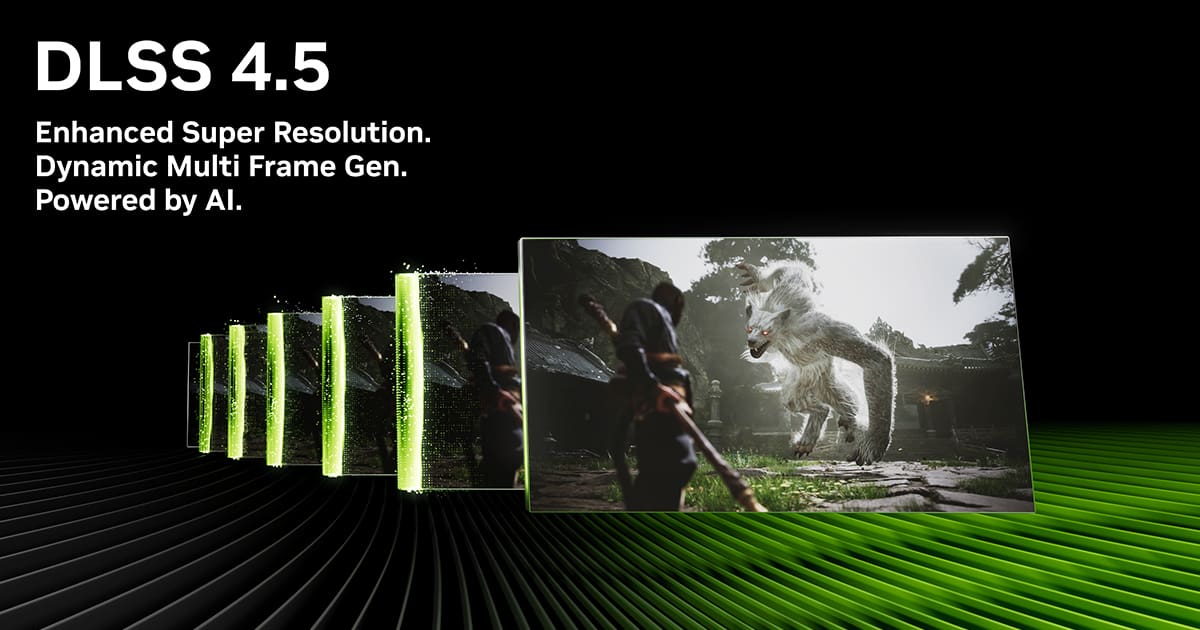
Nvidia has unveiled DLSS 4.5, the latest evolution of its Deep Learning Super Sampling technology that has become essential for modern PC gaming. Announced at CES 2026, the new version promises significant improvements in image quality and performance, particularly for owners of the company’s latest RTX 50 Series graphics cards.
The headline feature of DLSS 4.5 is Dynamic 6X Frame Generation, which can create up to five additional frames for each traditionally rendered frame. This represents a substantial increase from previous versions and enables gaming at extremely high frame rates even with demanding graphical features like path tracing enabled. Nvidia demonstrated 4K gaming at 240Hz with full path tracing, a performance level that would be impossible without AI-assisted frame generation.
DLSS 4.5 also introduces a second-generation Super Resolution Transformer that addresses persistent criticisms of previous versions. The new transformer promises better temporal stability, meaning that images remain consistent from frame to frame without flickering or shimmering artifacts. Additionally, Nvidia claims improvements in reducing ghosting, where moving objects leave trailing artifacts, and enhanced anti-aliasing that produces cleaner edges without jagged lines.
Importantly, while the most advanced frame generation features require RTX 50 Series cards, Nvidia is extending some DLSS 4.5 improvements to older graphics cards. RTX 20 and 30 Series cards will benefit from the improved Super Resolution Transformer, though they lack the specialized FP8 Tensor Cores that enable maximum performance. This backward compatibility demonstrates Nvidia’s commitment to supporting older hardware while still providing incentives to upgrade.
The gaming community has maintained mixed opinions about frame generation technology since its introduction. While the performance benefits are undeniable, some users question whether AI-generated frames provide the same responsive feel as traditionally rendered frames. Nvidia has worked to minimize latency and improve the quality of generated frames to address these concerns.
DLSS 4.5 arrives as competition in the GPU market intensifies. AMD continues developing its own FSR (FidelityFX Super Resolution) technology, while Intel’s entrance into the discrete graphics card market with its Arc series has added another competitor. Nvidia’s continued investment in DLSS represents an attempt to maintain its technological advantage through proprietary AI features that competing hardware cannot replicate.
The technology also has implications beyond gaming. Video rendering, 3D modeling, and other GPU-intensive professional applications can potentially benefit from DLSS upscaling and frame generation, though Nvidia has not yet detailed professional use cases for version 4.5.
Nvidia simultaneously announced improvements to G-Sync technology, its variable refresh rate standard. The new G-Sync Pulsar can effectively quadruple refresh rates to minimize motion blur, further enhancing the visual experience when combined with DLSS 4.5’s high frame rates.
For gamers, DLSS 4.5 represents another tool in the quest for higher performance without compromising visual quality. As games become increasingly demanding with features like ray tracing and path tracing, AI-assisted rendering technologies like DLSS become essential for making cutting-edge graphics accessible to more users.