


Overview
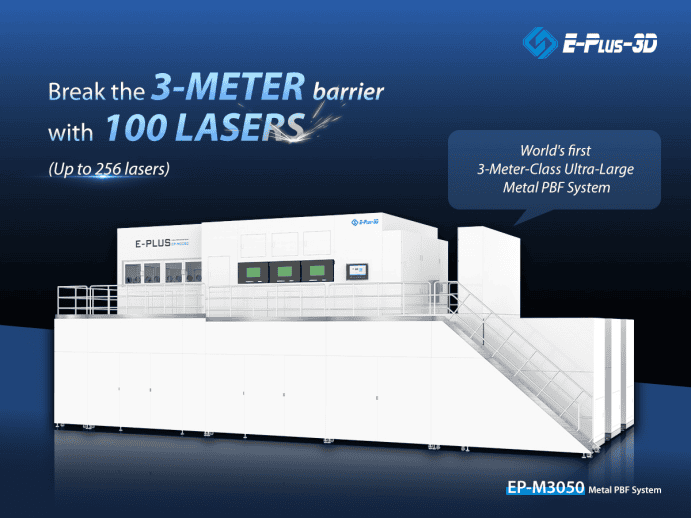
Chinese metal additive manufacturing solutions provider Eplus3D has unveiled the EP-M3050, an ultra-large-format metal powder bed fusion system that becomes the first industrial 3D printer to break the three-metre build chamber barrier. The system features a build area measuring 3,050 by 3,050 millimetres with a Z-axis height customisable up to 5,000 millimetres, combined with 256 coordinated lasers working simultaneously to achieve the kind of throughput and quality consistency required for commercial production of the largest structural components in aviation, energy, industrial manufacturing, and oil and gas sectors.
Why Breaking Three Metres Matters
For large aerospace structures, energy infrastructure components, and heavy industrial parts, the practical utility of metal 3D printing has historically been constrained by the maximum build volume that any printer could achieve. Parts larger than the available build envelope had to be manufactured in sections and joined — a process that introduces potential weak points at weld lines and increases quality control complexity considerably. The ability to print ultra-large components as a single integrated piece removes those limitations and opens metal AM to structural applications that have simply been out of reach.
A 2.8-metre casing printed integrally on the EP-M3050 is the machine’s debut showcase part, demonstrating in a single image the class of component that this system makes possible. For aviation, where structural casings for engine nacelles, structural frames, and large access panels demand both geometric complexity and metallurgical integrity, this represents a meaningful capability expansion.
Engineering the Impossible at Scale
Scaling metal powder bed fusion beyond three metres is not a matter of simply building a bigger box. The engineering challenges multiply with size. Maintaining uniform airflow across a giant build chamber to carry away the fumes and spatter generated during multi-day laser melting processes requires sophisticated computational fluid dynamics. Optical cleanliness — ensuring that the laser paths remain unobstructed by condensate depositing on optical elements — becomes progressively harder to maintain over longer print durations. And coordinating 256 lasers with path planning and real-time process control sophisticated enough to prevent inconsistencies across a build area measured in square metres is a signal processing and systems engineering challenge of considerable complexity.
Eplus3D states that the EP-M3050 solves all of these challenges through coordinated scan strategies and proprietary real-time monitoring, and that parts across the entire build area maintain uniform quality specifications.
Availability of Build Chamber Configurations
The EP-M3050 offers square, cylindrical (3,050 millimetres diameter), and optional ring-shaped build chambers, the latter being particularly relevant for producing ring-shaped structural components like large turbine casings or pressure vessel sections with minimal material waste.


