
Overview
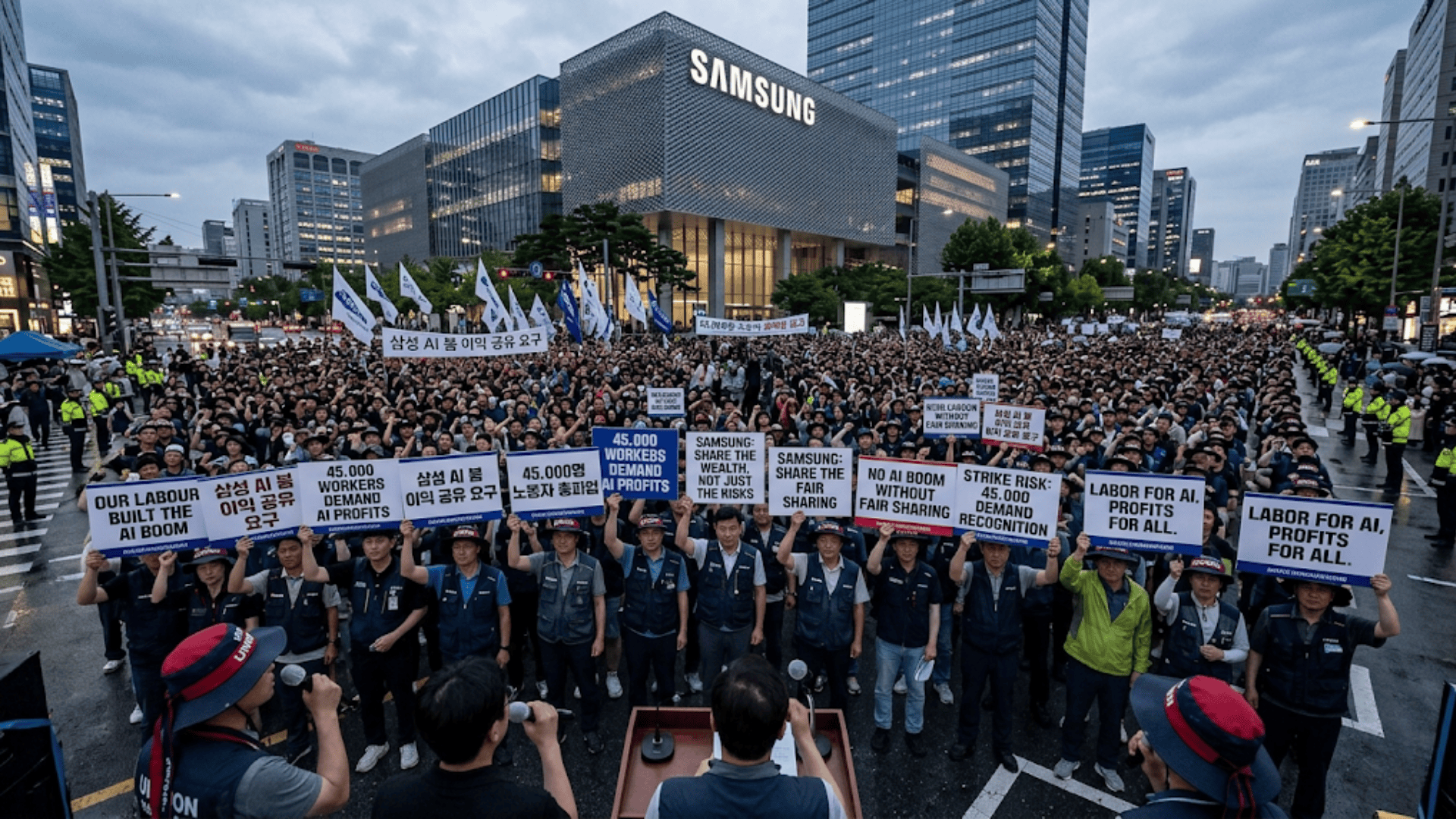
Samsung Electronics is facing the largest labour confrontation in its history, with more than 45,000 workers preparing an 18-day strike set to begin on May 21, 2026, after government-mediated negotiations broke down without agreement. The dispute centres on a fundamental question about the AI era: who within a company should benefit from a technological boom when its profits are distributed extremely unevenly across different divisions?
The AI Boom’s Internal Divide
Samsung’s Device Solutions Division encompasses three businesses — memory chips, system LSI logic chip design, and foundry manufacturing — and the AI-driven memory shortage has made these divisions starkly unequal in financial performance. In the first quarter of 2026, Samsung reported a nearly 50-fold year-over-year rise in income from its memory chip operations, driven by surging demand for DRAM and HBM chips used in AI data centres worldwide. Meanwhile, its foundry and system LSI businesses, responsible for manufacturing AI chips designed by clients including Tesla and Nvidia, have been running at significant losses.
In March, Samsung proposed giving its 27,000 memory chip workers bonuses equivalent to 607% of their annual salary — an extraordinary figure that would exceed even the bonuses paid to workers at rival SK Hynix, which had abolished its bonus cap the previous year, triggering an exodus of Samsung talent. However, the company proposed that the 23,000 workers in its logic chip and foundry businesses receive bonuses of only 50% to 100% of salary.
The Union’s Position
The union’s central objection is that this division is artificially arbitrary. Memory and logic chip employees often work in the same buildings, use the same facilities, and have the same career paths. Separating their compensation so dramatically — by a factor of six or more — would create damaging internal divisions and accelerate the departure of foundry and logic chip talent at precisely the moment Samsung’s chairman Jay Y. Lee has declared his intention to make Samsung the world’s number one logic chip company by 2030.
Union representative Choi Seung-ho told negotiators: “If the memory division gets 500 million won while the foundry division only gets 80 million won, what motivation would those employees have to keep working?” Government mediators have so far been unable to bridge the gap.
The Global Stakes
A previous one-day strike in April caused chip foundry output to drop by 58.1% and memory fabrication output to fall by 18% during the relevant shift. An 18-day strike at Samsung’s three South Korean facilities in Giheung, Hwaseong, and Pyeongtaek — which collectively serve the global AI data centre market — could send shockwaves through AI hardware supply chains at a time when memory chip availability is already a critical bottleneck.
The company estimates the potential cost to Samsung from a full strike could reach 30 trillion won — approximately $20 billion. The global AI industry is watching closely.