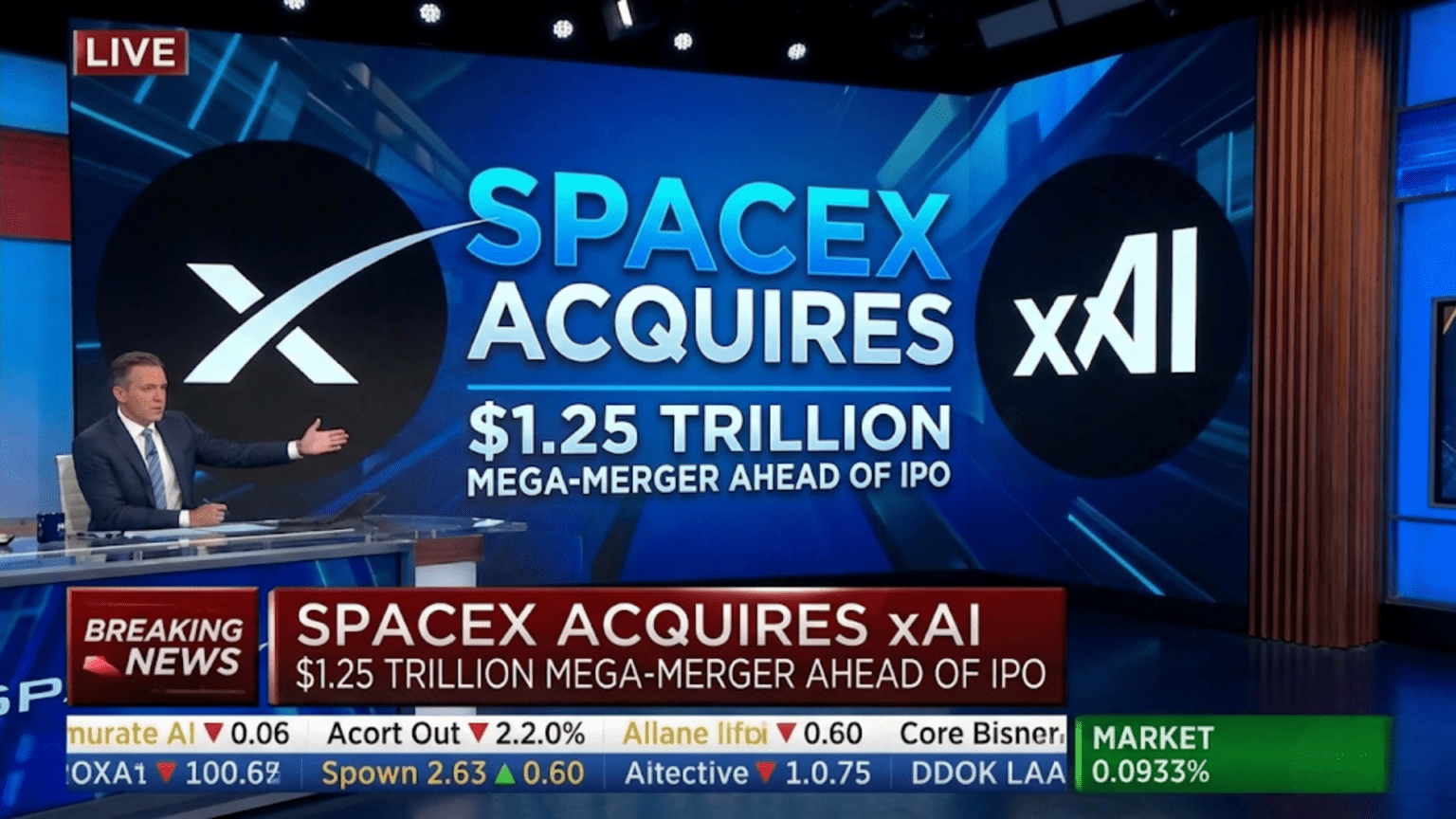
SpaceX announced on February 3, 2026, that it has acquired xAI, Elon Musk’s artificial intelligence startup, in a deal that values the combined entity at $1.25 trillion and represents the largest merger in corporate history. The transaction consolidates two of Musk’s most ambitious ventures ahead of a planned blockbuster initial public offering later this year.
The merger combines SpaceX, valued at approximately $1 trillion, with xAI, valued at $250 billion, creating what Musk described as “the most ambitious, vertically-integrated innovation engine on (and off) Earth.” The deal is structured as a share exchange where each xAI share converts to 0.1433 shares of SpaceX stock, with xAI priced at $75.46 per share and SpaceX at $526.59.
Musk framed the acquisition as essential for achieving his vision of orbital data centers. In a blog post, he argued that current AI infrastructure depends on terrestrial data centers requiring “immense amounts of power and cooling” that cannot be sustained without imposing hardship on communities and the environment. His solution: deploying AI computing infrastructure in space where solar energy is continuously available and cooling challenges are fundamentally different.
SpaceX has reportedly requested Federal Communications Commission authorization to launch up to 1 million satellites as part of its orbital data center plans. Musk estimates that within two to three years, generating AI compute in space will become more cost-efficient than terrestrial alternatives, enabling companies to “forge ahead in training AI models and processing data at unprecedented speeds and scales.”
The strategic rationale extends beyond orbital data centers. xAI has been burning approximately $1 billion monthly according to Bloomberg, creating urgent need for capital infusion. By folding xAI into SpaceX, Musk provides the AI venture access to SpaceX’s profitable operations—the company generated estimated $8 billion profit on $15-16 billion revenue in 2025 according to Reuters—while giving xAI investors an exit pathway through SpaceX’s planned IPO.
SpaceX is reportedly targeting a mid-2026 IPO that could raise up to $50 billion at a valuation approaching $1.5 trillion after the xAI merger. The Financial Times reported Musk is timing the debut for mid-June to coincide with his birthday and a planetary alignment, though the company has not confirmed specific timing.
The merger raises governance and regulatory questions. xAI previously acquired X (formerly Twitter) in a $33 billion all-stock deal in March 2025. Tesla, the publicly traded electric vehicle company where Musk serves as CEO, invested $2 billion in xAI just last month. This creates a complex web of interlocking transactions where Musk personally benefits through varying ownership stakes across entities.
Controversy surrounds xAI’s Grok chatbot, which recently faced regulatory scrutiny after enabling generation of sexualized images including of children. The Washington Post reported Musk loosened Grok restrictions amid competitive pressure from OpenAI, Google, and Anthropic. The Pentagon has reportedly begun using Grok within military intelligence databases despite these concerns.
Cultural integration challenges loom. Former xAI employees have publicly expressed concerns about culture clash between xAI’s “move fast and break things” philosophy and SpaceX’s more structured aerospace engineering culture requiring rigorous safety protocols.
The acquisition positions Musk to control integrated “compute + data + distribution” stack spanning AI development (xAI), orbital connectivity (Starlink satellites), launch capacity (SpaceX rockets), and social media distribution (X platform). This vertical integration creates competitive advantages few organizations can match while raising questions about market power concentration.