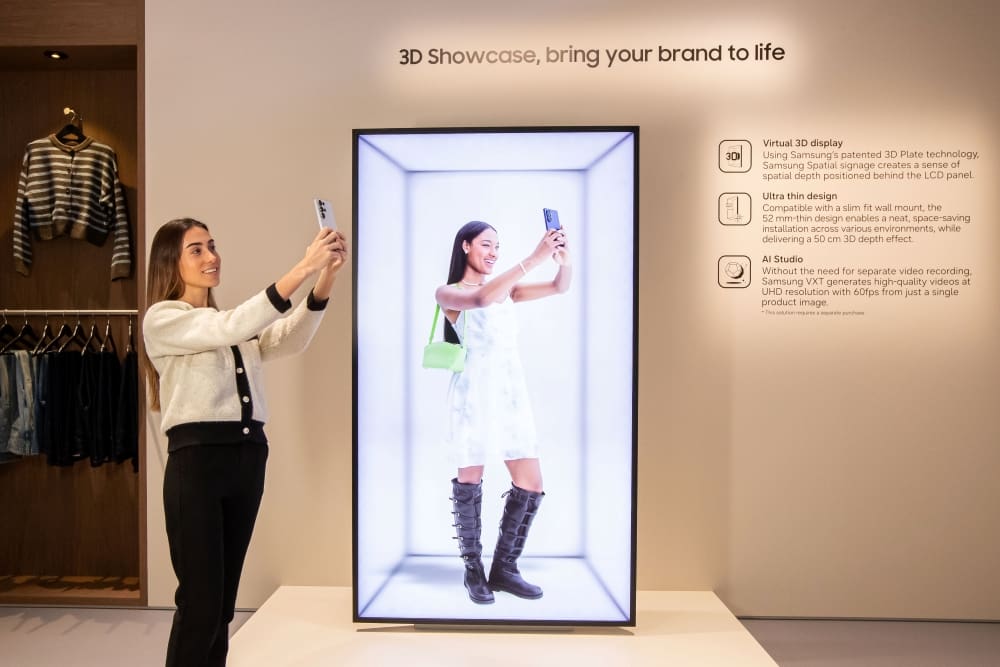
Samsung Electronics formally launched its glasses-free 3D digital signage displays to global markets at ISE 2026, the International Systems and Integration Exhibition held in Barcelona from February 4 to 7, 2026. The announcement represents a significant milestone in commercial display technology, introducing large-format autostereoscopic screens that create convincing three-dimensional visual experiences for multiple simultaneous viewers without requiring any special eyewear or headsets.
The technology relies on directional backlighting and lenticular lens arrays precisely engineered to deliver different image perspectives to viewers’ left and right eyes simultaneously, creating stereo depth perception without any active technology on the viewer’s end. Samsung’s implementation advances the state of autostereoscopic displays in several critical areas that have historically limited commercial adoption: the viewing angle sweet spot has been significantly expanded, the resolution penalty associated with splitting images across multiple viewing zones has been reduced, and colour accuracy meets professional broadcast standards required for retail and brand environments.
Commercial applications demonstrated at ISE 2026 included retail displays where products appear to float in three-dimensional space off the screen surface, creating engaging product showcases for luxury goods, electronics, and automotive brands. Architectural visualisation installations allow real estate developers to present building designs in interactive 3D without VR headsets. Corporate lobbies and entertainment venues can deploy the displays for branded content that differentiates from standard flat video walls.
Samsung is positioning the glasses-free 3D signage as a premium tier within its commercial display portfolio, targeting clients for whom visual impact justifies elevated hardware costs. The company has built a dedicated content creation ecosystem including software tools for producing glasses-free 3D content from existing 2D assets and design partnerships with digital agencies specialising in experiential retail environments.
The launch connects to Samsung’s broader strategy of advancing the ISE show as a platform for commercial display innovation. The company also revealed updates to its LYNK Cloud remote management platform enabling centralised control of large-scale display networks, and showcased the Samsung VXT content management system that integrates AI-powered scheduling and audience analytics into digital signage workflows.
The glasses-free 3D display market has seen multiple false starts over the past decade. Consumer interest peaked around 2010-2013 during the 3D television era, but adoption collapsed as consumers rejected the inconvenience of glasses and as content creation pipelines failed to deliver sufficient 3D material. Commercial environments present different dynamics: installation is purpose-built, content is professionally produced, and viewers engage briefly rather than watching for hours — conditions where 3D’s visual impact outweighs the limitations that frustrated home TV users.
Industry analysts tracking the commercial display sector expect Samsung’s entry to catalyse broader adoption of glasses-free 3D in high-footfall retail and entertainment venues. Competitors including LG, Sony, and Planar have respective development programmes, but Samsung’s manufacturing scale, global distribution, and established relationships with major retail and hospitality chains give it a significant advantage in bringing the technology to commercial deployment at meaningful scale.