
Overview
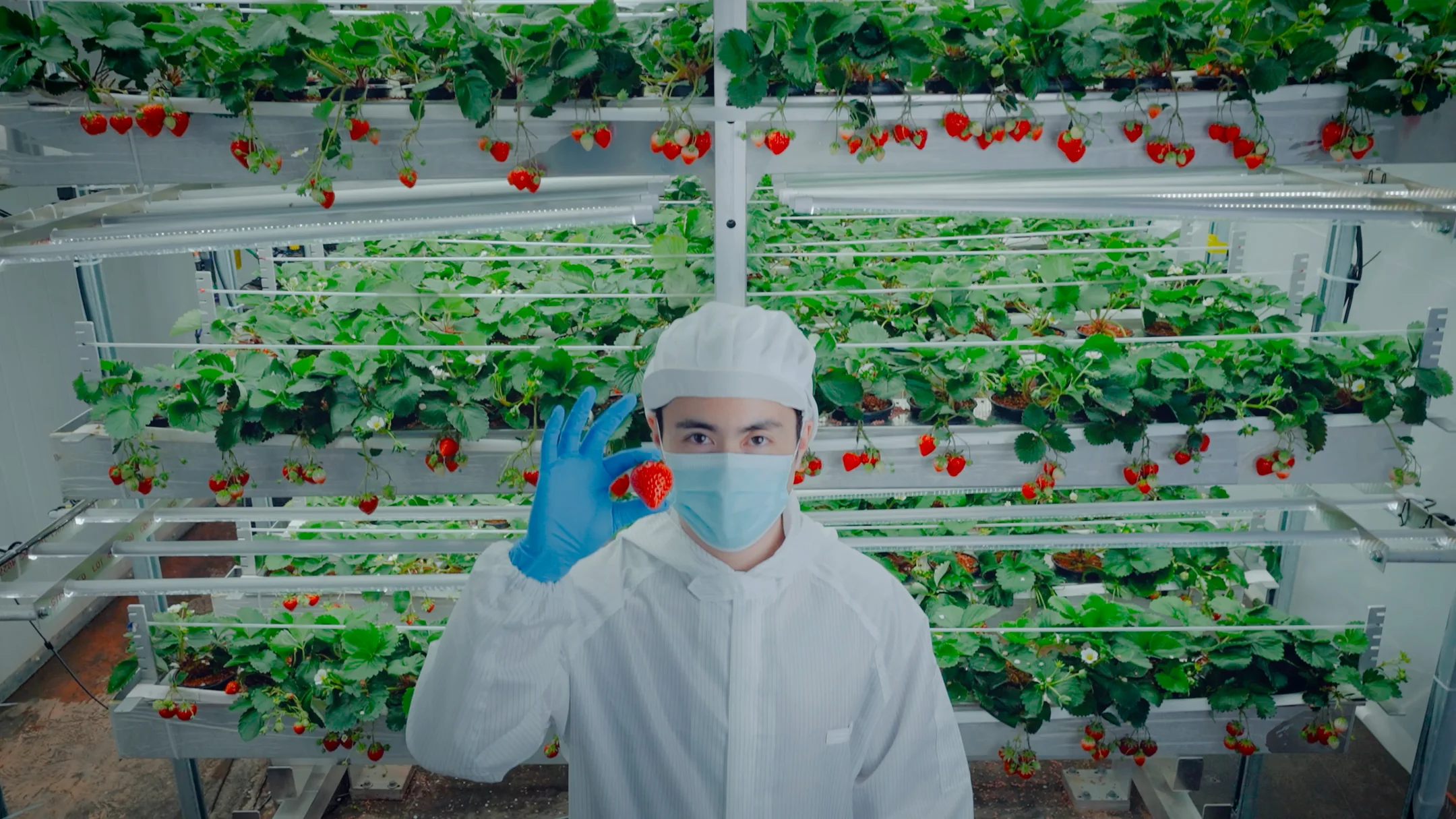
Oishii, the vertical farming company that has been developing AI-powered robotic systems for controlled-environment agriculture, has announced that its robotic platform has reached commercial production scale for pesticide-free, non-GMO strawberries — a milestone that marks a significant step in the long-running effort to prove that vertical farming robotics can compete with conventional field agriculture in both quality and cost at meaningful volumes. The announcement is being closely watched by the agricultural technology sector as an early indication of whether the economics of robot-intensive controlled-environment farming can work outside of highly premium product categories.
The Challenge of Strawberry Automation
Strawberries are a particularly demanding test case for agricultural robotics. Unlike some crops that can be harvested by applying uniform mechanical force, strawberries ripen non-uniformly across a plant, vary widely in size and shape, bruise easily under excessive gripping force, and need to be identified as ripe using a combination of colour, firmness, and positional cues that require sophisticated machine vision and gentle, adaptive manipulation. Human strawberry pickers develop highly refined tactile skills over time that are difficult to replicate mechanically, and the failure modes of agricultural robots — damaged fruit, missed ripe berries, contamination — have direct commercial consequences.
Oishii’s approach has been to design the growing environment itself to accommodate robotic harvesting, rather than trying to build robots that work in the variable conditions of a conventional greenhouse. In its vertically stacked growing system, plants are positioned at consistent heights, lighting and humidity are precisely controlled, and the robotic harvest systems can operate on predictable schedules with known plant geometries. This is a fundamentally different approach from building a general-purpose agricultural robot, and it has allowed the company to achieve the harvest reliability that commercial volume requires.
Why Commercial Scale Matters
Previous Oishii strawberry production was commercially credible but limited in volume, commanding premium prices in specialty retail channels that reflected both quality and scarcity. Reaching commercial scale means production volumes large enough to serve mainstream retail and food service customers, where unit economics are far more demanding and margins are far tighter. The company’s claim to have achieved this threshold — if accurate and sustained — would be a significant demonstration that robotic vertical farming is not limited to artisanal premium products.
The pesticide-free and non-GMO positioning of Oishii’s strawberries adds commercial relevance: consumer demand for produce grown without conventional pesticides continues to grow, and the ability to grow at commercial volumes without those inputs is both a product quality advantage and an environmental one.
Implications for Robotic Agriculture
A successful commercial-scale robotic vertical farm for strawberries establishes a template that can be applied to other high-value, labour-intensive specialty crops — berries, tomatoes, salad greens, herbs — that currently depend on seasonal farm labour. As robot hardware costs decline and AI-driven vision and manipulation systems improve, the economic case for expansion across crop categories strengthens.