
Overview
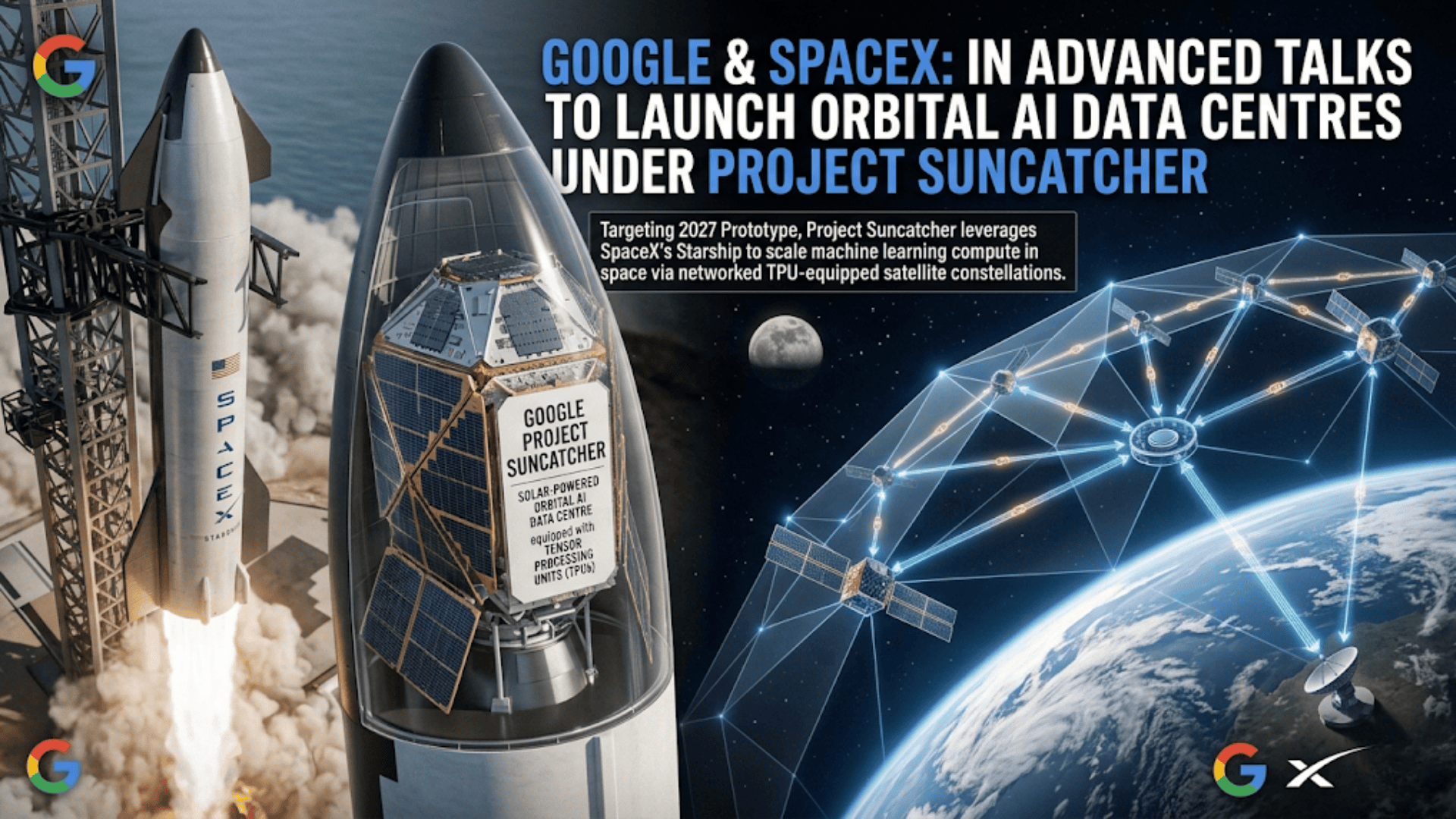
Google is in advanced discussions with SpaceX to use the rocket company’s launch capabilities to place experimental AI computing hardware into low Earth orbit, according to multiple reports published this week. The effort is being conducted under a Google initiative called Project Suncatcher, announced in November 2025, which aims to test whether AI workloads — specifically those powered by Google’s custom Tensor Processing Unit chips — can be run from solar-powered satellites orbiting the planet. If successful, the project would represent one of the most radical reimaginings of data centre infrastructure in the history of computing.
What Project Suncatcher Is
Project Suncatcher is Google’s long-horizon research programme into orbital compute. The central concept is to equip small satellites with Google TPUs, power them entirely from solar energy — which is available continuously in orbit without the atmospheric interruption that ground-based solar faces — and link them together via optical inter-satellite communications to create a mesh computing network above the Earth.
The appeal, from Google’s perspective, is that space-based data centres would sidestep several of the most pressing constraints currently slowing AI infrastructure expansion on the ground: land availability, freshwater requirements for cooling, grid power capacity, and the local public opposition that is increasingly stalling data centre approvals in the United States and Europe. A Gallup survey published this week found 71% of American adults oppose having an AI data centre in their local area — a finding that underscores the real-world permitting headwinds that orbital infrastructure would avoid entirely.
Why SpaceX and Why Now
SpaceX is the dominant commercial launch provider globally and is currently preparing for what is expected to be the largest IPO in history at a valuation approaching $1.75 trillion. Orbital data centres are a central pillar of the growth narrative SpaceX is presenting to investors, and a partnership with Google — which already owns approximately 6.1% of SpaceX — would be a powerful validation of that pitch. SpaceX has separately filed for regulatory authorisation to launch up to one million satellites to support orbital compute ambitions, and its February 2026 merger with xAI (Elon Musk’s AI company) created a combined entity valued at approximately $1.25 trillion that spans rockets, satellites, and AI systems.
The Technical and Economic Hurdles
Not everyone is convinced the economics work. Current SpaceX standard rideshare pricing runs at approximately $7,000 per kilogram to orbit — a figure that would make running AI chips in space vastly more expensive than ground-based alternatives for most workloads. Analysts estimate the break-even point for orbital data centres requires launch costs to fall below $200 per kilogram — a threshold that may not be reached until well into the next decade.
Project Suncatcher is deliberately framed as a research programme, not a commercial product launch. Google intends to begin with prototype test satellites before committing to anything at scale, acknowledging that technical questions around thermal management, radiation hardening, and latency all remain open.