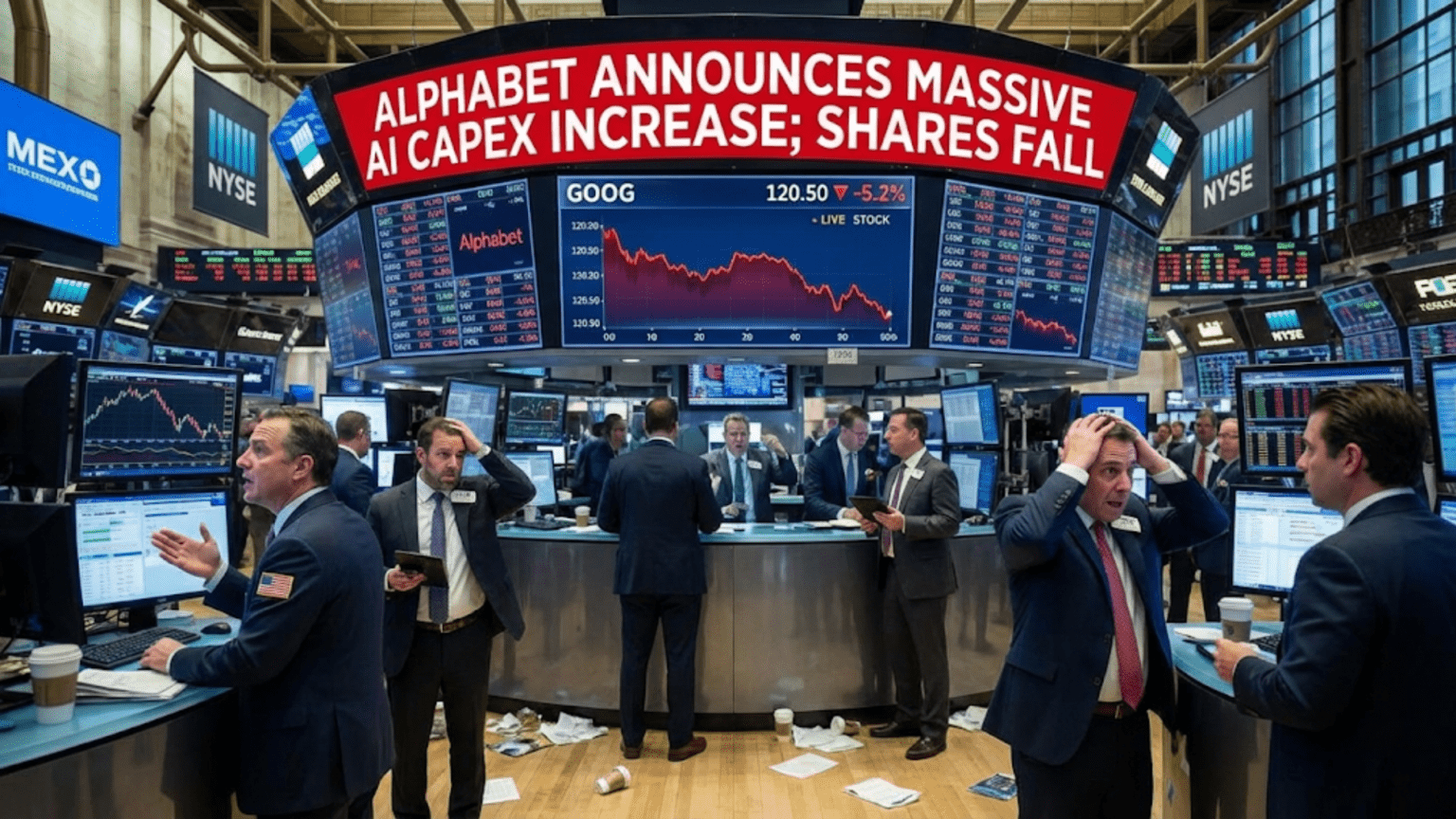
Alphabet reported fourth-quarter 2025 financial results on February 5, 2026, that exceeded revenue and earnings expectations, yet shares declined approximately 5% as the company revealed plans to potentially more than double capital expenditures in 2026 to fund artificial intelligence infrastructure buildout. The market reaction highlights growing investor concern about whether AI investments will generate returns justifying the massive spending commitments.
Fourth-quarter revenue reached $96.2 billion versus consensus estimates of $94.8 billion, representing 15% year-over-year growth driven by search advertising, YouTube, and Google Cloud. Earnings per share of $2.73 surpassed the $2.65 analyst consensus. Google Cloud revenue grew 29% year-over-year to $12.8 billion, with AI workloads representing increasingly important growth drivers.
However, CFO Ruth Porat indicated that Alphabet expects capital expenditures to increase significantly in 2026, potentially exceeding $200 billion compared to approximately $91 billion spent in 2025. This represents more than doubling annual spending and reflects aggressive investment in data centers, AI accelerator chips primarily from Nvidia, networking infrastructure, and power infrastructure to support training and deployment of advanced AI models.
CEO Sundar Pichai framed the spending as essential for maintaining competitive position as AI transforms search, advertising, productivity software, and cloud computing. Alphabet is racing against Microsoft, Meta, Amazon, and emerging AI startups including OpenAI and Anthropic to develop frontier AI capabilities and capture market share in AI-powered services.
The spending trajectory alarms investors for several reasons. First, uncertainty exists about whether AI capabilities translate to proportional revenue growth. While Google has integrated AI across products including search, Gmail, Google Workspace, and cloud services, monetization pathways remain unclear for many AI features. Second, capital intensity is structurally increasing, potentially compressing long-term margins even if revenue grows. Third, competitive dynamics create arms race pressure where companies must spend aggressively merely to maintain relative position rather than to capture differential advantage.
Analyst concerns focus on return on invested capital. If Alphabet spends $200 billion annually on infrastructure that depreciates over several years, the company must generate substantial incremental revenue and profit to justify these investments. Historical technology infrastructure buildouts—including fiber optic networks in the late 1990s and cloud data centers in the 2010s—demonstrate that massive capital deployment sometimes exceeds near-term demand, creating overcapacity and stranded assets.
The announcement follows similar capital expenditure increases from technology peers. Meta announced plans to spend $115-135 billion on AI infrastructure in 2026. Microsoft’s fiscal 2026 capital spending is projected to approach $100 billion. Amazon Web Services has guided to over $146 billion. This synchronized spending surge reflects shared belief that controlling AI infrastructure determines competitive positioning, but also raises questions about whether industry-wide capacity buildout exceeds realistic demand.
Alphabet’s stock decline despite earnings beat demonstrates market sensitivity to capital allocation decisions. Investors appear willing to reward AI investment when coupled with clear monetization strategies and disciplined deployment, but increasingly skeptical when spending accelerates without proportional revenue visibility.
The company emphasized that AI capabilities are already generating measurable benefits. Search quality improvements driven by AI increase user satisfaction and engagement. YouTube’s AI-powered recommendation algorithms drive viewing time. Google Cloud’s AI services attract enterprise customers willing to pay premiums for advanced capabilities. However, translating these qualitative benefits to quantitative returns that justify $200 billion annual spending remains the central investor question.
Looking ahead, Alphabet faces balancing act between investing sufficiently to remain competitive in AI while maintaining financial discipline that sustains profitability and shareholder returns.