Introduction
The word “circuit” appears constantly in electronics, yet many beginners struggle to grasp what a circuit truly represents beyond the vague notion that electricity somehow flows through connected components. This conceptual gap creates significant obstacles because nearly everything in electronics revolves around circuits. Every device you use, from the simplest flashlight to the most sophisticated computer, operates through electrical circuits performing specific functions.
Understanding what circuits actually do requires moving beyond seeing them as mere collections of wires and components. A circuit represents a complete system designed to control and direct electrical energy flow for a specific purpose. Whether that purpose involves illuminating a light bulb, amplifying an audio signal, processing digital information, or charging a battery, the circuit provides the structured pathway that makes it possible.
This comprehensive guide will build your understanding of circuits from fundamental principles, developing a robust mental model that helps you truly comprehend how electricity behaves in complete systems. We will explore why circuits must be complete, how energy flows through them, what different components contribute, and how these elements combine to create functional systems. Rather than memorizing facts about circuits, you will develop genuine intuition that serves as a foundation for all future learning in electronics.
The Fundamental Concept: The Complete Path
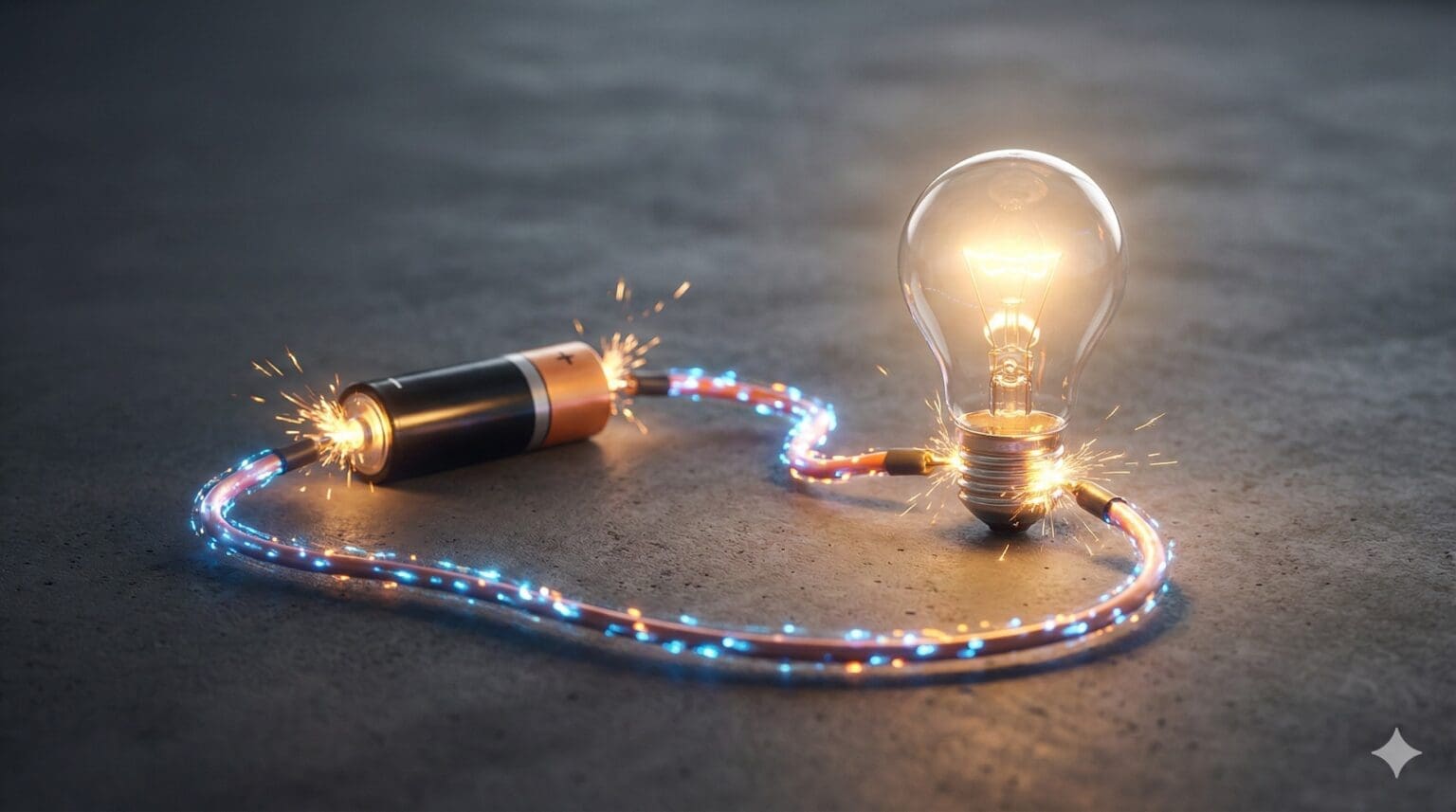
At its most basic level, a circuit is simply a complete, closed pathway that allows electrical current to flow continuously. This seemingly simple definition contains profound implications that govern all circuit behavior and design.
Why Circuits Must Be Complete
Electrical current consists of moving electrons, and these electrons cannot accumulate indefinitely at any point in a conductor. When electrons flow out of a power source’s negative terminal, they must have somewhere to go. They travel through the circuit, through whatever components and conductors we have connected, and eventually return to the power source’s positive terminal. This circular journey, returning to the starting point, gives circuits their name.
If we break this path at any point, current stops flowing immediately and completely. This is not a gradual reduction in flow but an instantaneous cessation. No matter how small the break or how close the two separated ends might be, even a microscopic air gap prevents current flow under normal voltages. The circuit becomes open, incomplete, and non-functional.
This requirement for a complete path means that circuit analysis always involves tracing current paths from negative to positive (using conventional current direction) or from positive to negative (following actual electron flow). Every electron that leaves the power source must find its way back through the circuit. If you cannot trace a complete path from one terminal through components back to the other terminal, you have an open circuit that will not function.
The Distinction Between Open and Closed Circuits
A closed circuit provides a complete path for current flow. All connections are intact, all switches are in their conducting positions, and electrons can flow continuously from the power source through the circuit and back. This is the normal operating condition for functional circuits. When you flip a light switch to the “on” position, you close the circuit, completing the path and allowing current to flow through the light bulb.
An open circuit contains a break somewhere in the path. This break might be intentional, like an open switch, or unintentional, like a broken wire or a burned-out component. Regardless of cause, an open circuit prevents current flow entirely. The voltage source might be connected and ready to push electrons, but without a complete return path, no current flows and the circuit performs no function.
Understanding this binary nature of circuits helps troubleshooting immensely. When a circuit fails to operate, one of the first questions to ask is whether the circuit is complete. Is there an open switch? A disconnected wire? A failed component that no longer conducts? Finding and closing the break often restores function immediately.
Short Circuits: The Dangerous Extreme
While open circuits fail to function due to incomplete paths, short circuits represent the opposite extreme: an unintended path of very low resistance that allows excessive current flow. A short circuit bypasses the intended circuit components, creating a direct or nearly direct connection between the power source terminals.
Consider a battery-powered flashlight. Normally, current flows from the battery through a switch, through the light bulb (which has significant resistance), and back to the battery. If a piece of wire accidentally connects the battery terminals directly, current bypasses the bulb entirely, flowing through the very low resistance of the wire. This short circuit draws enormous current, potentially limited only by the battery’s internal resistance and the wire’s resistance.
The consequences of short circuits range from merely annoying to genuinely dangerous. At minimum, a short circuit drains batteries rapidly and prevents the circuit from performing its intended function. More seriously, the excessive current generates heat that can damage components, melt insulation, start fires, or cause batteries to explode. This is why circuit protection devices like fuses and circuit breakers exist: they detect excessive current from short circuits and open the circuit automatically before damage occurs.
Energy Flow: What Really Happens in Circuits
Describing circuits as complete paths for current flow is accurate but incomplete. To truly understand what circuits do, we must examine how energy flows and transforms within them.
The Energy Perspective
Every circuit fundamentally performs energy conversion. A power source provides electrical energy, and the circuit components convert this energy into other useful forms or use it to perform specific functions. The circuit acts as a controlled pathway for energy flow, directing where and how energy conversion occurs.
In a simple flashlight circuit, chemical energy stored in the battery converts to electrical energy, which then flows through the circuit to the bulb where it converts to light and heat. The circuit’s job is to provide the pathway that enables this energy conversion to occur in a controlled, useful manner. Without the complete circuit path, energy cannot flow from the battery to the bulb.
This energy perspective helps explain several circuit behaviors that seem puzzling when thinking only about current flow. For instance, in a series circuit, the same current flows through all components, but different components may dissipate different amounts of power. This happens because components with higher resistance convert more energy per unit time, even though the same number of electrons flows through each component per second.
Voltage as Energy Distribution
As current flows through a circuit, voltage drops across each component in proportion to that component’s resistance. These voltage drops represent energy conversion. When we measure 3 volts dropped across a resistor, we are quantifying the fact that each coulomb of charge flowing through that resistor releases 3 joules of energy, converting it to heat.
The power source maintains voltage between the circuit’s beginning and end, constantly replenishing the energy that components consume. In a battery-powered circuit, this energy comes from chemical reactions. In a generator-powered circuit, it comes from mechanical energy. In a solar-powered circuit, it comes from light energy. Regardless of source, the power supply continually maintains the voltage that drives current through the circuit, supplying energy at the rate the circuit components consume it.
Understanding voltage drops as energy conversion helps make sense of series circuits. If you have a 9-volt battery powering three resistors in series, the voltage drops across those resistors must sum to 9 volts. Each resistor claims its share of the total available energy based on its resistance relative to the total circuit resistance. Higher resistance means a larger share of the voltage, hence more energy conversion in that component.
Current as the Energy Delivery Rate
While voltage represents energy per charge, current represents how much charge flows per unit time. Together, they determine the rate of energy delivery: power equals voltage times current. Higher current means more charge flowing per second, delivering more total energy even if each charge carrier contains the same energy (voltage).
This relationship explains why doubling current through a resistor quadruples power dissipation. Power equals current squared times resistance (P = I²R), so doubling current increases power by a factor of four. This quadratic relationship has important practical implications for circuit design, as small increases in current can cause large increases in power dissipation and heat generation.
Circuit Components and Their Roles
Real circuits contain various components, each performing specific functions that contribute to the circuit’s overall purpose. Understanding what these components do helps you see circuits as functional systems rather than random collections of parts.
Voltage Sources: Energy Providers
Every active circuit requires a voltage source that maintains the potential difference driving current flow. Batteries, power supplies, generators, and solar panels all serve this role, though they derive energy from different sources and have different characteristics.
The ideal voltage source maintains constant voltage regardless of how much current the circuit draws. Real voltage sources approximate this ideal to varying degrees. A fresh battery maintains reasonably constant voltage as current varies, at least until it begins depleting. A well-designed power supply regulates its output voltage tightly even as load demands change. Understanding how close a particular voltage source comes to the ideal helps predict circuit behavior under varying conditions.
Voltage sources have internal resistance, a characteristic that causes their output voltage to decrease when supplying high current. This internal resistance is usually small but becomes significant when circuits demand substantial current. A car battery might have 0.01 ohms of internal resistance, negligible when starting a car but measurable with precision instruments. Including internal resistance in circuit models improves accuracy, especially for high-current applications.
Resistors: Controlled Opposition
Resistors provide specific, predictable resistance values that control current flow and create designed voltage drops. While all conductors have some resistance, dedicated resistor components provide precise resistance values that designers use intentionally to achieve desired circuit behavior.
Resistors perform several crucial functions in circuits. They limit current to safe levels for sensitive components like LEDs that would burn out if excessive current flowed through them. They create specific voltage drops that bias transistors or provide reference voltages for comparators. They divide voltage to scale signals to appropriate levels. They convert current to voltage in sensing applications. They dissipate power to create heat in heating elements.
The resistor’s simplicity belies its importance. A circuit might contain exotic integrated circuits costing hundreds of dollars, but humble resistors costing pennies often determine whether the sophisticated components function correctly. Selecting appropriate resistor values represents one of the most frequent tasks in circuit design.
Switches: Pathway Control
Switches provide manual or automatic control over circuit completeness. A mechanical switch physically breaks or connects the circuit path, opening or closing the circuit in response to user action or sensor input. Electronic switches like transistors perform the same function without moving parts, using one electrical signal to control another circuit’s completeness.
The switch’s binary nature, either fully open or fully closed, makes it ideal for digital control applications. However, switches also enable analog functions through techniques like pulse width modulation, where rapid switching between on and off states creates effective intermediate states through averaging.
Switches appear in countless forms: pushbuttons, toggles, slides, rotary selectors, relays, reed switches, limit switches, transistors, and MOSFETs all act as switches despite their different implementations. Understanding a component as “essentially a switch” provides immediate insight into its function, even if you have never encountered that specific component type before.
Loads: Work Performers
The load represents whatever component or subsystem performs the circuit’s intended function. In a flashlight, the bulb is the load. In a motor controller, the motor is the load. In a phone charger, the phone’s battery charging circuitry is the load. The load consumes the electrical energy the circuit delivers, converting it to useful work or storage.
Loads can be simple resistive elements like light bulbs and heating elements, or complex systems containing their own internal circuitry. A computer power supply sees the entire computer as its load, even though that load contains billions of transistors switching millions of times per second. From the power supply’s perspective, what matters is the current demanded and the power consumed, not the load’s internal complexity.
Understanding load characteristics helps predict circuit behavior. Resistive loads have constant resistance, making their current proportional to applied voltage. Inductive loads like motors have characteristics that oppose changes in current. Capacitive loads oppose changes in voltage. Some loads actively regulate their power consumption, drawing constant power regardless of supply voltage variations. Each load type interacts differently with the circuit supplying it.
Conductors: The Pathway Itself
While we often focus on active components, the conductors connecting them play essential roles. Wires provide low-resistance paths for current flow, ideally dropping minimal voltage and wasting minimal energy. In reality, all conductors have some resistance that causes voltage drops and power dissipation.
Wire resistance depends on material, length, and cross-sectional area. Longer wires have more resistance; thicker wires have less. Copper provides excellent conductivity at reasonable cost, making it the standard choice for most wiring. Silver conducts slightly better but costs much more. Aluminum conducts worse than copper but weighs far less, making it suitable for long power transmission lines where weight matters.
Selecting appropriate wire gauge ensures adequate current capacity without excessive voltage drop or heat generation. Undersized wire in high-current applications creates fire hazards. Oversized wire wastes material and money without providing functional benefits. Proper wire sizing represents basic but essential circuit design practice.
Series Circuits: Single Path Systems
When components connect end-to-end in a single pathway, they form a series circuit. Understanding series circuit behavior provides foundation for analyzing more complex circuit configurations.
Defining Characteristics of Series Circuits
A series circuit offers only one path for current flow. Every electron that flows must pass through every component in sequence. This fundamental characteristic creates several important consequences that define series circuit behavior.
First, the same current flows through every component in a series circuit. If you measure 100 milliamps flowing through one resistor in a series string, exactly 100 milliamps flows through every other resistor in that string. Current cannot disappear or accumulate anywhere; it must be identical throughout the series path. This makes intuitive sense when you consider that electrons entering one component must exit it before entering the next.
Second, voltage drops across series components sum to equal the total applied voltage. If you connect a 12-volt battery to three series resistors, measuring the voltage across each resistor and summing those voltages gives you 12 volts. Each component claims its share of the total available voltage based on its resistance relative to the total circuit resistance.
Third, total resistance in a series circuit equals the sum of individual resistances. Connect a 100-ohm resistor in series with a 220-ohm resistor, and the total circuit resistance becomes 320 ohms. This additive property makes intuitive sense: electrons must overcome each resistance in sequence, accumulating total opposition equal to the sum of individual oppositions.
Voltage Division in Series Circuits
Series circuits naturally divide voltage among components in proportion to their resistances. A component with twice the resistance of another drops twice the voltage. This voltage division principle enables precision voltage reduction and signal scaling.
The voltage divider equation quantifies this relationship. For two resistors in series, the voltage across the first resistor equals the total voltage multiplied by the first resistor’s value divided by the sum of both resistor values: V₁ = V_total × (R₁ ÷ (R₁ + R₂)). This equation extends to any number of series resistors by dividing the resistor of interest by the total series resistance.
Voltage dividers appear everywhere in electronics. They scale sensor outputs to readable ranges. They create reference voltages for comparators and analog-to-digital converters. They bias transistor amplifiers. Understanding voltage division helps you recognize and design these common circuit elements.
Series Circuit Vulnerabilities
Series circuits have an important vulnerability: any single component failure that creates an open circuit stops current flow entirely, disabling the whole circuit. This is why old-style Christmas lights strung in series would all go dark when a single bulb burned out. The open circuit at the failed bulb prevented current from reaching any downstream bulbs.
This vulnerability makes series circuits less reliable for applications requiring continued operation despite component failures. However, it also makes series circuits excellent for applications where you want a single failure to disable the system for safety reasons. An emergency stop circuit might place multiple switches in series, ensuring the system shuts down if any switch activates.
Parallel Circuits: Multiple Path Systems
Parallel circuits provide multiple paths for current flow, creating behavior fundamentally different from series circuits and enabling capabilities series circuits cannot provide.
Defining Characteristics of Parallel Circuits
In parallel circuits, components connect to the same two points, creating multiple simultaneous paths for current flow. This configuration produces several important characteristics that distinguish parallel circuits from series circuits.
First, the same voltage appears across every component in parallel. If you connect multiple resistors between the same two points, each resistor experiences the full voltage difference between those points. Measuring voltage across any parallel component gives the same reading. This makes parallel circuits ideal for applications requiring multiple devices to operate at the same voltage, like the outlets in your home that all provide the same 120 volts.
Second, current divides among parallel branches, with more current flowing through paths offering less resistance. The total current supplied by the voltage source equals the sum of currents through all parallel branches. This current division follows Ohm’s Law: each branch draws current based on the applied voltage divided by that branch’s resistance.
Third, total resistance in parallel circuits is less than the smallest individual resistance. This seems counterintuitive at first—how can adding more resistors decrease total resistance? The explanation becomes clear when you consider that adding parallel paths gives current more routes to flow through, decreasing overall opposition. The mathematical relationship uses reciprocals: 1/R_total = 1/R₁ + 1/R₂ + 1/R₃, etc.
Current Division in Parallel Circuits
Understanding how current divides among parallel branches enables prediction of circuit behavior and design of circuits that distribute current appropriately. Current naturally divides in inverse proportion to resistance: branches with half the resistance carry twice the current.
For two parallel resistors, current through each branch can be calculated using the current divider formula. The current through the first resistor equals total current multiplied by the second resistor divided by the sum of both resistors: I₁ = I_total × (R₂ ÷ (R₁ + R₂)). Notice how the current through R₁ depends on R₂’s value—this reciprocal relationship reflects the inverse proportionality of current to resistance.
This current division enables load sharing in power systems and signal splitting in communication systems. It also explains why parallel resistance calculations use reciprocals: each additional parallel path adds conductance (the reciprocal of resistance) rather than adding resistance.
Parallel Circuit Advantages
Parallel circuits offer significant advantages for many applications. Individual components can be added or removed without affecting others, unlike series circuits where removing one component breaks the entire chain. Each parallel branch operates independently, so a failure in one branch does not disable other branches.
This independence makes parallel circuits standard for power distribution. Your home electrical system uses parallel circuits so that plugging in or unplugging devices does not affect other devices, and a failure in your television does not disable your refrigerator. The independence comes at a cost, though: parallel circuits can draw very high total current if many branches connect simultaneously, requiring robust power sources and appropriate wire sizing.
Series-Parallel Combinations: Real-World Complexity
Most practical circuits combine series and parallel elements, creating more complex topologies that offer advantages of both configurations. Understanding how to analyze these combined circuits builds on series and parallel principles.
Analyzing Combination Circuits
When faced with a circuit containing both series and parallel elements, systematic analysis breaks the circuit into manageable pieces. Identify which components are in series with each other, which are in parallel, and tackle them in logical order.
Generally, start by finding resistances that are obviously in series or parallel and combine them using the appropriate rules. This simplification creates an equivalent circuit with fewer components. Repeat this process until you reduce the circuit to a single equivalent resistance. Then work backwards, calculating currents and voltages throughout the original circuit using the values determined during simplification.
This step-by-step approach, sometimes called ladder analysis or reduction method, works for any resistive circuit that can be redrawn as series and parallel combinations. Not all circuits fit this pattern—some require more sophisticated techniques like nodal analysis or mesh analysis—but many practical circuits yield to this straightforward method.
Practical Examples of Combination Circuits
Consider a battery-powered device with three features: a display, a processor, and a sensor. The display might consist of several LEDs in series, each series string in parallel with other strings. The processor might connect directly in parallel with the battery. The sensor might connect through a resistor in series with the sensor itself, that combination in parallel with other loads.
This combination topology provides each subsystem with appropriate voltage and current while sharing a common power source. The parallel connection ensures each subsystem gets full battery voltage. Series resistors limit current or create necessary voltage drops for specific components. The combination enables complex functionality from a single power source.
What Circuits Actually Accomplish
Having explored circuit fundamentals, component roles, and configuration types, we can now address the central question more completely: what do circuits actually do?
Controlling Energy Flow
At the highest level, circuits control how electrical energy flows from sources to loads. This control can be as simple as a switch allowing current to flow when closed and stopping it when open, or as complex as a switching power supply that regulates voltage and current through thousands of switching cycles per second.
Energy control enables all circuit functions. A motor controller circuit controls energy delivery to create precise motor speed and torque. An audio amplifier circuit controls energy flow to create sound waves matching input signals. A battery charger circuit controls energy transfer to recharge batteries safely and efficiently.
Transforming Energy
Beyond merely controlling flow, circuits transform electrical energy into other useful forms. Light bulbs transform electrical energy into light and heat. Motors transform it into mechanical motion. Speakers transform it into sound. Heating elements transform it into thermal energy. These transformations make electricity useful for countless applications.
The efficiency of energy transformation varies tremendously. An LED might convert 20-30% of electrical energy into light, with the remainder becoming heat. An incandescent bulb converts only about 5% to light. An electric motor might achieve 90% efficiency or higher. Understanding and optimizing these transformations drives much of electrical engineering.
Processing Information
In digital circuits, electrical signals represent information rather than primarily delivering energy. The voltage at a particular node might represent a bit of data, a pixel intensity, or a measurement value. Circuits process this information through logic gates, arithmetic circuits, memory elements, and communication interfaces.
Information processing circuits still follow all the fundamental laws governing energy flow, voltage, current, and resistance. However, their design priorities differ. Energy efficiency matters, but correct logical function takes precedence. Noise immunity becomes crucial since small voltage errors can corrupt data. Timing requirements dominate design considerations in ways unnecessary for simple power delivery circuits.
Providing Feedback and Control
Many circuits incorporate feedback, where output influences input to achieve desired behavior. A voltage regulator measures its output voltage and adjusts its operation to maintain that voltage despite varying loads or input voltage changes. A thermostat measures temperature and controls a heater to maintain set temperature. An audio amplifier might include negative feedback to reduce distortion.
Feedback circuits create systems that automatically regulate themselves, providing stability and accuracy impossible with purely open-loop control. Understanding feedback transforms circuits from passive pathways into active systems that respond and adapt to changing conditions.
Practical Circuit Analysis Approach
When confronting a new circuit, systematic analysis reveals its function and behavior. Developing a consistent approach makes complex circuits manageable.
Step One: Identify the Power Source
Every active circuit has at least one power source. Find it first. Identify the voltage it provides and its polarity. This establishes the energy source driving everything else in the circuit.
Step Two: Trace Current Paths
Follow the current from the power source’s negative terminal through the circuit back to the positive terminal. Identify series and parallel sections. Recognize branches where current divides and points where it recombines. This current path analysis reveals the circuit’s structure.
Step Three: Identify Components and Functions
Examine each component along the current paths. Is this a resistor limiting current? A switch controlling flow? A load performing work? Understanding individual component roles helps comprehend the circuit’s overall function.
Step Four: Calculate Key Values
Use Ohm’s Law and series/parallel rules to calculate important voltages and currents. What current flows through each branch? What voltage appears across each component? How much power does each component dissipate? These calculations reveal whether the circuit operates within safe limits and performs its intended function.
Step Five: Verify Against Specifications
Compare calculated values against component specifications. Does any resistor exceed its power rating? Does any component experience voltage or current beyond its limits? This verification catches design errors before they become circuit failures.
Common Circuit Patterns
Certain circuit configurations appear repeatedly because they solve common problems effectively. Recognizing these patterns accelerates understanding and design.
Current-Limiting Circuits
An LED with a series resistor exemplifies the current-limiting pattern. The power source provides voltage, the resistor limits current to a safe level, and the LED performs the desired function without burning out. This pattern appears whenever we must protect a component from excessive current.
Voltage Divider Circuits
Two resistors in series across a voltage source create a voltage divider, providing a fraction of the source voltage at their junction. This pattern appears in sensor circuits, bias networks, and anywhere we need precise voltage reduction.
Switched Loads
A switch in series with a load, both across a power source, represents the most basic control circuit. The switch enables or disables the load. This pattern underlies relay controls, transistor switches, and countless applications where we need manual or automatic on/off control.
Parallel Redundancy
Multiple components in parallel provide redundancy and increased capacity. Battery packs use parallel cells to increase capacity while maintaining voltage. Power supplies use parallel outputs to increase current capability. This pattern trades complexity for reliability and performance.
Safety Considerations in Circuit Operation
Understanding what circuits do includes understanding their hazards and operating them safely.
Overcurrent Hazards
Excessive current generates heat through I²R losses. If current exceeds conductor and component ratings, temperatures can reach dangerous levels, melting insulation, igniting fires, or destroying components. Fuses and circuit breakers protect against overcurrent conditions by opening the circuit when current exceeds safe limits.
Designing circuits with appropriate current ratings and protection prevents overcurrent hazards. Calculate expected currents, select components with adequate ratings, and include protective devices where failures could cause dangerous overcurrent conditions.
Overvoltage Hazards
Applying voltage beyond component ratings can cause immediate destruction through insulation breakdown, junction rupture, or excessive current flow. Even voltages within normal operating range can be dangerous if they appear at unexpected locations, like when stored energy in inductors or capacitors releases suddenly.
Voltage protection includes selecting components rated for expected voltages plus safety margin, using voltage clamps or suppressors for transient protection, and designing circuits that prevent voltage spikes during switching events.
Short Circuit Hazards
Short circuits present perhaps the most dangerous common fault condition. Extremely high currents can flow through low-resistance short circuit paths, creating fire hazards, explosive battery failures, and arc flash dangers. Proper design includes short circuit protection through fuses, circuit breakers, or current-limiting circuitry.
When troubleshooting or modifying circuits, ensuring power is removed before making connections prevents accidental short circuits. This simple precaution eliminates many potential hazards.
Conclusion: Circuits as Functional Systems
Electrical circuits are complete, closed pathways that control electrical energy flow from sources to loads, enabling energy transformation and information processing. They combine voltage sources that provide energy, conductors that carry current, and components that control, transform, or consume that energy. Series circuits provide single paths with shared current and divided voltage. Parallel circuits provide multiple paths with shared voltage and divided current. Real circuits combine these configurations to achieve desired functionality.
Understanding what circuits actually do transforms them from mysterious black boxes into comprehensible systems. You can trace current flow, predict voltage and current values, identify component roles, and comprehend overall circuit function. This understanding enables you to design simple circuits that perform specific tasks, analyze existing circuits to understand their operation, and troubleshoot faulty circuits by identifying where behavior deviates from expected values.
Every circuit, no matter how complex, builds on these fundamental principles. A microprocessor containing billions of transistors still operates through circuits with complete paths, voltage sources, current flow, and resistance. A power grid spanning a continent still follows Ohm’s Law and basic circuit principles at every level. The concepts you have learned here scale from the simplest LED flashlight to the most sophisticated electronic systems.
As you continue learning electronics, you will encounter circuits of increasing complexity and sophistication. You will learn about capacitors and inductors that add time-dependent behavior. You will study semiconductors that enable amplification and switching. You will explore digital logic that processes information. You will discover communication circuits that transmit data across distances. Throughout all this learning, the fundamental concepts of complete circuits, energy flow, and component interaction remain central.
The circuit is the fundamental unit of electronics, the basic building block from which all electronic systems are constructed. Master circuit concepts, and you have established the foundation for understanding any electronic device or system you encounter. This foundation will serve you whether you pursue electronics professionally, enjoy it as a hobby, or simply want to understand the technology that increasingly shapes modern life.