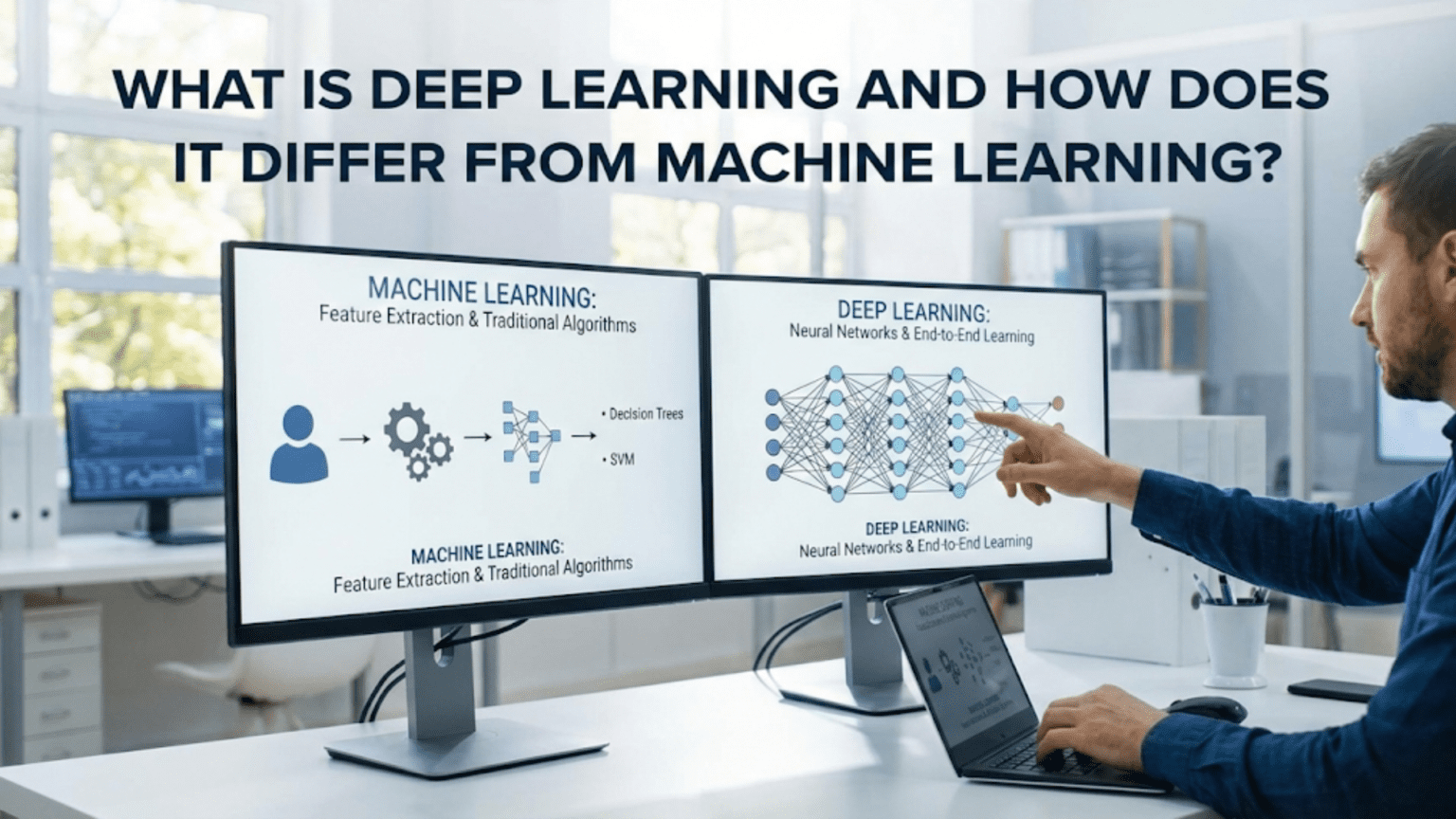
Deep learning is a specialized subset of machine learning that uses artificial neural networks with multiple layers (hence “deep”) to automatically learn hierarchical representations from data. While traditional machine learning requires manual feature engineering, deep learning automatically discovers the features needed for detection or classification from raw data. Deep learning excels at processing unstructured data like images, audio, and text, but requires large datasets and significant computational power, whereas traditional machine learning works well with smaller datasets and structured data.
Introduction: The AI Revolution Within AI
Imagine trying to teach a computer to recognize cats in photos. With traditional machine learning, you’d need to manually define features: “look for pointy ears, whiskers, four legs, fur texture.” You’d spend months engineering these features, testing them, refining them. Now imagine instead showing the computer millions of cat photos and saying “learn what makes a cat a cat on your own.” That’s the fundamental shift deep learning represents.
Deep learning has sparked an AI renaissance. It’s the technology behind virtual assistants understanding speech, smartphones recognizing faces, cars driving themselves, and chatbots conversing naturally. In barely a decade, deep learning transformed AI from a promising but limited technology into systems that rival and sometimes exceed human capabilities in specific domains.
Yet deep learning is often misunderstood, conflated with all of machine learning or portrayed as completely different. The reality is more nuanced: deep learning is a powerful subset of machine learning with unique characteristics, capabilities, and limitations. Understanding what deep learning is, how it differs from traditional machine learning, when to use it, and when traditional approaches work better is essential for anyone working with or evaluating AI systems.
This comprehensive guide clarifies the relationship between machine learning and deep learning. You’ll learn what deep learning actually is, how neural networks work at a high level, the key differences from traditional ML, why deep learning has become so powerful, its advantages and limitations, and practical guidance for choosing between approaches. With clear explanations and concrete examples, you’ll develop an accurate mental model of deep learning’s place in the broader AI landscape.
What is Deep Learning? The Core Concept
Deep learning is a subset of machine learning based on artificial neural networks with multiple layers, enabling automatic learning of hierarchical representations from data.
The Building Blocks
Artificial Neural Networks (ANNs):
- Computational models inspired by biological neurons
- Composed of interconnected nodes (neurons) organized in layers
- Each connection has a weight that adjusts during learning
- Neurons apply mathematical functions to inputs
“Deep” in Deep Learning:
- Refers to multiple hidden layers between input and output
- “Shallow” networks: 1-2 hidden layers
- “Deep” networks: Many hidden layers (10s to 100s)
- Each layer learns increasingly abstract representations
Example Architecture:
Input Layer → Hidden Layer 1 → Hidden Layer 2 → Hidden Layer 3 → Output Layer
(Raw pixels) → (Edges/textures) → (Parts/shapes) → (Objects) → (Classification)How Deep Learning Works: The High-Level View
Training Process:
- Forward Pass: Input data flows through network
- Each layer transforms the data
- Final layer produces prediction
- Compare: Prediction vs. actual answer
- Calculate error/loss
- Backward Pass: Error propagates backward
- Adjust weights to reduce error
- Uses algorithm called backpropagation
- Repeat: Process thousands/millions of examples
- Gradually improves predictions
- Network “learns” patterns in data
Key Insight: Unlike traditional ML, you don’t specify what features to look for. The network automatically learns useful representations at each layer.
The Hierarchical Learning
Image Recognition Example:
Layer 1 (Low-level features):
- Detects edges, lines, simple shapes
- Horizontal, vertical, diagonal lines
- Basic textures
Layer 2 (Mid-level features):
- Combines edges into parts
- Corners, curves, simple patterns
- Basic object parts
Layer 3 (High-level features):
- Complex parts and shapes
- Eyes, noses, ears, wheels
- Recognizable object components
Output Layer:
- Combines high-level features
- Final classification: “cat,” “dog,” “car”
Automatic Discovery: Network learns this hierarchy automatically from labeled images, without being told what features to look for.
Traditional Machine Learning: The Comparison Point
To understand deep learning, we need to understand traditional machine learning.
Traditional ML Workflow
Process:
- Collect Data: Gather labeled examples
- Feature Engineering (Manual, Critical):
- Human experts design features
- Extract relevant characteristics
- Transform raw data into numerical features
- Most time-consuming step
- Select Algorithm: Choose learning algorithm
- Decision trees, SVM, Random Forest, etc.
- Relatively simple compared to deep networks
- Train Model: Learn from features and labels
- Evaluate: Test performance
Example: Spam Detection
Feature Engineering:
Raw email → Extract features:
- Word frequencies (count "viagra", "winner", etc.)
- Email length
- Number of exclamation marks
- Sender domain
- Presence of links
- Time sent
- etc.

Human expert decides which features matterModel: Use extracted features with Random Forest or SVM
The Feature Engineering Bottleneck
Challenge: Designing good features requires:
- Domain expertise
- Trial and error
- Time and effort
- Different features for each problem
Example: Medical Diagnosis
Traditional ML:
- Radiologist identifies relevant image features
- Tumor size, shape, border characteristics
- Texture patterns, density measurements
- Manually extract these from images
- Train classifier on extracted features
Limitation: Features limited by human knowledge and perception
Deep Learning vs. Machine Learning: The Key Differences
Let’s examine the fundamental differences between these approaches.
Difference 1: Feature Engineering
Traditional ML:
- Manual feature engineering required
- Humans design and extract features
- Domain expertise crucial
- Different features for each problem type
Deep Learning:
- Automatic feature learning (representation learning)
- Network discovers useful features
- Same architecture applicable to different problems
- Features emerge during training
Example Impact:
Traditional ML:
- Weeks designing features
- Expert knowledge required
- Limited by human insight

Deep Learning:
- Network learns features automatically
- No feature engineering needed
- Can discover non-obvious patternsDifference 2: Data Requirements
Traditional ML:
- Works with small to medium datasets
- Can learn from hundreds to thousands of examples
- Feature engineering compensates for limited data
- Performance plateaus with more data
Deep Learning:
- Requires large datasets
- Typically needs thousands to millions of examples
- More data → better performance (often)
- Data-hungry but scales well
Performance vs. Data:
Traditional ML:  _____/‾‾‾‾‾
                ____/
                   (plateaus early)

Deep Learning:      ____
                 __/
              __/
            _/
           (keeps improving)

         ↑
Amount of DataDifference 3: Computational Requirements
Traditional ML:
- CPU-friendly: Trains on standard computers
- Minutes to hours on laptop
- Moderate computational requirements
- Deployable on resource-constrained devices
Deep Learning:
- GPU-intensive: Requires specialized hardware
- Hours to weeks on powerful GPUs
- High computational requirements
- Often needs server/cloud deployment
Example:
Random Forest (1000 trees):
- Training: 10 minutes on laptop CPU
- Inference: Milliseconds

Deep CNN (ResNet-50):
- Training: 24 hours on high-end GPU
- Inference: Faster on GPU, slower on CPUDifference 4: Interpretability
Traditional ML:
- More interpretable (especially simpler models)
- Decision trees: can see decision rules
- Linear models: understand feature weights
- Feature importance clear
Deep Learning:
- “Black box” nature
- Millions of parameters
- Difficult to understand why specific decision made
- Active research on interpretability
Consequence:
Traditional ML: Good for regulated industries (finance, healthcare) where explanations required

Deep Learning: Acceptable for applications prioritizing performance over interpretabilityDifference 5: Best Use Cases
Traditional ML:
- Structured/tabular data (spreadsheets, databases)
- Small to medium datasets
- Need interpretability
- Limited computational resources
- Well-defined features available
Examples:
- Customer churn prediction
- Fraud detection (when explanations needed)
- Credit scoring
- Sales forecasting
- Medical diagnosis with structured clinical data
Deep Learning:
- Unstructured data (images, audio, text, video)
- Large datasets available
- Complex pattern recognition
- Performance critical, interpretability less so
- Abundant computational resources
Examples:
- Image recognition
- Speech recognition
- Natural language processing
- Video analysis
- Autonomous driving
- Game playing
Difference 6: Development and Deployment
Traditional ML:
- Faster development: Simpler to prototype
- Easier debugging
- Less hyperparameter tuning
- Lighter deployment (smaller models)
- Easier to maintain
Deep Learning:
- Longer development: Complex architectures
- Challenging debugging
- Extensive hyperparameter tuning
- Heavy deployment requirements
- More complex maintenance
The Relationship: Hierarchy of AI Technologies
Understanding how deep learning fits in the broader AI landscape:
┌───────────────────────────────────────────── ┐
│         Artificial Intelligence              │
│  (Machines performing tasks requiring        │
│   human intelligence)                        │
│                                              │
│  ┌──────────────────────────────────────── ┐ │
│  │      Machine Learning                   │ │
│  │  (Learning from data without explicit   │ │
│  │   programming)                          │ │
│  │                                         │ │
│  │  ┌──────────────────────────────────┐   │ │
│  │  │     Deep Learning                │   │ │
│  │  │  (Neural networks with multiple  │   │ │
│  │  │   layers)                        │   │ │
│  │  └──────────────────────────────────┘   │ │
│  │                                         │ │
│  │  Traditional ML (Decision trees, SVM,   │ │
│  │  Random Forest, etc.)                   │ │
│  └──────────────────────────────────────── ┘ │
│                                              │
│  Rule-based AI (Expert systems, etc.)        │
└───────────────────────────────────────────── ┘
Key Points:
- Deep learning ⊂ Machine learning ⊂ Artificial Intelligence
- Deep learning is one approach to machine learning
- Traditional ML includes many other algorithms
- All share the goal: learn from data
Why Deep Learning Emerged: The Perfect Storm
Deep learning isn’t new—neural networks date to the 1950s. Why the recent explosion?
Factor 1: Big Data
Historical Constraint: Insufficient training data
Modern Reality:
- Internet generates massive data
- Millions of labeled images (ImageNet)
- Billions of text documents
- Petabytes of video
- Social media interactions
Impact: Deep learning finally has data to learn from
Factor 2: Computational Power
Historical Constraint: Computers too slow
Modern Reality:
- GPUs (Graphics Processing Units) accelerate training 10-100x
- Specialized AI chips (TPUs)
- Cloud computing provides accessible power
- Distributed training across multiple machines
Impact: What took months now takes hours
Factor 3: Algorithmic Innovations
Breakthroughs:
- Better activation functions (ReLU vs. sigmoid)
- Improved initialization methods
- Batch normalization
- Dropout for regularization
- Residual connections for very deep networks
- Attention mechanisms
Impact: Networks train more effectively and achieve better performance
Factor 4: Open Source Frameworks
Accessibility:
- TensorFlow (Google)
- PyTorch (Facebook)
- Keras (high-level API)
- Pre-trained models available
Impact: Democratized deep learning development
The Convergence
These factors converged around 2012:
2012: ImageNet Breakthrough
- Deep learning (AlexNet) crushed traditional ML
- Error rate: 15.3% (DL) vs. 26.2% (traditional)
- Sparked deep learning revolution
Since Then:
- Rapid improvements in performance
- Expansion to new domains
- Integration into products
Deep Learning Architectures: Different Types for Different Tasks
Deep learning isn’t monolithic—different architectures for different problems.
Convolutional Neural Networks (CNNs)
Designed For: Images and spatial data
Key Idea:
- Convolutional layers detect local patterns
- Preserve spatial relationships
- Translation invariant (recognize cat anywhere in image)
Applications:
- Image classification
- Object detection
- Facial recognition
- Medical image analysis
- Self-driving cars (vision)
Example:
Input Image → Convolution layers → Pooling layers → Dense layers → Classification
(Raw pixels) → (Detect features) → (Downsample) → (Combine) → (Cat/Dog)Recurrent Neural Networks (RNNs)
Designed For: Sequential data (time series, text)
Key Idea:
- Maintain internal state/memory
- Process sequences of variable length
- Output depends on current input and past context
Variants:
- LSTM (Long Short-Term Memory): Better at long sequences
- GRU (Gated Recurrent Unit): Simpler variant
Applications:
- Language modeling
- Machine translation
- Speech recognition
- Time series forecasting
- Sentiment analysis
Transformers
Designed For: Sequence-to-sequence tasks, especially language
Key Idea:
- Attention mechanism: focus on relevant parts of input
- Parallel processing (faster than RNNs)
- Captures long-range dependencies
Applications:
- Modern NLP (GPT, BERT)
- Machine translation
- Text generation
- Question answering
- Image generation (Vision Transformers)
Impact: Revolutionized NLP, enabling models like ChatGPT
Generative Adversarial Networks (GANs)
Designed For: Generating new data
Key Idea:
- Two networks compete
- Generator: Creates fake data
- Discriminator: Tries to detect fakes
- Competition improves both
Applications:
- Image generation (faces, art)
- Style transfer
- Data augmentation
- Super-resolution
- Video generation
Autoencoders
Designed For: Dimensionality reduction, denoising, anomaly detection
Key Idea:
- Compress input to lower dimensions
- Reconstruct original from compressed version
- Learns efficient representations
Applications:
- Anomaly detection
- Denoising images
- Dimensionality reduction
- Recommendation systems
- Generative modeling (VAEs)
Practical Example: Image Classification
Let’s compare approaches for classifying images of cats and dogs.
Traditional ML Approach
Process:
- Feature Engineering:
# Extract handcrafted features
features = []
for image in images:
    # Color histogram
    color_hist = compute_color_histogram(image)

    # Texture features
    texture = compute_texture_features(image)

    # Edge detection
    edges = detect_edges(image)

    # Shape descriptors
    shapes = compute_shape_descriptors(image)

    # Combine all features
features.append([color_hist, texture, edges, shapes])- Train Classifier:
from sklearn.ensemble import RandomForestClassifier

model = RandomForestClassifier(n_estimators=100)
model.fit(features, labels)Characteristics:
- Manual feature design
- Domain expertise required
- Works with moderate data (1000s of images)
- Fast training
- Limited by feature quality
Performance: ~80-85% accuracy (typical)
Deep Learning Approach
Process:
- Load Data (No feature engineering!):
# Raw images directly
X_train = load_images()  # Just pixel values
y_train = load_labels()- Define Network:
from tensorflow.keras import Sequential, layers

model = Sequential([
    layers.Conv2D(32, (3,3), activation='relu', input_shape=(224, 224, 3)),
    layers.MaxPooling2D((2,2)),
    layers.Conv2D(64, (3,3), activation='relu'),
    layers.MaxPooling2D((2,2)),
    layers.Conv2D(64, (3,3), activation='relu'),
    layers.Flatten(),
    layers.Dense(64, activation='relu'),
    layers.Dense(1, activation='sigmoid')
])- Train:
model.compile(optimizer='adam', loss='binary_crossentropy', metrics=['accuracy'])
model.fit(X_train, y_train, epochs=50, validation_split=0.2)Characteristics:
- No feature engineering
- Network learns features automatically
- Needs large data (10,000s+ images)
- Slow training (GPU required)
- Learns complex patterns
Performance: ~95-98% accuracy (with sufficient data)
Comparison Results
| Aspect | Traditional ML | Deep Learning |
|---|---|---|
| Feature Engineering | Weeks of work | None required |
| Data Needed | 2,000 images | 20,000 images |
| Training Time | 10 minutes (CPU) | 4 hours (GPU) |
| Development Time | 2-3 weeks | 3-5 days |
| Accuracy | 82% | 96% |
| Interpretability | High (can see features) | Low (black box) |
| Deployment | Light (small model) | Heavy (large model) |
When Traditional ML Wins:
- Only 2,000 images available
- Need fast training/inference
- Must explain decisions
- Limited GPU access
When Deep Learning Wins:
- Have 20,000+ images
- Performance critical
- GPU available
- Don’t need interpretability
Advantages of Deep Learning
Advantage 1: Automatic Feature Learning
Benefit: No feature engineering required
- Saves weeks/months of development
- Discovers non-obvious patterns
- Adapts features to specific task
Example: ImageNet competition
- Traditional ML: Hand-designed features (SIFT, HOG)
- Deep Learning: Learned features automatically
- Result: Deep learning dominates
Advantage 2: Scalability with Data
Benefit: Performance improves with more data
Traditional ML: Plateaus after moderate data amount Deep Learning: Continues improving with massive data
Real-World:
- Google Translate: Billions of sentences
- Face recognition: Millions of faces
- Speech recognition: Thousands of hours
Advantage 3: Transfer Learning
Benefit: Pre-trained models reusable
Process:
- Train large network on massive dataset (ImageNet)
- Use learned features for different task
- Fine-tune on small dataset for new task
Impact:
- Achieve good results with limited data
- Reduce training time dramatically
- Democratizes deep learning
Example:
Pre-trained on ImageNet (1M images, 1000 classes)
→ Fine-tune on medical images (1K images, 5 diseases)
→ Achieve 90%+ accuracy despite small datasetAdvantage 4: Multi-Task Learning
Benefit: Single network handles multiple related tasks
Example: Object detection network
- Identifies objects
- Localizes position
- Estimates pose
- All from one network
Advantage 5: End-to-End Learning
Benefit: Learn entire pipeline jointly
Traditional: Multiple stages, each optimized separately Deep Learning: One network, optimized together
Example: Speech Recognition
Traditional:
Audio → Feature extraction → Phoneme detection → Word formation → Language model
(Each stage separate)Deep Learning:
Audio → Neural Network → Text
(End-to-end, optimized together)Result: Better performance, simpler pipeline
Limitations of Deep Learning
Limitation 1: Data Hunger
Challenge: Requires large labeled datasets
Problem:
- Labeling expensive (human time)
- Some domains lack data (rare diseases)
- Privacy concerns (medical, financial)
Mitigations:
- Transfer learning
- Data augmentation
- Semi-supervised learning
- Synthetic data generation
Limitation 2: Computational Cost
Challenge: Expensive training and inference
Training:
- Large models: Weeks on multiple GPUs
- Cost: Thousands to millions of dollars
- Environmental impact (energy consumption)
Inference:
- Real-time applications challenging
- Edge deployment difficult
- Latency concerns
Limitation 3: Black Box Nature
Challenge: Difficult to interpret decisions
Problems:
- Regulatory compliance (finance, healthcare)
- Debugging failures
- Building trust
- Bias detection
Example:
- Traditional ML: “Rejected loan because debt-to-income ratio too high”
- Deep Learning: “Neural network score below threshold” (Why? Hard to say)
Limitation 4: Adversarial Vulnerability
Challenge: Easily fooled by specially crafted inputs
Example:
- Add imperceptible noise to image
- Human sees same image
- Network completely misclassifies
Concern: Security-critical applications
Limitation 5: Poor Generalization to Different Distributions
Challenge: Performance drops when data distribution changes
Example:
- Train on sunny daytime images
- Test on rainy nighttime images
- Performance degrades significantly
Traditional ML: Often more robust to distribution shift
Limitation 6: Hyperparameter Sensitivity
Challenge: Many hyperparameters to tune
Examples:
- Learning rate
- Batch size
- Network architecture
- Regularization strength
- Optimizer choice
Result: Extensive experimentation needed
When to Use Deep Learning vs. Traditional ML
Decision framework for choosing approach:
Use Deep Learning When:
- Unstructured Data:
- Images, video, audio, text
- Complex patterns
- Large Datasets Available:
- 10,000s to millions of examples
- Or can leverage pre-trained models
- Performance Critical:
- Need state-of-the-art accuracy
- Small improvements valuable
- Computational Resources Available:
- Access to GPUs
- Cloud computing budget
- Interpretability Not Required:
- Black box acceptable
- Performance over explanations
Best Applications:
- Computer vision
- Speech recognition
- Natural language processing
- Recommendation systems (with large data)
- Game playing
Use Traditional ML When:
- Structured/Tabular Data:
- Spreadsheets, databases
- Well-defined features
- Small to Medium Datasets:
- Hundreds to thousands of examples
- Limited labeled data
- Need Interpretability:
- Regulated industries
- Must explain decisions
- Limited Computational Resources:
- CPU-only environment
- Edge devices
- Fast inference required
- Fast Development Needed:
- Quick prototypes
- Limited time/resources
Best Applications:
- Fraud detection (with explanations)
- Customer churn prediction
- Credit scoring
- Medical diagnosis (structured clinical data)
- Sales forecasting
- A/B test analysis
Hybrid Approaches
Best of Both Worlds:
- Deep learning for feature extraction
- Traditional ML for final prediction
Example:
Images → Pre-trained CNN → Feature vectors → Random Forest → Prediction
(Deep features) → (Interpretable classifier)Benefits:
- Powerful features from deep learning
- Interpretability from traditional ML
- Can work with moderate data
The Future: Converging and Evolving
Trends Blurring the Lines
AutoML: Automated machine learning
- Automatically select algorithms
- Tune hyperparameters
- Works for both traditional ML and deep learning
Neural Architecture Search:
- Deep learning for deep learning
- Automatically design network architectures
Explainable AI:
- Making deep learning more interpretable
- Reducing black box concern
Emerging Paradigms
Few-Shot Learning:
- Learn from very few examples
- Reduces data requirements
Self-Supervised Learning:
- Learn from unlabeled data
- Reduces labeling needs
Neural-Symbolic Integration:
- Combine neural networks with symbolic reasoning
- Best of both worlds
Efficient Deep Learning:
- Smaller, faster models
- Mobile and edge deployment
- Reduce computational cost
Comparison Table: Deep Learning vs. Traditional ML
| Aspect | Traditional ML | Deep Learning |
|---|---|---|
| Feature Engineering | Manual, expert-driven | Automatic, learned |
| Data Requirements | Small-medium (100s-1000s) | Large (10,000s-millions) |
| Training Time | Minutes-hours (CPU) | Hours-weeks (GPU) |
| Hardware | CPU sufficient | GPU/TPU needed |
| Interpretability | High (simpler models) | Low (black box) |
| Best For | Structured/tabular data | Unstructured (image/text/audio) |
| Computational Cost | Low | High |
| Development Speed | Fast prototyping | Slower development |
| Performance Ceiling | Good | Excellent (with data) |
| Scalability | Plateaus with data | Improves with data |
| Deployment | Lightweight | Heavy models |
| Examples | Decision trees, SVM, Random Forest | CNN, RNN, Transformers |
| When to Use | Small data, need interpretability | Large data, unstructured, performance critical |
Conclusion: Complementary Tools in the AI Toolkit
Deep learning hasn’t replaced traditional machine learning—it’s expanded the toolkit. Both approaches have distinct strengths and ideal use cases. Understanding the differences enables you to choose the right tool for each problem.
Deep learning excels at:
- Automatic feature learning from raw, unstructured data
- Handling massive datasets with millions of examples
- Achieving state-of-the-art performance on perceptual tasks
- Learning hierarchical representations of increasing abstraction
Traditional ML excels at:
- Working with small to medium structured datasets
- Providing interpretable, explainable models
- Fast training and deployment on standard hardware
- Problems where domain-specific features are well understood
The key insights:
Deep learning is a subset of machine learning, not a replacement. It’s one approach among many, particularly powerful for specific types of problems.
The automatic feature learning of deep learning is revolutionary, but comes with significant data and computational requirements.
Neither approach is universally superior—the best choice depends on your specific problem, data, resources, and constraints.
Modern practice often combines both: deep learning for powerful feature extraction, traditional ML for interpretability or when data is limited.
As you work with machine learning, consider both approaches. Don’t default to deep learning because it’s trendy, nor avoid it when it’s actually the right tool. Evaluate based on your data characteristics, computational resources, interpretability needs, and performance requirements.
The future of AI isn’t deep learning OR traditional machine learning—it’s knowing when to use each, how to combine them, and leveraging both to solve real problems effectively. Master both, and you’ll be equipped to tackle the full spectrum of machine learning challenges.