
Overview
Scientists working with Europe’s newly operational JUPITER exascale supercomputer have accomplished a landmark computational achievement: the first-ever complete simulation of a 50-qubit quantum computer, shattering the previous record of 48 qubits and establishing a new benchmark for classical simulation of quantum systems. The result, announced this week, represents not only a technical milestone for the JUPITER system but also a significant advance for the field of quantum computing research, where classical simulations of quantum behaviour are essential tools for developing and validating quantum algorithms before they can be deployed on actual quantum hardware.
Why Simulating Quantum Computers Is Hard
The difficulty of simulating quantum computers on classical hardware scales exponentially with the number of qubits. Each additional qubit doubles the computational state space that must be tracked, because quantum systems can exist in superpositions of all possible states simultaneously until measured. To simulate a 50-qubit system, a classical computer must track and update 250 — approximately one quadrillion — complex probability amplitudes at each computational step. At 50 qubits, the memory requirements alone approach the limits of what even the most powerful classical supercomputing systems can handle.
The previous record of 48 qubits was already considered to be at the frontier of what classical simulation could practically achieve. JUPITER’s ability to push past that barrier to 50 qubits reflects both the raw computational power of the exascale architecture and the algorithmic innovations required to distribute the simulation workload across hundreds of thousands of processing cores without the communication overhead making the calculation intractable.
What the JUPITER System Is
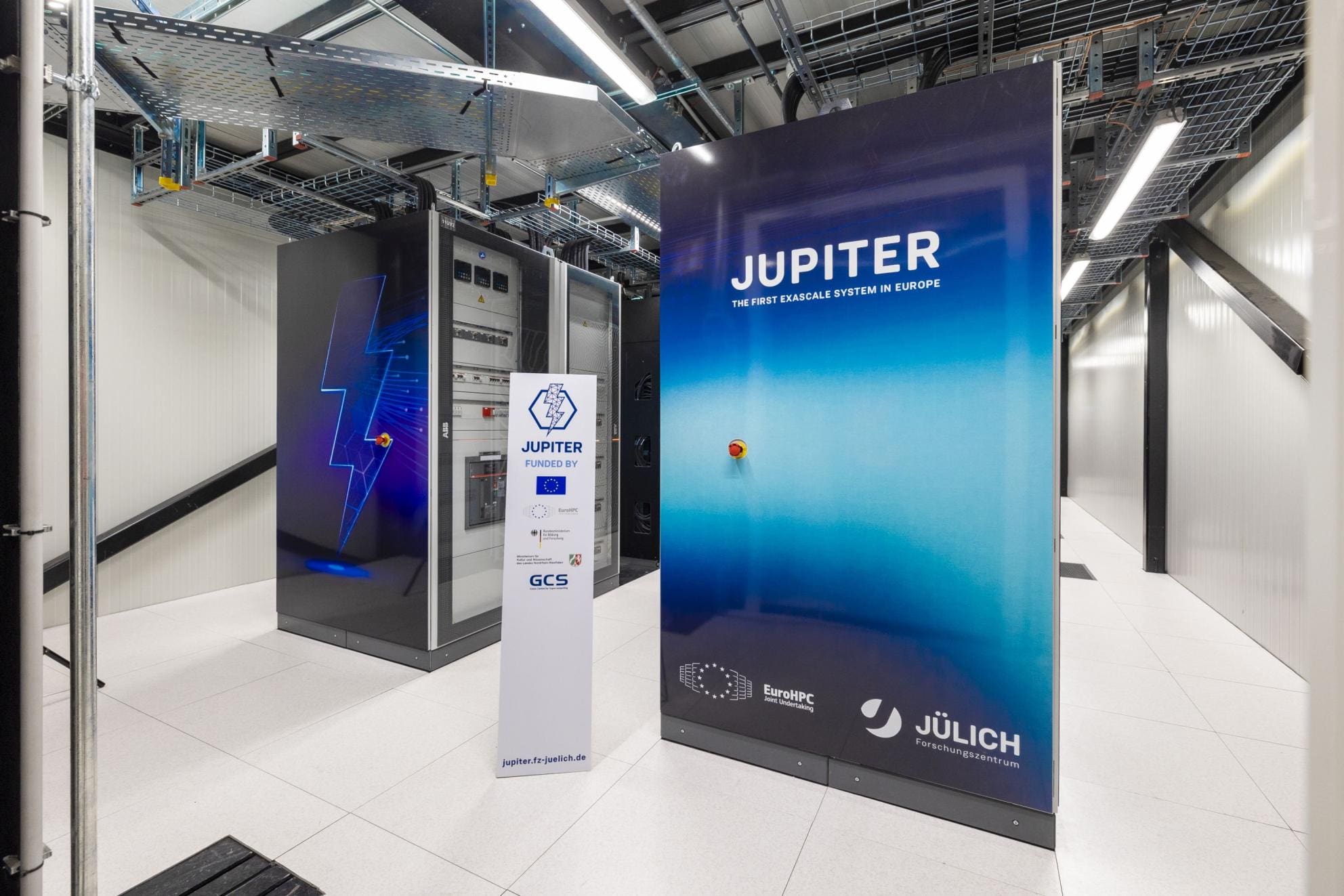
JUPITER — the Joint Undertaking Pioneer for Innovative and Transformative Exascale Research — is Europe’s first exascale supercomputer, based at the Jülich Supercomputing Centre in Germany. It can perform more than one quintillion (10^18) floating point operations per second, placing it among the most powerful computing systems ever built. The system was designed with complex scientific simulation workloads in mind, including quantum system modelling, climate simulation, particle physics, and materials science.
Implications for Quantum Research
The ability to fully simulate 50-qubit systems on a classical machine has immediate research value. It gives quantum algorithm developers a high-fidelity testing ground for code that will eventually run on real quantum hardware, allowing them to identify bugs and optimise performance without the noise and decoherence that current quantum processors introduce. It also gives theorists a tool for studying the boundary between quantum advantage and classical computability in unprecedented detail.
For Europe’s broader quantum computing ambitions — which include significant investments under the EU Quantum Flagship programme — the JUPITER result demonstrates that European supercomputing infrastructure is operating at the global frontier and can support the quantum research ecosystem that will be needed to develop practical quantum applications in the years ahead.