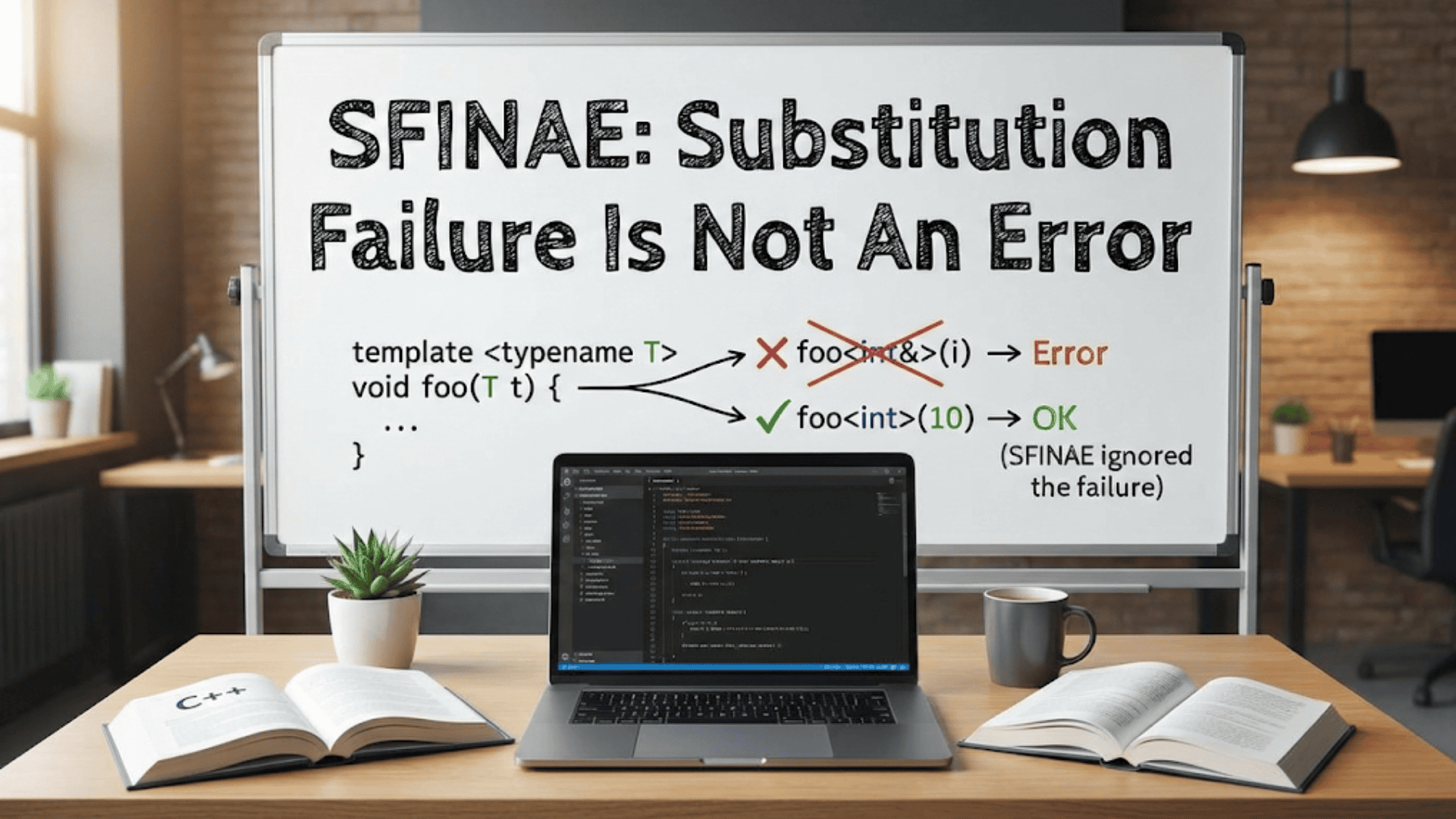

SFINAE (Substitution Failure Is Not An Error) is a C++ template rule that states: when the compiler attempts to substitute template arguments into a function template and the substitution produces an invalid type or expression, that function template is silently removed from the overload set — it is not a compilation error. This mechanism allows template authors to selectively enable or disable function and class template overloads based on compile-time properties of their type arguments, enabling type-safe generic programming without runtime overhead.
Introduction
Imagine you want to write a function template that works differently depending on whether its argument is an integer type or a floating-point type. Or a function that should only compile for types that have a serialize() method. Or a class that provides different behavior when instantiated with a pointer type versus a non-pointer type.
In all of these cases, you need a mechanism to conditionally include or exclude a template from consideration based on compile-time properties of the types involved. In C++, that mechanism is SFINAE — Substitution Failure Is Not An Error.
SFINAE is one of the most powerful — and historically one of the most arcane — features of C++ template programming. Understanding it requires first grasping the precise moment in the compilation process where it applies: during overload resolution, when the compiler substitutes deduced or explicitly provided template arguments into function signatures to determine which overloads are viable candidates.
When that substitution produces something invalid — like trying to take the ::type member of a type that has none — the compiler does not emit an error. Instead, it simply removes that overload from consideration and moves on. Only if no valid overload remains does a compile error occur.
This article demystifies SFINAE completely. You will understand exactly where and when it applies, learn to use std::enable_if to write conditioned overloads, build and use type traits with SFINAE, detect member functions at compile time, understand the limitations of SFINAE, and see how C++20 Concepts supersedes many SFINAE patterns with dramatically more readable syntax.
The Problem SFINAE Solves
Before diving into SFINAE mechanics, see the problem it addresses. You want to write a double_it function that works for both integers (using multiplication) and strings (by concatenating with itself):
#include <iostream>
#include <string>
#include <type_traits>
using namespace std;

// Attempt 1: One function — does not work for both types simultaneously
template<typename T>
T double_it(T value) {
    return value * 2;  // Works for int, double — NOT for string
}

// What we want:
// - For arithmetic types: return value * 2
// - For strings: return value + value

int main() {
    cout << double_it(5)    << endl;   // 10 — fine
    cout << double_it(3.14) << endl;   // 6.28 — fine
    // cout << double_it(string("hi")) << endl;  // ERROR: can't multiply string by 2
    return 0;
}One approach is to overload the function for string explicitly. But what if you want the string version to work for all string-like types? And what if you want the numeric version to work for any arithmetic type, not just int and double? You need a way to say “this overload is valid only when T is arithmetic” and “this other overload is valid only when T is a string type.”
SFINAE lets you do exactly that — and the compiler chooses the right overload automatically based on the type of the argument.
How Template Substitution Works
To understand SFINAE, you must first understand what “substitution” means in the context of template instantiation.
When you call a function template, the compiler goes through three stages:
Stage 1 — Template argument deduction: The compiler examines the function call and deduces the template arguments. For double_it(5), it deduces T = int.
Stage 2 — Substitution: The compiler substitutes the deduced arguments into the function’s declaration (its signature — return type, parameter types, template parameter constraints). This may produce valid types or invalid ones.
Stage 3 — Overload resolution: All candidate functions (template and non-template) whose substitution succeeded in Stage 2 form the viable overload set. The best match is selected.
SFINAE operates in Stage 2. If substitution of template arguments into the function declaration produces an invalid type or expression, that template is silently excluded from the viable set. It is not an error — unless the viable set becomes empty.
Critically, SFINAE only applies to errors in the immediate context of the substitution — errors in the function declaration itself, not in the function body.
#include <iostream>
#include <type_traits>
using namespace std;

// Two overloads: only one will be valid for any given T

// Overload A: enabled only when T is an arithmetic type
// The return type "typename enable_if<is_arithmetic_v<T>, T>::type"
// becomes a valid type T when is_arithmetic is true,
// and becomes ill-formed (causing substitution failure) when false
template<typename T>
typename enable_if<is_arithmetic_v<T>, T>::type
double_it(T value) {
    cout << "[arithmetic] ";
    return value * 2;
}

// Overload B: enabled only when T is a string type
template<typename T>
typename enable_if<is_same_v<T, string>, T>::type
double_it(T value) {
    cout << "[string] ";
    return value + value;
}

int main() {
    cout << double_it(5)           << endl;  // [arithmetic] 10
    cout << double_it(3.14)        << endl;  // [arithmetic] 6.28
    cout << double_it(string("hi")) << endl; // [string] hihi
    return 0;
}Output:
[arithmetic] 10
[arithmetic] 6.28
[string] hihiStep-by-step explanation:
- For
double_it(5),T = int. In Overload A,is_arithmetic_v<int>istrue, soenable_if<true, int>::typeis valid (int). The return type resolves. In Overload B,is_same_v<int, string>isfalse, soenable_if<false, string>::typehas no membertype— substitution fails silently. Overload B is removed. Only Overload A is viable. - For
double_it(string("hi")),T = string. In Overload A,is_arithmetic_v<string>isfalse— substitution fails silently, Overload A removed. In Overload B,is_same_v<string, string>istrue— Overload B is valid and selected. - Neither function “knows about” the other. Each is a standalone overload. The compiler uses SFINAE to determine which one is valid for a given
T, then selects from the valid set. - If you called
double_it('x')(achar, which is arithmetic but notstring), Overload A would fire:'x' * 2 = 240(the ASCII value doubled). If you wanted a different behavior forchar, you could add a third overload gated onis_same_v<T, char>.
std::enable_if: The Primary SFINAE Tool
std::enable_if<Condition, T = void> is the workhorse of SFINAE-based programming. It is a simple template struct with a partial specialization:
// The standard library implementation (simplified):
template<bool Condition, typename T = void>
struct enable_if {};  // Primary template: no ::type member

template<typename T>
struct enable_if<true, T> {  // Specialization: has ::type only when true
    using type = T;
};When Condition is true, enable_if<true, T>::type exists and equals T. When Condition is false, enable_if<false, T>::type does not exist — accessing it causes a substitution failure, which (in the context of a function declaration) silently removes that overload.
There are three common places to put enable_if in a function template:
#include <type_traits>
#include <iostream>
using namespace std;

// Method 1: In the return type
template<typename T>
enable_if_t<is_integral_v<T>, string>   // Return type is string, only for integrals
describeType_1(T) { return "integer"; }

// Method 2: As an extra defaulted template parameter
template<typename T,
         typename = enable_if_t<is_integral_v<T>>>  // Extra parameter, defaults to void
string describeType_2(T) { return "integer"; }

// Method 3: As a non-type template parameter with default
template<typename T,
         enable_if_t<is_integral_v<T>, int> = 0>  // Non-type param, defaults to 0
string describeType_3(T) { return "integer"; }

int main() {
    cout << describeType_1(42)    << endl;  // integer
    cout << describeType_2(42)    << endl;  // integer
    cout << describeType_3(42)    << endl;  // integer

    // describeType_1(3.14);  // Would be a compile error — no valid overload
    return 0;
}Step-by-step explanation:
- Method 1 (return type):
enable_if_t<is_integral_v<T>, string>is the return type. For non-integralT, this has notypemember, causing substitution failure. Clean and readable for simple cases. - Method 2 (extra type parameter):
typename = enable_if_t<is_integral_v<T>>adds a dummy template type parameter that defaults tovoidwhenTis integral. WhenTis not integral, the default is ill-formed — substitution failure. The drawback: two overloads using this method with complementary conditions would have the same signaturef(T, typename = void)versusf(T, typename = void), causing ambiguity. - Method 3 (non-type parameter):
enable_if_t<is_integral_v<T>, int> = 0adds a dummyintnon-type parameter defaulting to0. This avoids the Method 2 ambiguity problem when writing complementary overloads, because the non-type parameter type can differ between overloads. enable_if_t<Cond, T>is a C++14 alias fortypename enable_if<Cond, T>::type. Always prefer the_tform in modern code.
Writing Complementary Overloads
The most common SFINAE pattern is providing two (or more) overloads for a function where the conditions are mutually exclusive — exactly one overload is valid for any given type.
#include <iostream>
#include <type_traits>
using namespace std;

// Overload for integral types
template<typename T>
enable_if_t<is_integral_v<T>, void>
printTypeInfo(T value) {
    cout << "Integer: " << value
         << " (bits=" << sizeof(T)*8 << ")" << endl;
}

// Overload for floating-point types
template<typename T>
enable_if_t<is_floating_point_v<T>, void>
printTypeInfo(T value) {
    cout << "Float: " << value
         << " (bits=" << sizeof(T)*8 << ")" << endl;
}

// Overload for pointer types
template<typename T>
enable_if_t<is_pointer_v<T>, void>
printTypeInfo(T value) {
    cout << "Pointer to " << (value ? "non-null" : "null")
         << " address" << endl;
}

// Overload for everything else
template<typename T>
enable_if_t<!is_integral_v<T> && !is_floating_point_v<T> && !is_pointer_v<T>, void>
printTypeInfo(T value) {
    cout << "Other type, size=" << sizeof(T) << " bytes" << endl;
}

int main() {
    printTypeInfo(42);           // Integer: 42 (bits=32)
    printTypeInfo(42LL);         // Integer: 42 (bits=64)
    printTypeInfo(3.14f);        // Float: 3.14 (bits=32)
    printTypeInfo(3.14);         // Float: 3.14 (bits=64)
    int x = 5;
    printTypeInfo(&x);           // Pointer to non-null address
    printTypeInfo((int*)nullptr); // Pointer to null address

    struct Point { int x, y; };
    Point p{1, 2};
    printTypeInfo(p);            // Other type, size=8 bytes

    return 0;
}Output:
Integer: 42 (bits=32)
Integer: 42 (bits=64)
Float: 3.14 (bits=32)
Float: 3.14 (bits=64)
Pointer to non-null address
Pointer to null address
Other type, size=8 bytesStep-by-step explanation:
- For
printTypeInfo(42),T = int.is_integral_v<int>istrue— the first overload is selected. For the other three overloads,is_floating_point_v<int>,is_pointer_v<int>, and the compound condition are allfalse— all three fail substitution silently. - For
printTypeInfo(3.14),T = double.is_floating_point_v<double>istrue— the second overload fires. The others fail SFINAE. - The “everything else” overload uses a compound negated condition. This correctly catches any type that is not integral, floating-point, or a pointer — such as the
Pointstruct. - The conditions must be mutually exclusive (exactly one true for any
T) to avoid ambiguous overload resolution. If two overloads could both match a givenT, the compiler would report an ambiguous call error.
SFINAE in Class Templates
SFINAE also works in class template partial specializations, enabling different class definitions based on type properties.
#include <iostream>
#include <type_traits>
using namespace std;

// Primary template: generic storage
template<typename T, typename Enable = void>
class SmartStorage {
public:
    T value;
    explicit SmartStorage(T v) : value(v) {}
    void describe() const {
        cout << "Generic storage, size=" << sizeof(T) << " bytes" << endl;
    }
};

// Specialization for arithmetic types: adds math operations
template<typename T>
class SmartStorage<T, enable_if_t<is_arithmetic_v<T>>> {
public:
    T value;
    explicit SmartStorage(T v) : value(v) {}
    void describe() const {
        cout << "Arithmetic storage: " << value
             << " (signed=" << is_signed_v<T> << ")" << endl;
    }
    SmartStorage operator+(const SmartStorage& other) const {
        return SmartStorage(value + other.value);
    }
    SmartStorage operator*(T factor) const {
        return SmartStorage(value * factor);
    }
};

// Specialization for pointer types: adds null-safety
template<typename T>
class SmartStorage<T*, enable_if_t<is_pointer_v<T*>>> {
public:
    T* value;
    explicit SmartStorage(T* v) : value(v) {}
    void describe() const {
        cout << "Pointer storage: "
             << (value ? "non-null" : "null") << endl;
    }
    T& operator*() {
        if (!value) throw runtime_error("Null pointer dereference");
        return *value;
    }
    bool isNull() const { return value == nullptr; }
};

int main() {
    SmartStorage<int> intStore(42);
    intStore.describe();
    auto sum = intStore + SmartStorage<int>(8);
    cout << "Sum: " << sum.value << endl;
    auto scaled = intStore * 3;
    cout << "Scaled: " << scaled.value << endl;

    int x = 100;
    SmartStorage<int*> ptrStore(&x);
    ptrStore.describe();
    cout << "Deref: " << *ptrStore << endl;

    SmartStorage<string> strStore(string("hello"));
    strStore.describe();

    return 0;
}Output:
Arithmetic storage: 42 (signed=1)
Sum: 50
Scaled: 126
Pointer storage: non-null
Deref: 100
Generic storage, size=32 bytes
Step-by-step explanation:
SmartStorage<int>matches the arithmetic specialization becauseis_arithmetic_v<int>istrue, makingenable_if_t<true>valid (void). This specialization providesoperator+andoperator*.SmartStorage<int*>matches the pointer specialization becauseT* = int*.SmartStorage<string>does not match either specialization —is_arithmetic_v<string>andis_pointer_v<string>are bothfalse, so both specializations fail SFINAE. The primary template (generic storage) is used.- The
Enable = voiddefault in the primary template andenable_if_t<condition>(which resolves tovoidwhen true) in specializations make the specializations override the primary template specifically when their conditions are met.
Detecting Member Functions with SFINAE
One of SFINAE’s most powerful applications is detecting whether a type has a specific member function or operator. This allows templates to adapt to the capabilities of their type arguments.
#include <iostream>
#include <type_traits>
#include <string>
#include <vector>
using namespace std;

// Detect if T has a .size() member function
// Uses the "expression SFINAE" pattern: the decltype expression
// evaluates the call; if invalid, substitution fails
template<typename T, typename = void>
struct has_size : false_type {};

template<typename T>
struct has_size<T, void_t<decltype(declval<T>().size())>> : true_type {};

// Detect if T has a .serialize() member function
template<typename T, typename = void>
struct has_serialize : false_type {};

template<typename T>
struct has_serialize<T, void_t<decltype(declval<T>().serialize())>> : true_type {};

// Detect if T supports operator<< (stream output)
template<typename T, typename = void>
struct is_streamable : false_type {};

template<typename T>
struct is_streamable<T,
    void_t<decltype(declval<ostream&>() << declval<T>())>> : true_type {};

// Use the traits to write adaptive functions
template<typename T>
void describeContainer(const T& container) {
    if constexpr (has_size<T>::value) {
        cout << "Has size(): " << container.size() << " elements" << endl;
    } else {
        cout << "No size() method" << endl;
    }
}

template<typename T>
void smartPrint(const T& value) {
    if constexpr (is_streamable<T>::value) {
        cout << "Value: " << value << endl;
    } else {
        cout << "Type is not streamable (size=" << sizeof(T) << " bytes)" << endl;
    }
}

// Example of a type with serialize()
struct ConfigData {
    string name;
    int version;
    string serialize() const {
        return "ConfigData{name=" + name + ",version=" + to_string(version) + "}";
    }
};

// Example without serialize
struct RawData {
    int buffer[10];
};

int main() {
    // has_size tests
    cout << "has_size<vector<int>>: " << has_size<vector<int>>::value  << endl;  // 1
    cout << "has_size<int>:         " << has_size<int>::value          << endl;  // 0
    cout << "has_size<string>:      " << has_size<string>::value       << endl;  // 1
    cout << "has_size<int[5]>:      " << has_size<int[5]>::value       << endl;  // 0

    // has_serialize tests
    cout << "\nhas_serialize<ConfigData>: " << has_serialize<ConfigData>::value << endl; // 1
    cout << "has_serialize<RawData>:    " << has_serialize<RawData>::value    << endl; // 0

    // is_streamable tests
    cout << "\nis_streamable<int>:    " << is_streamable<int>::value    << endl;  // 1
    cout << "is_streamable<string>: " << is_streamable<string>::value  << endl;  // 1
    cout << "is_streamable<RawData>:" << is_streamable<RawData>::value << endl;  // 0

    cout << "\n--- Container describe ---" << endl;
    vector<int> v = {1, 2, 3};
    describeContainer(v);
    int arr[5] = {};
    describeContainer(arr);  // No size() on C arrays

    cout << "\n--- Smart print ---" << endl;
    smartPrint(42);
    smartPrint(string("hello"));
    RawData rd{};
    smartPrint(rd);  // Not streamable

    return 0;
}
Output:
has_size<vector<int>>: 1
has_size<int>:         0
has_size<string>:      1
has_size<int[5]>:      0

has_serialize<ConfigData>: 1
has_serialize<RawData>:    0

is_streamable<int>:    1
is_streamable<string>: 1
is_streamable<RawData>:0

--- Container describe ---
Has size(): 3 elements
No size() method

--- Smart print ---
Value: 42
Value: hello
Type is not streamable (size=40 bytes)Step-by-step explanation:
has_size<T>uses thevoid_tidiom (C++17).void_t<decltype(declval<T>().size())>evaluates the expressiondeclval<T>().size().declval<T>()produces an rvalue of typeTwithout constructing it — purely for the sake of type checking. If.size()is a valid call,decltype(...)gives its return type,void_t<...>converts it tovoid, and the partial specialization matches (true_type). If.size()is invalid, thedecltypeexpression fails — substitution failure — and the primary template (false_type) is used.has_serialize<ConfigData>detects thatConfigDatahas a.serialize()method.has_serialize<RawData>does not find one, sofalse_typeis returned.is_streamable<T>checks whethercout << valueis a valid expression by checkingdeclval<ostream&>() << declval<T>(). Forintandstring(which haveoperator<<), this is valid. ForRawData(which does not haveoperator<<), it fails.- With
if constexpr, these traits drive compile-time branches indescribeContainerandsmartPrint. The non-taken branch is not compiled — so accessing.size()on an array (which would fail) is never even evaluated.
void_t: The Simplest SFINAE Helper
std::void_t<...> (C++17) is a variadic alias template that maps any sequence of types to void. Its entire purpose is to trigger SFINAE:
template<typename... Ts>
using void_t = void;The key is that evaluating the types in ... may fail if any expression is invalid — and that failure is a substitution failure, which triggers SFINAE. void_t converts success into void for use in specialization matching.
#include <iostream>
#include <type_traits>
using namespace std;

// Detects whether T::value_type exists (has a nested type alias 'value_type')
template<typename T, typename = void>
struct has_value_type : false_type {};

template<typename T>
struct has_value_type<T, void_t<typename T::value_type>> : true_type {};

// Detects whether T is comparable with ==
template<typename T, typename = void>
struct is_equality_comparable : false_type {};

template<typename T>
struct is_equality_comparable<T,
    void_t<decltype(declval<T>() == declval<T>())>> : true_type {};

// Detects whether T has both begin() and end() (is iterable)
template<typename T, typename = void>
struct is_iterable : false_type {};

template<typename T>
struct is_iterable<T,
    void_t<decltype(declval<T>().begin()),
           decltype(declval<T>().end())>> : true_type {};

struct NotIterable { int x; };
struct ManualIterable {
    int* begin() { return nullptr; }
    int* end()   { return nullptr; }
};

int main() {
    cout << "has_value_type<vector<int>>: " << has_value_type<vector<int>>::value << endl;
    cout << "has_value_type<int>:         " << has_value_type<int>::value         << endl;
    cout << "has_value_type<string>:      " << has_value_type<string>::value      << endl;

    cout << "\nis_equality_comparable<int>:    " << is_equality_comparable<int>::value    << endl;
    cout << "is_equality_comparable<string>: " << is_equality_comparable<string>::value  << endl;

    cout << "\nis_iterable<vector<int>>:    " << is_iterable<vector<int>>::value    << endl;
    cout << "is_iterable<NotIterable>:    " << is_iterable<NotIterable>::value     << endl;
    cout << "is_iterable<ManualIterable>: " << is_iterable<ManualIterable>::value  << endl;

    return 0;
}Output:
has_value_type<vector<int>>: 1
has_value_type<int>:         0
has_value_type<string>:      1

is_equality_comparable<int>:    1
is_equality_comparable<string>: 1

is_iterable<vector<int>>:    1
is_iterable<NotIterable>:    0
is_iterable<ManualIterable>: 1Step-by-step explanation:
void_t<typename T::value_type>attempts to accessT::value_type.vector<int>::value_typeisint— valid, specialization matches.int::value_typedoes not exist — substitution fails, primary template (false_type) used.void_t<decltype(declval<T>() == declval<T>())>checks ifT == Tis a valid expression. Forintandstring(both haveoperator==), this succeeds.void_t<decltype(...begin()), decltype(...end())>accepts two expressions insidevoid_t. Both must be valid.ManualIterablehas bothbegin()andend(), so it correctly reports as iterable.NotIterablehas neither, so it reports as not iterable.- The
void_tpattern works because partial template specializations are preferred over the primary template when they match. The specializationhas_value_type<T, void_t<...>>matches when the inner expression is valid — and the primary templatehas_value_type<T, void>matches when the specialization fails. Sincevoid_talways producesvoid, both usevoidas the second argument — but the specialization’s check is what determines which one wins.
Practical SFINAE: A Type-Safe Serializer
Let’s combine everything into a practical, real-world application: a serializer that adapts its behavior based on the capabilities of the type it serializes.
#include <iostream>
#include <string>
#include <vector>
#include <sstream>
#include <type_traits>
using namespace std;

// Type traits for serialization capabilities
template<typename T, typename = void>
struct has_to_string_method : false_type {};
template<typename T>
struct has_to_string_method<T,
    void_t<decltype(declval<T>().to_string())>> : true_type {};

template<typename T, typename = void>
struct has_begin_end : false_type {};
template<typename T>
struct has_begin_end<T,
    void_t<decltype(declval<T>().begin()), decltype(declval<T>().end())>>
    : true_type {};

// The adaptive serializer
template<typename T>
string serialize(const T& value) {
    if constexpr (is_arithmetic_v<T>) {
        // Numbers: use to_string
        return to_string(value);

    } else if constexpr (is_same_v<T, string>) {
        // Strings: quote them
        return "\"" + value + "\"";

    } else if constexpr (has_to_string_method<T>::value) {
        // Types with .to_string(): use it
        return value.to_string();

    } else if constexpr (has_begin_end<T>::value) {
        // Iterable containers: serialize as JSON array
        ostringstream oss;
        oss << "[";
        bool first = true;
        for (const auto& elem : value) {
            if (!first) oss << ",";
            oss << serialize(elem);  // Recursive: serialize each element
            first = false;
        }
        oss << "]";
        return oss.str();

    } else {
        // Fallback: just report the type size
        return "<opaque:" + to_string(sizeof(T)) + "bytes>";
    }
}

// A custom type with to_string()
struct Color {
    int r, g, b;
    string to_string() const {
        return "rgb(" + std::to_string(r) + ","
                      + std::to_string(g) + ","
                      + std::to_string(b) + ")";
    }
};

// A type with no serialization support
struct BinaryData {
    char bytes[16];
};

int main() {
    cout << serialize(42)              << endl;  // 42
    cout << serialize(3.14f)           << endl;  // 3.140000
    cout << serialize(string("hello")) << endl;  // "hello"

    Color red{255, 0, 0};
    cout << serialize(red) << endl;              // rgb(255,0,0)

    vector<int> nums = {1, 2, 3, 4, 5};
    cout << serialize(nums) << endl;             // [1,2,3,4,5]

    vector<string> words = {"foo", "bar", "baz"};
    cout << serialize(words) << endl;            // ["foo","bar","baz"]

    // Nested: vector of vectors
    vector<vector<int>> matrix = {{1,2},{3,4},{5,6}};
    cout << serialize(matrix) << endl;           // [[1,2],[3,4],[5,6]]

    BinaryData bd{};
    cout << serialize(bd) << endl;               // <opaque:16bytes>

    return 0;
}Output:
42
3.140000
"hello"
rgb(255,0,0)
[1,2,3,4,5]
["foo","bar","baz"]
[[1,2],[3,4],[5,6]]
<opaque:16bytes>Step-by-step explanation:
- The
serializefunction usesif constexprbranches driven by type traits to select the right serialization strategy for each type. Each branch is only compiled for types where the condition is true. has_to_string_method<Color>::valueistruebecauseColorhas a.to_string()method. The serializer calls it directly.has_begin_end<vector<int>>::valueistrue. The serializer iterates the container and recursively serializes each element. Becauseserializeis itself a template, the recursive callserialize(elem)selects the right overload forelem‘s type —intin this case.- The recursive call works for nested containers too:
serialize(matrix)callsserializeon eachvector<int>row, which callsserializeon eachintelement. BinaryDatahas noto_string(), no begin/end, and is not arithmetic or string — it hits the fallback branch and reports its size.
The Limits of SFINAE: Where It Gets Painful
SFINAE is powerful but has significant drawbacks that motivated the creation of C++20 Concepts.
Problem 1: Error messages are catastrophic. When all overloads fail SFINAE, the compiler reports that no matching function was found, but the error often buries the real reason under pages of template instantiation notes. Identifying why each overload was eliminated requires deep template expertise.
Problem 2: Code is difficult to read. Functions that use complex enable_if conditions in their signature are visually cluttered. A function with three SFINAE conditions in its signature can become nearly unreadable.
Problem 3: The “SFINAE barrier” only applies to immediate context. Errors inside template function bodies are always hard errors — SFINAE does not apply there. Only errors in the function declaration (return type, parameter types, template parameter list) trigger SFINAE.
// This is NOT SFINAE — the error is in the function BODY
template<typename T>
void badSFINAE(T value) {
    value.nonExistentMethod();  // Hard error, NOT SFINAE — compilation fails
}

// This IS SFINAE — the error is in the function DECLARATION
template<typename T>
auto goodSFINAE(T value) -> decltype(value.existingMethod()) {
    // decltype in return type is immediate context — SFINAE applies here
    return value.existingMethod();
}Problem 4: Complex SFINAE for multiple constraints requires nesting enable_if.
// Multiple constraints: verbose and hard to maintain
template<typename T>
enable_if_t<
    is_integral_v<T> &&
    is_signed_v<T> &&
    (sizeof(T) >= 4),
    void>
processLargeSignedInt(T value) {
    cout << value << endl;
}C++20 Concepts solve all of these problems with readable syntax, clear error messages, and constraints that apply to the entire function body, not just the declaration.
SFINAE vs. C++20 Concepts: A Comparison
#include <concepts>
#include <iostream>
using namespace std;

// SFINAE version: hard to read
template<typename T>
enable_if_t<is_integral_v<T> && is_signed_v<T>, void>
processOld(T value) {
    cout << "Old SFINAE: " << value << endl;
}

// Concepts version: clear and readable
template<typename T>
    requires integral<T> && signed_integral<T>
void processNew(T value) {
    cout << "Concept: " << value << endl;
}

// Even cleaner with abbreviated function template (C++20)
void processNewest(signed_integral auto value) {
    cout << "Abbreviated: " << value << endl;
}

int main() {
    processOld(-42);
    processNew(-42);
    processNewest(-42);

    // With Concepts, if you pass the wrong type, you get a clear message:
    // processNew(3.14);  // Error: constraint not satisfied for 'double'
    // Instead of: no matching function for call to 'processNew(double)'
    // with a wall of template substitution failures

    return 0;
}Output:
Old SFINAE: -42
Concept: -42
Abbreviated: -42| Feature | SFINAE | C++20 Concepts |
|---|---|---|
| Syntax complexity | High — enable_if, void_t, decltype | Low — requires, named concepts |
| Error messages | Cryptic — shows all substitution failures | Clear — “constraint not satisfied for T” |
| Applies to body? | No — body errors are hard errors | Yes — constraints checked throughout |
| Overload control | Full control via enable_if | Full control via requires clauses |
| Readable constraints | No | Yes — self-documenting |
| Requires C++ standard | C++11 and later | C++20 and later |
| Available in older code | Yes | No — needs C++20 compiler |
Common SFINAE Patterns Quick Reference
#include <type_traits>
using namespace std;

// Pattern 1: Enable function only for arithmetic types
template<typename T>
enable_if_t<is_arithmetic_v<T>, T> square(T x) { return x * x; }

// Pattern 2: Enable for types derived from a base class
template<typename T>
enable_if_t<is_base_of_v<BaseClass, T>, void> process(T& obj) { obj.process(); }

// Pattern 3: Enable for types that are NOT const
template<typename T>
enable_if_t<!is_const_v<T>, void> modify(T& obj) { /* modify */ }

// Pattern 4: Enable based on multiple conditions (all must be true)
template<typename T>
enable_if_t<is_integral_v<T> && is_unsigned_v<T> && (sizeof(T) == 4), void>
processUint32(T x) { /* handles exactly uint32_t */ }

// Pattern 5: Detect nested type alias
template<typename T, typename = void>
struct has_iterator : false_type {};
template<typename T>
struct has_iterator<T, void_t<typename T::iterator>> : true_type {};

// Pattern 6: Detect specific operator
template<typename T, typename = void>
struct has_less : false_type {};
template<typename T>
struct has_less<T, void_t<decltype(declval<T>() < declval<T>())>> : true_type {};

// Pattern 7: Conditional return type (decltype in trailing return)
template<typename T>
auto getFirst(const T& container) -> decltype(container.front()) {
    return container.front();
}
// Only works for containers with .front() — SFINAE removes it for othersConclusion
SFINAE is the mechanism that makes C++ template programming truly powerful. By silently removing overloads that fail substitution rather than generating errors, the compiler enables libraries and frameworks to present single, clean interfaces that transparently adapt to any type passed to them — dispatching to specialized implementations based on the type’s properties, without any runtime cost.
The rule “substitution failure is not an error” transforms what would be compile errors into graceful overload elimination. std::enable_if gives you explicit control over when overloads are valid. void_t and decltype let you detect member functions, operators, nested types, and any other type property through expression SFINAE. Together, these tools enable you to write library-quality generic code.
That said, SFINAE’s age shows. Its syntax is verbose, error messages are opaque, and the “immediate context only” restriction creates sharp edges. C++20 Concepts address all of these shortcomings, making constraint-based programming dramatically more readable and producing clear error messages when constraints are not satisfied.
Understanding SFINAE remains essential even if you use Concepts: it explains what Concepts are built on, it is the only option in codebases targeting C++11 through C++17, and many existing libraries and frameworks use it extensively. SFINAE and Concepts are not mutually exclusive — they are successive generations of the same idea, and knowing both gives you the full picture of C++ template constraint programming.