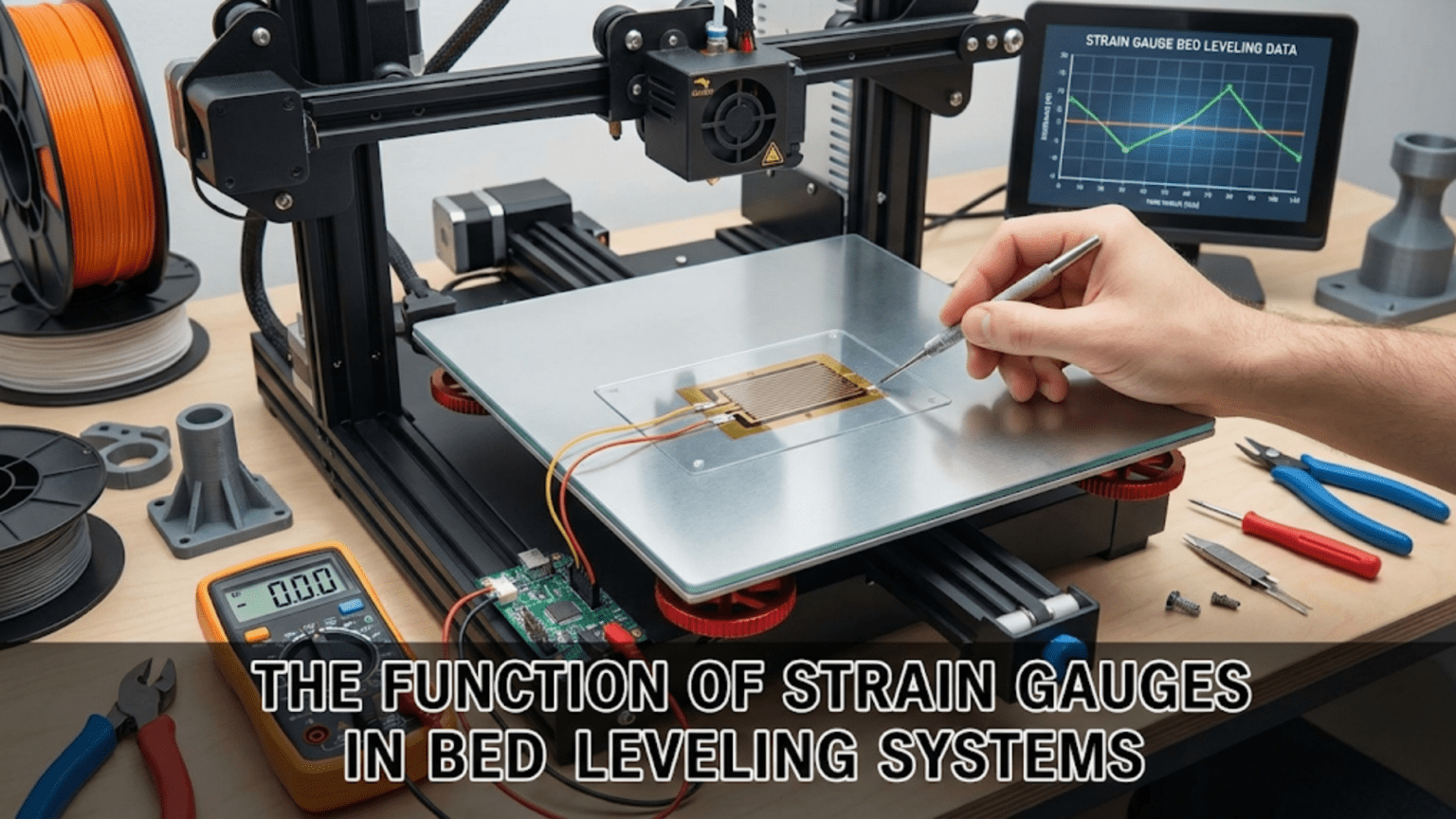
Strain gauges in bed leveling systems measure the tiny forces created when the nozzle contacts the bed surface, effectively using the nozzle itself as the probe and eliminating the need for separate probe sensors. These systems work by mounting the nozzle or entire toolhead on strain-sensitive load cells or piezoelectric sensors that detect the deflection or force when the nozzle touches the bed, with firmware interpreting these signals to determine the exact Z-height at each probe point, enabling accurate bed leveling without additional probing hardware while ensuring measurements occur at the exact nozzle position rather than an offset probe location.
Introduction
Traditional bed leveling probes—BLTouch sensors, inductive probes, capacitive sensors—all share a common limitation: they measure bed height at a location offset from the nozzle. While firmware compensates for this offset, it introduces potential error sources. The probe might trigger on a different surface than where the nozzle will actually print. Temperature differences between probing and printing can shift the relationship. Any probe offset misconfiguration translates directly to first layer problems.
Strain gauge systems take a radically different approach: use the nozzle itself as the probe. By measuring the forces created when the nozzle touches the bed, these systems detect contact with perfect accuracy—no offset, no calibration of probe-to-nozzle distance, and measurements at the exact location where plastic will be deposited. This elegant solution eliminates multiple error sources while simplifying the mechanical design.
Yet strain gauge leveling remains less common than traditional probes, appearing primarily in higher-end or custom-built printers. Understanding how these systems work—the physics of strain gauges, the mechanics of force measurement, and the firmware integration making it useful—reveals both their advantages and why they haven’t completely displaced traditional probing methods.
In this comprehensive guide, we’ll explore strain gauge bed leveling from fundamental principles through practical implementation, understanding what makes these systems special and when they offer genuine advantages over conventional probes.
What Are Strain Gauges?
Before examining their bed leveling application, understanding the basic technology:
Strain Gauge Fundamentals
Definition: A strain gauge is a sensor that measures deformation (strain) by detecting changes in electrical resistance.
Construction:
- Very thin metal foil arranged in a grid pattern
- Bonded to a flexible backing material
- Applied to surfaces that will deform under load
- Lead wires connect to measurement electronics
Operating Principle:
- When the material deforms, the metal foil stretches or compresses
- Stretching increases resistance (longer, thinner conductor)
- Compression decreases resistance (shorter, thicker conductor)
- Resistance change is proportional to strain
- Electronics measure this resistance change
Sensitivity:
- Extremely sensitive to tiny deformations
- Can detect micrometers of deflection
- Typical resistance: 120-350 ohms
- Resistance change: 0.1-0.5% per 1000 microstrain
- Requires precision measurement electronics
Wheatstone Bridge Circuit
Strain gauges typically connect in a Wheatstone bridge configuration:
Circuit Function:
- Four resistors arranged in a bridge
- One or more are strain gauges
- Bridge balanced when unstrained (zero output)
- Strain creates imbalance, producing voltage output
- Output voltage proportional to strain
Temperature Compensation:
- Temperature affects resistance similar to strain
- Bridge configuration cancels temperature effects
- Multiple gauges in bridge compensate each other
- Improves measurement accuracy
- Bridge output very small (millivolts)
- Requires amplification for useful measurement
- Dedicated instrumentation amplifiers used
- Often integrated in strain gauge signal conditioners
Strain Gauges in Bed Leveling
Several implementations use strain measurement for leveling:
Nozzle-as-Probe Systems
The most elegant approach mounts the hotend on strain-sensitive supports:
Mechanical Design:
- Hotend mounted on flexible element
- Strain gauges bonded to flexible element
- Entire hotend can deflect slightly
- Contact with bed creates measurable deflection
Operation:
- Z-axis lowers nozzle toward bed
- Nozzle contacts bed surface
- Contact force causes hotend deflection
- Strain gauges detect deflection
- Signal exceeds threshold, firmware recognizes contact
- Z-height recorded at this point
Advantages:
- No probe offset (nozzle IS the probe)
- Measures exactly where printing occurs
- Works with any bed surface
- No deployment/retraction delays
- One less component to maintain
Challenges:
- Mechanical complexity in hotend mounting
- Electronics must handle noise and temperature
- Calibration sensitivity critical
- Potential for false triggers from vibration
Piezoelectric Force Sensors
An alternative uses piezo sensors instead of strain gauges:
Piezoelectric Effect:
- Certain crystals generate voltage when mechanically stressed
- No external power needed for sensing
- Very fast response time
- Sensitive to force/pressure
Implementation:
- Piezo disks or washers under hotend mounting
- Nozzle contact creates force on piezo
- Voltage spike indicates contact
- Electronics detect voltage threshold
Characteristics:
- Simpler than full strain gauge bridges
- Lower cost implementation
- May be less stable over temperature
- Typically requires AC-coupled signal processing
Load Cell Based Systems
Some systems use complete load cells:
Load Cell Design:
- Commercial load cells with integrated strain gauges
- Designed specifically for force measurement
- Incorporate compensation and protection
- Available in various force ranges
Application:
- Hotend or entire carriage mounted on load cells
- Very precise force measurement
- Professional-grade accuracy possible
- More expensive than discrete strain gauges
Implementation Architectures
Different mechanical approaches to strain gauge leveling:
Three-Point Mount Design
Configuration:
- Hotend mounted on three points
- Each with strain-sensitive element
- Triangle configuration provides stability
- Averaging three measurements improves accuracy
Benefits:
- Redundancy improves reliability
- Can detect non-perpendicular contact
- Better noise rejection
- Identifies mounting problems
Complexity:
- Three separate sensor channels
- More complex signal processing
- Higher cost
- More difficult calibration
Single Strain-Sensitive Mount
Simpler Approach:
- Hotend on single flexible element
- One or two strain gauges measure deflection
- Lower cost and complexity
- Adequate for many applications
Tradeoffs:
- Less redundancy
- More sensitive to mechanical variations
- Adequate accuracy for most users
- Easier implementation
Bed-Mounted Strain Sensors
Alternative Configuration:
- Strain gauges on bed mounting instead of hotend
- Bed deflects slightly when nozzle contacts
- Detects force transmitted through bed
- Less common implementation
Considerations:
- Large bed mass reduces sensitivity
- Thermal effects from bed heating
- Mounting point strain may be inconsistent
- Generally less practical than hotend mounting
Signal Processing and Electronics
Converting strain gauge signals to usable bed leveling data:
Amplification and Conditioning
Signal Chain:
- Strain gauge bridge produces millivolt signals
- Instrumentation amplifier boosts to volt-level
- Filtering removes noise and vibration
- Analog-to-digital conversion creates digital signal
- Microcontroller processes digital values
Noise Challenges:
- Mechanical vibration creates noise
- Electromagnetic interference from steppers/heaters
- Thermal drift from temperature changes
- Ground loops in wiring
Filtering Strategies:
- Low-pass filtering removes high-frequency noise
- Averaging multiple samples improves signal-to-noise
- Threshold detection ignores small fluctuations
- Software filtering complements hardware
Threshold Detection
Triggering Logic:
- Firmware monitors strain signal continuously
- Compares to configured threshold
- Signal exceeding threshold indicates contact
- Must distinguish real contact from noise
Threshold Setting:
- Too low: False triggers from vibration or noise
- Too high: Excessive force on bed, delayed detection
- Optimal: Just above noise floor, quick detection
- May require calibration for specific printer
Temperature Compensation
Thermal Effects:
- Strain gauges sensitive to temperature
- Hotend heating changes baseline reading
- Bed heating affects measurements
- Ambient temperature variations matter
Compensation Methods:
- Wheatstone bridge configuration cancels some effects
- Reference measurements at known temperatures
- Software compensation based on temperature sensors
- Thermal stabilization before probing
Firmware Integration
Strain gauge systems require firmware support:
Marlin Support
Configuration: Some experimental Marlin forks support strain gauges, but not in standard Marlin as of most recent stable releases.
Implementation Concepts:
- Analog pin reads strain gauge signal
- Threshold value defines contact
- Z-movement stops on trigger
- Standard bed leveling mesh code applies
Klipper Support
More Flexible Architecture: Klipper’s design better accommodates custom sensors:
Configuration Example (conceptual):
[strain_gauge_probe]
sensor_pin: analog11
threshold: 2.5
sample_count: 5
sample_tolerance: 0.02Features:
- Custom sensor definitions possible
- Signal processing in host computer
- Advanced filtering and averaging
- Calibration routines
RepRapFirmware
Duet Boards:
- Some support for force-sensing probes
- Configuration through config.g
- Threshold and sensitivity adjustable
- Good documentation for supported systems
Advantages of Strain Gauge Leveling
Understanding the benefits:
Zero Probe Offset
Perfect Alignment:
- Nozzle itself makes contact
- No X/Y offset to configure
- No probe-to-nozzle distance errors
- Measurements exactly where printing occurs
Simplified Configuration:
- Eliminates probe offset calibration
- One less potential error source
- Easier for beginners to set up correctly
- No offset drift over time
Surface Independence
Universal Compatibility:
- Works with metal, glass, PEI, BuildTak, anything
- No surface-specific calibration
- No sensing distance variations
- Consistent across different bed materials
Flexibility:
- Change bed surfaces without reconfiguration
- Multi-surface users benefit greatly
- Experimenting with surfaces simplified
Accurate Z-Height
Direct Measurement:
- Nozzle contact is definitive
- No interpretation of trigger distance
- Thermal expansion doesn’t affect offset
- True nozzle-to-bed distance measured
Challenges and Limitations
Understanding the drawbacks:
Mechanical Complexity
Implementation Difficulty:
- Requires specialized hotend mounting
- Flexible elements must allow deflection but maintain rigidity
- More complex than adding external probe
- DIY implementation challenging
Potential Failure Modes:
- Strain gauge damage from excessive force
- Mechanical mounting degradation
- Signal wire fatigue from flexing
- Requires careful design and assembly
Electrical Noise
Noisy Environment:
- 3D printers generate significant electromagnetic interference
- Stepper motors create pulses
- Heater switching adds noise
- Long signal wires act as antennas
Signal Quality:
- Requires good shielding and grounding
- Filtering necessary but can slow response
- Balancing noise rejection with sensitivity
- More electrically complex than simple switches
Calibration Sensitivity
Threshold Adjustment:
- Must be set precisely
- Too sensitive: false triggers
- Too insensitive: excessive force or missed detection
- May require adjustment for different conditions
Environmental Factors:
- Temperature affects calibration
- Vibration from floor/building
- Electrical noise varies by environment
- May need periodic recalibration
Cost and Availability
Commercial Systems:
- Strain gauge bed leveling not in most consumer printers
- Limited commercial availability
- Higher cost than traditional probes
- Less community support and documentation
DIY Challenges:
- Requires understanding of strain gauges
- Electronics knowledge necessary
- Mechanical fabrication skills needed
- Troubleshooting more complex
Strain Gauge vs Traditional Probe Comparison
| Feature | Strain Gauge System | BLTouch Probe | Inductive Probe |
|---|---|---|---|
| Probe Offset | None (nozzle is probe) | X/Y offset needs configuration | X/Y offset needs configuration |
| Surface Compatibility | Any surface | Any surface | Metal only |
| Accuracy | Excellent (direct nozzle contact) | Excellent | Good |
| Speed | Fast (instant contact detection) | Moderate (deploy/retract delays) | Fast |
| Mechanical Complexity | High | Moderate | Low |
| Electrical Complexity | High | Moderate | Low |
| Cost | High (DIY) to Very High (commercial) | Moderate | Low |
| Availability | Limited | Widely available | Widely available |
| Reliability | Good (when properly implemented) | Good | Excellent |
| Maintenance | Moderate | Moderate (mechanical parts) | Low |
Practical Implementations
Examples of strain gauge leveling in real systems:
Prusa MK4 and XL
Load Cell System:
- Prusa’s newer printers use load cell based leveling
- Nextruder design incorporates force sensing
- Commercial implementation proving viability
- Demonstrates mainstream adoption potential
Benefits Realized:
- Simplified user experience
- Excellent first layer consistency
- No probe offset configuration needed
- Proves concept for consumer applications
DIY Implementations
Community Projects:
- Various open-source designs exist
- Often using piezo sensors for lower cost
- Sharing calibration and configuration information
- Advancing the technology accessibility
Common Approaches:
- Piezo disks under hotend mounting screws
- Strain gauges on flexible mounting plates
- Load cells in custom carriages
- Mix of mechanical and electronic solutions
Future of Strain Gauge Leveling
Technology development directions:
Increasing Adoption
Trends:
- More manufacturers exploring implementation
- Prusa adoption encouraging others
- Patents expiring enabling broader use
- Technology maturity improving reliability
Barriers Decreasing:
- Electronics becoming cheaper and more integrated
- Designs being refined and shared
- Firmware support improving
- Documentation and knowledge growing
Enhanced Features
Beyond Basic Leveling:
- First layer pressure monitoring
- Nozzle crash detection
- Automatic flow rate adjustment based on resistance
- Build surface characterization
Integration Opportunities:
- Combined with other sensors
- Part of larger quality control systems
- Enabling new capabilities beyond current probes
Troubleshooting Strain Gauge Systems
Common issues and solutions:
False Triggers
Symptoms: Probe triggers before nozzle contacts bed.
Causes:
- Threshold set too low
- Excessive electrical noise
- Mechanical vibration sensitivity
- Ground loop issues
Solutions:
- Increase threshold slightly
- Improve shielding and grounding
- Add vibration damping
- Filter signal more aggressively
Missed Contacts
Symptoms: Nozzle contacts bed but probe doesn’t trigger.
Causes:
- Threshold too high
- Signal conditioning inadequate
- Strain gauge damage
- Poor electrical connections
Solutions:
- Decrease threshold
- Check and improve signal amplification
- Test strain gauge resistance
- Verify all connections secure
Inconsistent Measurements
Symptoms: Repeated probing shows significant variation.
Causes:
- Temperature effects
- Mechanical instability
- Electrical noise
- Surface inconsistency
Solutions:
- Allow thermal stabilization
- Improve mechanical rigidity
- Enhance noise filtering
- Ensure clean, flat probing surface
Conclusion
Strain gauge bed leveling represents an elegant solution to the probe offset problem, using the nozzle itself as the sensing element through force measurement rather than separate probe sensors. By detecting the tiny deflections or forces created when the nozzle touches the bed, these systems achieve perfect alignment between probing and printing locations while working with any bed surface material.
The advantages are compelling: zero probe offset eliminates a major configuration and error source, universal surface compatibility means changing bed materials requires no recalibration, and direct nozzle contact provides the most accurate possible Z-height measurement. These benefits explain why manufacturers like Prusa have adopted the technology in their latest printers.
Yet the challenges are real: mechanical complexity in implementation, electrical noise sensitivity requiring careful signal processing, and calibration demands that exceed simple probe installation. The higher cost and limited availability compared to traditional probes means strain gauge systems remain primarily in higher-end printers or sophisticated DIY builds.
As the technology matures, costs decrease, and adoption increases, strain gauge leveling may eventually displace traditional probes in many applications. The fundamental advantages of probe-less bed leveling—measuring exactly where you print, with what you print—make it attractive enough that the current limitations likely represent temporary obstacles rather than permanent barriers.
The next time you see a printer probing the bed with its nozzle rather than a separate sensor, appreciate the sophisticated strain measurement happening in that instant of contact. Those tiny deflections detected by strain gauges or piezo sensors represent the cutting edge of bed leveling technology, pointing toward a future where probe offsets and calibration complexities become relics of an earlier era.