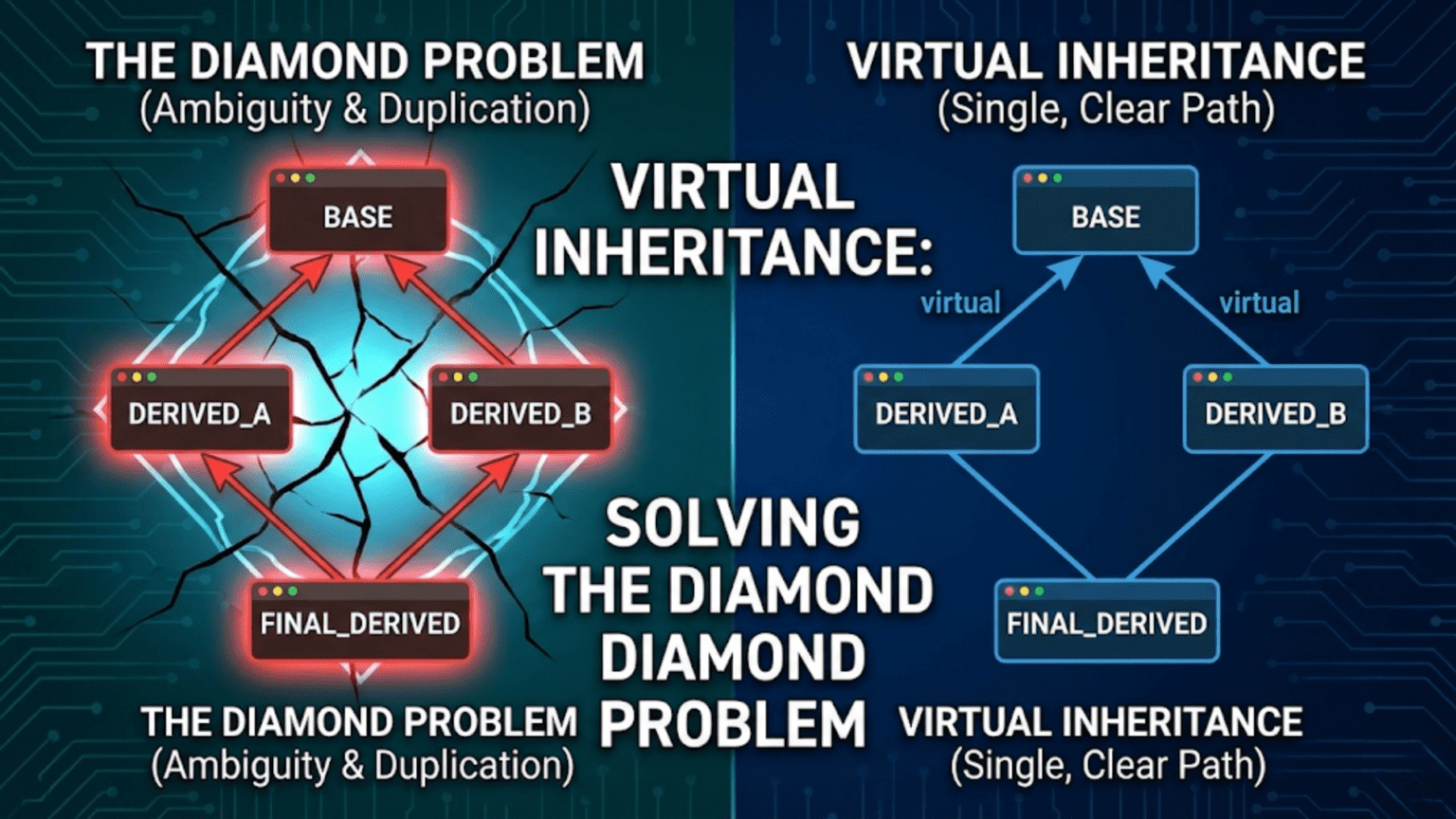
Virtual inheritance in C++ is a mechanism that ensures only one shared instance of a common base class exists in a complex multiple-inheritance hierarchy, even when that base class is inherited through multiple paths. It is the standard solution to the diamond problem, a well-known ambiguity that arises when two classes share the same ancestor and a fourth class inherits from both of them.
Introduction
If you have been working with C++ for any meaningful length of time, you have likely encountered the concept of multiple inheritance — the ability for one class to inherit from two or more parent classes simultaneously. Multiple inheritance is powerful, but it comes with a specific structural hazard called the diamond problem.
The diamond problem is not just a theoretical curiosity. It causes real compilation errors, introduces subtle runtime ambiguity, wastes memory by duplicating base class data, and makes code extremely difficult to reason about. C++ was designed with this problem in mind, and the language provides an elegant, built-in solution: virtual inheritance.
This article takes a deep dive into virtual inheritance. You will understand exactly why the diamond problem occurs by looking at what the compiler generates under the hood, how virtual inheritance restructures the object memory layout to eliminate the duplication, the special constructor rules that come with virtual inheritance, and the trade-offs to keep in mind. Every concept is illustrated with clear, runnable code and step-by-step explanation.
A Quick Review: How the Diamond Problem Forms
To appreciate the solution, you must first fully understand the problem. The diamond problem always arises from the same structural pattern in a class hierarchy.
Imagine you have four classes:
- Class A — the common ancestor (the “top” of the diamond)
- Class B — inherits from A (the left side of the diamond)
- Class C — inherits from A (the right side of the diamond)
- Class D — inherits from both B and C (the “bottom” of the diamond)
Drawn as a hierarchy, this looks like a diamond:
       A
      / \
     B   C
      \ /
DHere is the fundamental question: when D is constructed, how many copies of A’s data does it contain?
Without virtual inheritance, the answer is two: one copy inherited through B, and another inherited through C. These are completely separate, independent copies of A’s sub-object living inside every D object. This is almost never what you want, and it causes a cascade of problems that we will now examine in full detail.
The Diamond Problem: A Complete Demonstration
Let’s build a complete, runnable example that clearly demonstrates every symptom of the diamond problem.
#include <iostream>
#include <string>
using namespace std;

class Vehicle {
public:
    int speed;
    string brand;

    Vehicle(string b, int s) : brand(b), speed(s) {
        cout << "Vehicle constructor: " << brand << endl;
    }

    void describe() {
        cout << "Brand: " << brand << ", Speed: " << speed << " km/h" << endl;
    }
};

class Car : public Vehicle {
public:
    int numDoors;

    Car(string b, int s, int doors)
        : Vehicle(b, s), numDoors(doors) {
        cout << "Car constructor" << endl;
    }
};

class Boat : public Vehicle {
public:
    int hullDepth;

    Boat(string b, int s, int depth)
        : Vehicle(b, s), hullDepth(depth) {
        cout << "Boat constructor" << endl;
    }
};

// AmphibiousVehicle inherits from both Car and Boat
// Both Car and Boat inherit from Vehicle — diamond!
class AmphibiousVehicle : public Car, public Boat {
public:
    AmphibiousVehicle(string b, int s, int doors, int depth)
        : Car(b, s, doors), Boat(b, s, depth) {
        cout << "AmphibiousVehicle constructor" << endl;
    }
};

int main() {
    AmphibiousVehicle amphi("DuckCar", 80, 4, 2);

    // ERROR: ambiguous — which Vehicle's describe() to call?
    // amphi.describe();

    // Works, but calls two separate Vehicle sub-objects
    amphi.Car::describe();
    amphi.Boat::describe();

    // ERROR: ambiguous — two copies of 'speed' exist
    // amphi.speed = 100;

    // Must specify which copy
    amphi.Car::speed = 100;
    amphi.Boat::speed = 60;

    cout << "Car speed: " << amphi.Car::speed << endl;
    cout << "Boat speed: " << amphi.Boat::speed << endl;

    return 0;
}Output:
Vehicle constructor: DuckCar
Car constructor
Vehicle constructor: DuckCar
Boat constructor
AmphibiousVehicle constructor
Car speed: 100
Boat speed: 60Step-by-step explanation:
- When
AmphibiousVehicle amphi(...)is created, the output shows thatVehicle constructoris called twice — once when constructingCar, and once when constructingBoat. This is the clearest sign of the diamond problem: the base class is initialized more than once. - Every
AmphibiousVehicleobject contains two completely independentVehiclesub-objects inside it. One belongs to theCarportion of the object; the other belongs to theBoatportion. - Calling
amphi.describe()produces a compile-time error because the compiler cannot determine whichVehicle::describe()to call — the one accessed throughCaror the one accessed throughBoat. This is the ambiguity problem. - The only way to call
describe()is to explicitly qualify the call:amphi.Car::describe()oramphi.Boat::describe(). This is awkward and fragile. - Similarly,
amphi.speed = 100is ambiguous. You must writeamphi.Car::speed = 100andamphi.Boat::speed = 60to set them separately. But now you have anAmphibiousVehiclewhere the twoVehiclesub-objects have different speeds — a nonsensical situation for a single vehicle. - The duplicate
Vehiclesub-object also wastes memory. EveryAmphibiousVehiclecarries two full copies ofbrand,speed, and anything elseVehiclecontains.
This is the diamond problem in full. Now let’s see exactly how virtual inheritance fixes every one of these issues.
Virtual Inheritance: The Solution
Virtual inheritance tells the C++ compiler: “Even if the class hierarchy creates multiple inheritance paths leading to a common ancestor, that ancestor should have only one shared sub-object in the final derived class.”
The syntax change is small but significant. You add the virtual keyword to the inheritance declarations in the intermediate classes (B and C), not in the final derived class (D).
// Without virtual inheritance (causes diamond problem)
class Car : public Vehicle { };
class Boat : public Vehicle { };

// With virtual inheritance (solves diamond problem)
class Car : public virtual Vehicle { };
class Boat : public virtual Vehicle { };Let’s rewrite the previous example with virtual inheritance:
#include <iostream>
#include <string>
using namespace std;

class Vehicle {
public:
    int speed;
    string brand;

    Vehicle(string b, int s) : brand(b), speed(s) {
        cout << "Vehicle constructor: " << brand << endl;
    }

    void describe() {
        cout << "Brand: " << brand << ", Speed: " << speed << " km/h" << endl;
    }
};

// Note the 'virtual' keyword before Vehicle
class Car : public virtual Vehicle {
public:
    int numDoors;

    Car(string b, int s, int doors)
        : Vehicle(b, s), numDoors(doors) {
        cout << "Car constructor" << endl;
    }
};

// Note the 'virtual' keyword here too
class Boat : public virtual Vehicle {
public:
    int hullDepth;

    Boat(string b, int s, int depth)
        : Vehicle(b, s), hullDepth(depth) {
        cout << "Boat constructor" << endl;
    }
};

// AmphibiousVehicle must now explicitly call Vehicle's constructor
class AmphibiousVehicle : public Car, public Boat {
public:
    AmphibiousVehicle(string b, int s, int doors, int depth)
        : Vehicle(b, s),        // Most-derived class calls virtual base
          Car(b, s, doors),
          Boat(b, s, depth) {
        cout << "AmphibiousVehicle constructor" << endl;
    }
};

int main() {
    AmphibiousVehicle amphi("DuckCar", 80, 4, 2);

    // Now completely unambiguous — only one Vehicle sub-object
    amphi.describe();

    // One speed, one brand — perfectly natural
    amphi.speed = 120;
    amphi.brand = "HydroJet";
    amphi.describe();

    cout << "Doors: " << amphi.numDoors << endl;
    cout << "Hull Depth: " << amphi.hullDepth << endl;

    return 0;
}Output:
Vehicle constructor: DuckCar
Car constructor
Boat constructor
AmphibiousVehicle constructor
Brand: DuckCar, Speed: 80 km/h
Brand: HydroJet, Speed: 120 km/h
Doors: 4
Hull Depth: 2Step-by-step explanation:
- The output now shows
Vehicle constructorcalled only once — the diamond problem’s core symptom is gone. - The
Vehicleconstructor is called first, before eitherCarorBoatconstructors. This is becauseAmphibiousVehicle::AmphibiousVehicleexplicitly callsVehicle(b, s)in its initializer list, and the compiler ensures the virtual base is always initialized before any other base class. amphi.describe()is now completely unambiguous. There is only oneVehiclesub-object, so there is only onedescribe().amphi.speed = 120sets the single, sharedspeedmember.amphi.brand = "HydroJet"updates the single, sharedbrand. No duplication, no inconsistency.amphi.numDoorsandamphi.hullDepthremain accessible from their respective base classes, exactly as before.
Virtual inheritance has resolved every symptom of the diamond problem with a minimal change to the code.
The Most-Derived Class Constructor Rule
The most important behavioral change that virtual inheritance introduces involves constructors. This rule catches many developers off guard, so it deserves careful attention.
The rule: In a virtual inheritance chain, the most-derived (concrete) class is always responsible for directly calling the virtual base class’s constructor. The intermediate classes’ calls to the virtual base constructor are ignored when constructing the most-derived class.
This might sound confusing, so let’s trace through exactly what happens:
#include <iostream>
using namespace std;

class A {
public:
    int value;
    A(int v) : value(v) {
        cout << "A(" << v << ") constructed" << endl;
    }
};

class B : public virtual A {
public:
    B(int v) : A(v * 10) {  // This call to A is ignored when constructing D
        cout << "B constructed, A.value=" << value << endl;
    }
};

class C : public virtual A {
public:
    C(int v) : A(v * 20) {  // This call to A is also ignored when constructing D
        cout << "C constructed, A.value=" << value << endl;
    }
};

class D : public B, public C {
public:
    D(int v) : A(v),   // This is the call that ACTUALLY constructs A
               B(v),
               C(v) {
        cout << "D constructed, A.value=" << value << endl;
    }
};

int main() {
    cout << "--- Constructing D(5) ---" << endl;
    D d(5);

    cout << "\n--- Constructing B(5) standalone ---" << endl;
    B b(5);  // When B is constructed alone, its A(v*10) call DOES execute

    return 0;
}Output:
--- Constructing D(5) ---
A(5) constructed
B constructed, A.value=5
C constructed, A.value=5
D constructed, A.value=5

--- Constructing B(5) standalone ---
A(50) constructed
B constructed, A.value=50Step-by-step explanation:
- When
D d(5)is constructed,D‘s initializer list callsA(v)withv=5, soAis constructed withvalue=5. The output confirms:A(5) constructed. - When
Bis subsequently initialized as part ofD, theA(v * 10)call inB‘s initializer list is completely skipped.Bsimply accesses the already-constructedAsub-object thatDcreated. That’s why the output showsA.value=5, notA.value=50. - The same applies to
C. ItsA(v * 20)call is also ignored.Caccesses the same sharedAsub-object. - When
B b(5)is constructed as a standalone object (not as part of D),Bbecomes the most-derived class. NowB‘sA(v * 10)call does execute, producingA(50) constructed. - This behavior is intentional and consistent: only the most-derived class in any construction chain gets to initialize the virtual base. This prevents the virtual base from being initialized multiple times with potentially conflicting arguments.
Practical implication: If your virtual base class has no default constructor (i.e., it requires arguments), every concrete class that will ever be instantiated in the hierarchy must explicitly call the virtual base’s constructor in its own initializer list. Forgetting this will cause a compilation error if there is no default constructor, or a subtle bug if the default constructor initializes members to wrong values.
Memory Layout: Before and After Virtual Inheritance
Understanding the memory layout of objects with and without virtual inheritance helps explain both the problem and the solution at the deepest level.
Memory Layout Without Virtual Inheritance
Consider a AmphibiousVehicle object without virtual inheritance. Its memory layout looks something like this:
AmphibiousVehicle object:
┌────────────────────────────────┐
│  Car sub-object                │
│  ┌──────────────────────────┐  │
│  │  Vehicle sub-object      │  │  <- First copy of Vehicle
│  │    brand (string)        │  │
│  │    speed (int)           │  │
│  └──────────────────────────┘  │
│  numDoors (int)                │
├────────────────────────────────┤
│  Boat sub-object               │
│  ┌──────────────────────────┐  │
│  │  Vehicle sub-object      │  │  <- Second copy of Vehicle
│  │    brand (string)        │  │
│  │    speed (int)           │  │
│  └──────────────────────────┘  │
│  hullDepth (int)               │
└────────────────────────────────┘Two Vehicle sub-objects, two copies of every Vehicle data member. The total size is larger than necessary, and every access to Vehicle members requires explicit disambiguation.
Memory Layout With Virtual Inheritance
With virtual inheritance, the compiler restructures the object so that the shared base class sub-object appears only once, typically at the end of the object:
AmphibiousVehicle object:
┌────────────────────────────────┐
│  Car sub-object                │
│    vbptr (pointer to vbtable)  │  <- Points to shared Vehicle
│    numDoors (int)              │
├────────────────────────────────┤
│  Boat sub-object               │
│    vbptr (pointer to vbtable)  │  <- Points to shared Vehicle
│    hullDepth (int)             │
├────────────────────────────────┤
│  Vehicle sub-object (shared)   │  <- Single copy, at fixed offset
│    brand (string)              │
│    speed (int)                 │
└────────────────────────────────┘Each intermediate class (Car and Boat) contains a virtual base table pointer (vbptr). This pointer links the intermediate sub-object to the actual location of the shared Vehicle data within the full AmphibiousVehicle object. When Car code accesses brand, it follows the vbptr to find Vehicle. When Boat code accesses brand, it follows its own vbptr to the same location.
This mechanism ensures that both Car and Boat always see — and modify — the same Vehicle data, regardless of their position in the object.
Comparison: Regular vs. Virtual Inheritance Behavior
| Aspect | Regular Inheritance | Virtual Inheritance |
|---|---|---|
| Copies of shared base | One per inheritance path (2 in diamond) | Exactly one, always |
| Base constructor calls | Each intermediate class calls it | Only most-derived class calls it |
| Member access ambiguity | Yes — must qualify with Base::member | No — single copy, no ambiguity |
| Memory overhead per class | None | One extra pointer per virtual base (vbptr) |
| Access speed | Direct (no indirection) | Slight indirection through vbptr |
| Constructor complexity | Simple initializer lists | Most-derived must call virtual base explicitly |
| Use case | All standard single/multiple inheritance | Diamond-shaped hierarchies |
| C++ Standard Library use? | Extensively | iostream hierarchy (basic_ios) |
Virtual Inheritance with Virtual Functions
Virtual inheritance and virtual functions are two separate concepts in C++ (despite sharing the word “virtual”), but they work together seamlessly. When you have virtual functions in a virtual base class, they are dispatched correctly even across complex hierarchies.
#include <iostream>
using namespace std;

class Shape {
public:
    virtual double area() = 0;
    virtual void describe() {
        cout << "Shape with area: " << area() << endl;
    }
    virtual ~Shape() {}
};

class Colored : public virtual Shape {
public:
    string color;
    Colored(string c) : color(c) {}

    void showColor() {
        cout << "Color: " << color << endl;
    }
};

class Sized : public virtual Shape {
public:
    double size;
    Sized(double s) : size(s) {}

    double area() override {
        return size * size;
    }
};

class ColoredSquare : public Colored, public Sized {
public:
    ColoredSquare(string c, double s)
        : Colored(c), Sized(s) {}

    double area() override {
        return size * size;
    }

    void display() {
        cout << color << " square with side " << size << endl;
        describe();   // Calls Shape::describe(), which calls area() polymorphically
        showColor();
    }
};

int main() {
    ColoredSquare cs("Red", 5.0);
    cs.display();

    // Polymorphism through the virtual base interface
    Shape* s = &cs;
    s->describe();

    return 0;
}Output:
Red square with side 5
Shape with area: 25
Color: Red
Shape with area: 25Step-by-step explanation:
Shapeis the virtual base class with a pure virtual functionarea()and a concrete methoddescribe()that callsarea()polymorphically.- Both
ColoredandSizedinherit virtually fromShape. Neither of them can be instantiated on their own because they do not implementarea()completely. ColoredSquareinherits from bothColoredandSized. It provides the final implementation ofarea().- There is only one
Shapesub-object inColoredSquare. The vtable forColoredSquarepoints to its overriddenarea(), so whendescribe()callsarea()through the virtual dispatch mechanism, it correctly resolves toColoredSquare::area(). Shape* s = &csdemonstrates thatColoredSquarecan be treated as aShape. The single virtual base ensures clean, unambiguous polymorphism.- Without virtual inheritance,
cs.describe()would be ambiguous (twoShapesub-objects), and the virtual function dispatch would be unreliable.
Practical Example: A Complete Plugin Architecture
Virtual inheritance is used in real production code, particularly in framework and plugin architectures where objects need to satisfy multiple interfaces while sharing common infrastructure. Here is a more complete example that models a plugin system.
#include <iostream>
#include <string>
#include <vector>
using namespace std;

// Virtual base: all plugins share this common lifecycle
class Plugin {
public:
    string name;
    bool enabled;

    Plugin(string n) : name(n), enabled(false) {
        cout << "Plugin '" << name << "' registered" << endl;
    }

    virtual void initialize() {
        enabled = true;
        cout << "[" << name << "] Initialized" << endl;
    }

    virtual void shutdown() {
        enabled = false;
        cout << "[" << name << "] Shut down" << endl;
    }

    virtual ~Plugin() {}
};

// Audio capability — virtually inherits Plugin
class AudioPlugin : public virtual Plugin {
public:
    int sampleRate;

    AudioPlugin(string n, int rate)
        : Plugin(n), sampleRate(rate) {}

    virtual void playAudio(const string& track) {
        if (enabled) {
            cout << "[" << name << "] Playing: " << track
                 << " at " << sampleRate << "Hz" << endl;
        }
    }
};

// Video capability — virtually inherits Plugin
class VideoPlugin : public virtual Plugin {
public:
    int resolution;

    VideoPlugin(string n, int res)
        : Plugin(n), resolution(res) {}

    virtual void renderFrame() {
        if (enabled) {
            cout << "[" << name << "] Rendering frame at "
                 << resolution << "p" << endl;
        }
    }
};

// Multimedia plugin: combines both capabilities
class MultimediaPlugin : public AudioPlugin, public VideoPlugin {
public:
    MultimediaPlugin(string n, int rate, int res)
        : Plugin(n),                // Most-derived calls virtual base directly
          AudioPlugin(n, rate),
          VideoPlugin(n, res) {}

    void initialize() override {
        Plugin::initialize();       // Calls shared Plugin::initialize once
        cout << "[" << name << "] Multimedia subsystems ready" << endl;
    }
};

int main() {
    MultimediaPlugin media("MediaCore", 44100, 1080);
    media.initialize();

    media.playAudio("symphony.mp3");
    media.renderFrame();
    media.shutdown();

    // Use through base class pointer — polymorphism works cleanly
    Plugin* p = &media;
    cout << "\nPlugin name via base pointer: " << p->name << endl;

    return 0;
}Output:
Plugin 'MediaCore' registered
[MediaCore] Initialized
[MediaCore] Multimedia subsystems ready
[MediaCore] Playing: symphony.mp3 at 44100Hz
[MediaCore] Rendering frame at 1080p
[MediaCore] Shut down

Plugin name via base pointer: MediaCoreStep-by-step explanation:
Pluginis the virtual base class representing the common lifecycle (name,enabled,initialize(),shutdown()). It is shared by all plugin types.AudioPluginandVideoPluginboth inherit virtually fromPlugin. This ensures that any class combining both capabilities has only onePluginsub-object — onename, oneenabledflag, one lifecycle.MultimediaPlugininherits from both. Its constructor explicitly callsPlugin(n)to initialize the single sharedPluginsub-object. TheAudioPlugin(n, rate)andVideoPlugin(n, res)calls are also there, but their internalPlugin(n)calls are ignored by the compiler (as per the virtual base constructor rule).media.initialize()is unambiguous because there is only onePlugininterface. The override inMultimediaPlugincallsPlugin::initialize()once, setsenabled = true, and then adds its own setup message.media.playAudio(...)andmedia.renderFrame()both checkenabled, which is the single sharedPlugin::enabledflag. This is semantically correct — one enable flag for the whole plugin.Plugin* p = &mediademonstrates clean base-class polymorphism.p->nameaccesses the singlenameunambiguously.
This architecture would be deeply broken without virtual inheritance. With it, the design is clean, correct, and extensible.
What Happens When You Forget the Virtual Keyword
A common mistake is adding virtual inheritance to only one of the intermediate classes (B or C) but not both. The diamond problem is only fully solved when both intermediate classes declare virtual inheritance from the common base.
#include <iostream>
using namespace std;

class Base {
public:
    int x;
    Base(int val) : x(val) {}
};

// Only Left uses virtual inheritance
class Left : public virtual Base {
public:
    Left(int val) : Base(val) {}
};

// Right does NOT use virtual inheritance — MISTAKE
class Right : public Base {
public:
    Right(int val) : Base(val) {}
};

class Bottom : public Left, public Right {
public:
    Bottom(int val) : Base(val), Left(val), Right(val) {}
};

int main() {
    Bottom b(10);
    // b.x is still ambiguous because Right carries a non-virtual Base
    b.Left::x = 10;
    b.Right::x = 20;
    cout << "Left::x = " << b.Left::x << endl;
    cout << "Right::x = " << b.Right::x << endl;
    return 0;
}Output:
Left::x = 10
Right::x = 20The ambiguity persists because Right still carries its own independent Base sub-object. For virtual inheritance to fully solve the diamond problem, every path that leads to the common base must declare that inheritance as virtual. Adding virtual to only one path leaves the other path creating its own separate copy.
The rule: If you are creating a diamond-shaped hierarchy intentionally, add public virtual in front of the common base class name in all intermediate classes that participate in the shared path.
Virtual Inheritance and typeid / RTTI
Runtime Type Information (RTTI) — specifically typeid and dynamic_cast — works correctly with virtual inheritance, but there are behaviors worth understanding.
#include <iostream>
#include <typeinfo>
using namespace std;

class Base { public: virtual ~Base() {} };
class Left : public virtual Base {};
class Right : public virtual Base {};
class Bottom : public Left, public Right {};

int main() {
    Bottom b;

    // dynamic_cast works correctly across virtual inheritance
    Left* l = &b;
    Right* r = dynamic_cast<Right*>(l);  // Cross-cast
    Base* base = dynamic_cast<Base*>(l); // Up-cast

    cout << "Left ptr: " << l << endl;
    cout << "Right ptr (cross-cast): " << r << endl;
    cout << "Base ptr (up-cast): " << base << endl;

    // All three point to portions of the same object
    // base, l, r are all valid non-null pointers

    // typeid correctly identifies the actual type
    cout << "Actual type: " << typeid(*l).name() << endl;
    cout << "Actual type via Base*: " << typeid(*base).name() << endl;

    return 0;
}Step-by-step explanation:
dynamic_cast<Right*>(l)performs a cross-cast: starting from aLeft*, it navigates the fullBottomobject and returns a properly adjustedRight*. This works becausedynamic_castuses RTTI to understand the complete object layout, including virtual base class offsets.dynamic_cast<Base*>(l)performs an up-cast to the virtual base. Because there is only oneBasesub-object, this is unambiguous and correct.l,r, andbasemay hold different memory addresses because each points to a different portion of theBottomobject. The vbptrs in the object guide each sub-object to the sharedBasedata.typeid(*l).name()returns the mangled name ofBottom, notLeft. RTTI correctly identifies the actual runtime type of the object through any pointer or reference to it, even through a virtual base class pointer.- Never use C-style casts in multiple inheritance scenarios. A C-style cast from
Left*toRight*would simply reinterpret the pointer value, pointing to the wrong location in memory and causing undefined behavior.
Virtual Inheritance in the C++ Standard Library
The clearest real-world example of virtual inheritance in action is the C++ I/O streams library. The hierarchy was carefully designed to support both input and combined input/output streams without duplicating the shared stream state.
std::ios_base          (raw stream infrastructure)
       |
std::basic_ios<char>   (virtual base: locale, state, buffer link)
      / \
     /   \
std::basic_istream<char>     std::basic_ostream<char>
(both inherit virtually from basic_ios)
      \ /
std::basic_iostream<char> (inherits from both)std::cin is a basic_istream. std::cout is a basic_ostream. std::fstream derives from basic_iostream, which inherits from both basic_istream and basic_ostream. Without virtual inheritance from basic_ios, every fstream object would contain two separate stream states, two separate locale objects, and two separate buffer pointers — a complete mess.
With virtual inheritance, basic_iostream (and therefore fstream) has exactly one shared basic_ios sub-object. Both the input and output sides of the stream share the same buffer, the same locale, and the same error state flags. This is not just a design nicety — it is an absolute requirement for a stream that must both read and write the same buffer coherently.
The fact that the standard library itself relies on virtual inheritance validates the feature and demonstrates how to use it correctly in production code.
Common Mistakes and How to Avoid Them
Mistake 1: Adding virtual Only on One Side
As demonstrated earlier, virtual inheritance only works when all intermediate classes use it. If even one class inherits from the common base non-virtually, a separate copy is created for that branch, and the ambiguity persists.
Fix: When designing a diamond hierarchy intentionally, audit every intermediate class and confirm that all paths to the shared base use virtual inheritance.
Mistake 2: Relying on Intermediate Classes to Initialize the Virtual Base
If class D : public B, public C and B and C both virtually inherit from A, then D must call A‘s constructor directly. If A requires arguments and D omits the explicit A(...) call in its initializer list, A‘s default constructor is used — or you get a compilation error if no default constructor exists.
// BAD: D forgets to call A's constructor
class D : public B, public C {
public:
    D(int v) : B(v), C(v) {}  // A is default-constructed — may be wrong
};

// GOOD: D explicitly calls A's constructor
class D : public B, public C {
public:
    D(int v) : A(v), B(v), C(v) {}  // A is correctly initialized
};Mistake 3: Using Virtual Inheritance Everywhere “Just in Case”
Virtual inheritance carries overhead: each class that virtually inherits gains a hidden vbptr, object layout is more complex, and accessing virtual base members requires an extra pointer dereference. Apply virtual inheritance only when the diamond problem is a real concern in your design.
Mistake 4: Using C-Style Casts with Multiple Inheritance
When multiple base classes are involved, different base class sub-objects reside at different offsets within the derived object. A C-style cast or reinterpret_cast blindly reinterprets a pointer without adjusting for these offsets, leading to pointers that point to the wrong location and corrupted data. Always use dynamic_cast for downcasts and cross-casts in hierarchies with multiple or virtual inheritance.
Mistake 5: Declaring a Non-Virtual Destructor in a Virtual Base Class
If your virtual base class has virtual functions (making it polymorphic), its destructor must also be virtual. Deleting a derived object through a base class pointer with a non-virtual destructor is undefined behavior in C++.
// BAD
class Base {
public:
    virtual void doSomething() {}
    ~Base() {}  // Non-virtual destructor — undefined behavior on polymorphic delete
};

// GOOD
class Base {
public:
    virtual void doSomething() {}
    virtual ~Base() {}  // Virtual destructor — correct
};When to Use Virtual Inheritance: A Decision Guide
Virtual inheritance is the right tool when your class hierarchy has these characteristics:
Use virtual inheritance when:
- You have a genuine diamond-shaped class hierarchy where the same base class is inherited through two or more paths.
- The shared base class represents shared identity or shared state (a single concept that should exist once per object).
- You are designing a framework or library hierarchy where external users will extend classes and may create diamonds unintentionally.
- You need clean polymorphism through the shared base (as in the plugin architecture example).
Do not use virtual inheritance when:
- Your hierarchy has no diamond shape. Virtual inheritance adds complexity and overhead with no benefit in flat or tree-shaped hierarchies.
- You are using mixins (small, stateless classes that add behavior). Mixins rarely share a common base, so the diamond problem does not arise.
- You want to avoid the complexity of the most-derived class constructor rule and can redesign the hierarchy to remove the diamond.
- Performance is critical in inner loops and you need to eliminate every possible pointer indirection.
In many practical situations, the best response to a diamond hierarchy is to question whether the design is correct in the first place. Can the common base be eliminated? Can composition replace inheritance? Can an interface (pure abstract class) replace the concrete base class? If after this analysis the diamond hierarchy is truly the right model, virtual inheritance is the correct and well-supported solution.
Conclusion
Virtual inheritance is one of C++’s most specialized features, existing precisely to solve one well-defined problem: the diamond problem in multiple inheritance hierarchies. When a class hierarchy forms a diamond shape — where two paths from a most-derived class converge on the same ancestor — regular inheritance silently creates multiple copies of that ancestor, causing ambiguity, wasted memory, and inconsistent state.
Virtual inheritance solves this by ensuring that only one shared instance of the common base exists within any derived object, no matter how many inheritance paths lead to it. The mechanism works through virtual base table pointers (vbptrs) that guide each sub-object to the single shared base, and it integrates cleanly with the rest of C++’s object model including virtual functions, RTTI, and dynamic_cast.
The key rules to remember are: add virtual before the base class name in every intermediate class that participates in the diamond; always have the most-derived concrete class explicitly call the virtual base class constructor; and use dynamic_cast instead of C-style casts when navigating complex pointer relationships.
Used correctly, virtual inheritance is a precise, powerful tool that enables clean, correct designs for genuinely complex relationships — as demonstrated by its presence in the C++ standard library’s own I/O streams hierarchy.