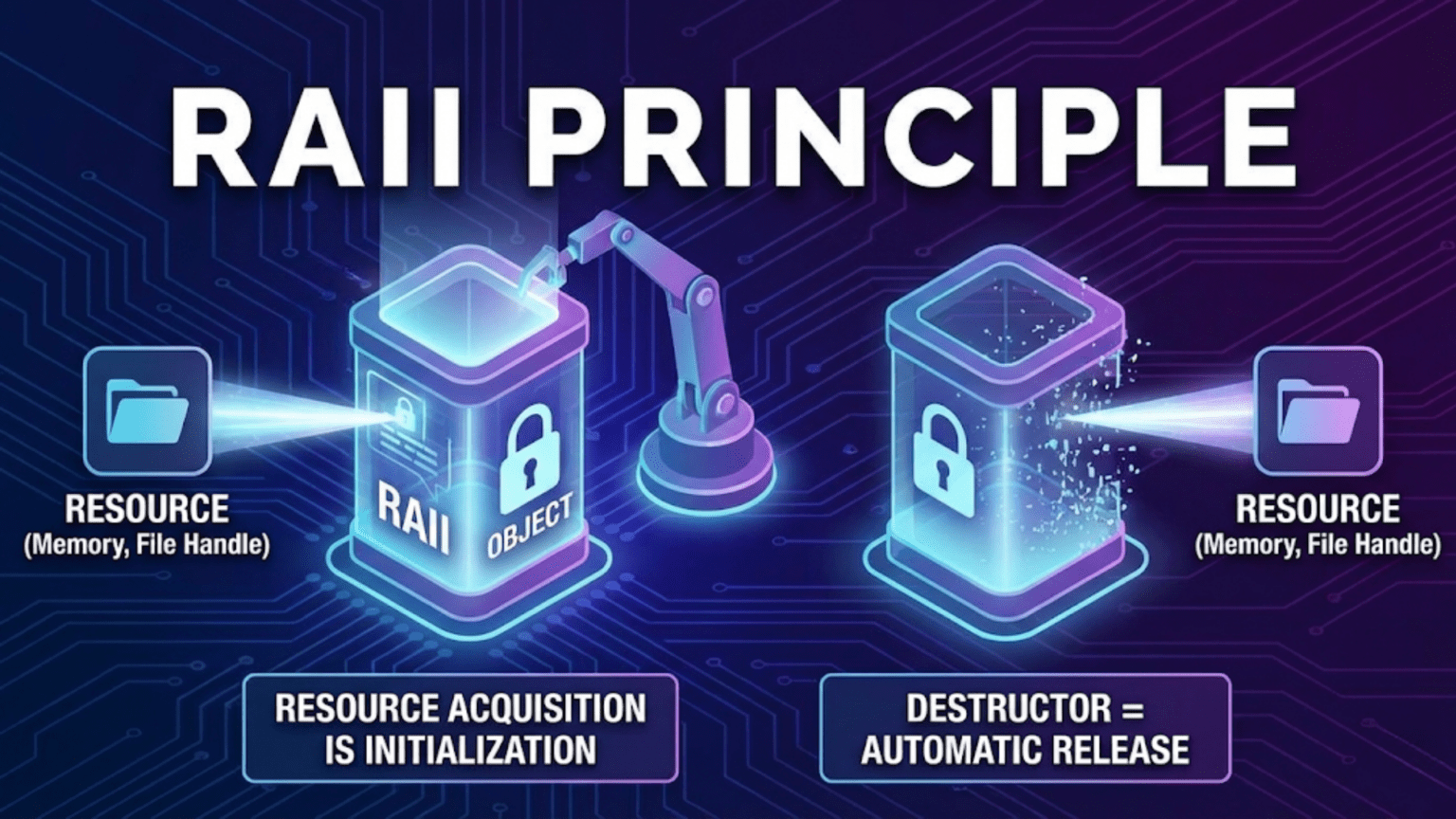
RAII (Resource Acquisition Is Initialization) is a fundamental C++ programming principle where the lifetime of a resource — such as heap memory, a file handle, a network socket, or a mutex lock — is tied directly to the lifetime of an object. The resource is acquired in the object’s constructor and released in its destructor, guaranteeing cleanup regardless of how the code exits — including through exceptions. RAII is the foundation of safe, leak-free C++ programming.
Introduction
If you have ever written C code — or C++ code without any guiding principles — you have encountered the manual resource management pattern: allocate a resource, use it, and remember to free it before every possible exit point. In a simple function with one exit, this is manageable. In a real program with multiple return statements, nested conditionals, and exception handling, guaranteeing that every resource is always released is extraordinarily difficult.
This is not a hypothetical problem. Memory leaks, file descriptor exhaustion, deadlocks from unreleased mutexes, and corrupted state from partially constructed objects are among the most common and costly bugs in production C++ software. They are notoriously difficult to reproduce and debug.
RAII — Resource Acquisition Is Initialization — is the C++ idiom that eliminates this class of bugs by design. It is not a library, not a compiler feature, and not a complex pattern. It is a discipline: wrap your resource in a class, acquire it in the constructor, and release it in the destructor. From that point forward, the C++ object lifetime rules guarantee cleanup automatically.
RAII is the principle behind std::unique_ptr, std::lock_guard, std::fstream, std::vector, and virtually every resource-managing class in the C++ standard library. Understanding RAII deeply is not optional for C++ developers — it is foundational.
This article walks you through RAII from first principles. You will see the exact problem it solves, learn how to design RAII classes for different kinds of resources, explore real-world examples, understand the relationship between RAII and exception safety, and learn the rules that make RAII wrappers correct and safe.
The Problem RAII Solves
Before exploring the solution, it is worth examining the problem in its full complexity. Resource management without RAII is fragile in ways that are easy to overlook.
The Basic Case: A Leak Waiting to Happen
#include <iostream>
#include <stdexcept>
using namespace std;

void processData(bool shouldFail) {
    // Manual resource management
    int* data = new int[1000];               // Acquire resource
    FILE* file = fopen("output.txt", "w");   // Acquire another resource

    cout << "Processing..." << endl;

    if (shouldFail) {
        // Early exit — must manually release EVERYTHING
        delete[] data;
        if (file) fclose(file);
        throw runtime_error("Processing failed");
        // Easy to forget one of these!
    }

    // Normal processing
    for (int i = 0; i < 1000; i++) data[i] = i;
    fputs("Done\n", file);

    // Must release at the end too
    delete[] data;
    if (file) fclose(file);
    cout << "Done." << endl;
}

int main() {
    try {
        processData(false);
        processData(true);
    } catch (const exception& e) {
        cout << "Caught: " << e.what() << endl;
    }
    return 0;
}Step-by-step explanation of the problems:
- There are two resources: a heap-allocated array and a file handle. Every exit path — the early
if (shouldFail)branch, any futurereturnstatements, any exceptions thrown by called functions — must release both resources in the correct order. - If a developer adds a new early return path and forgets to release
file, the file descriptor leaks. If they forgetdelete[] data, memory leaks. If the cleanup order is wrong, subtle bugs appear. - The problem compounds with more resources. A function managing five resources has a combinatorial explosion of exit paths, each requiring careful cleanup.
- Exception safety is the hardest part. If some call between the allocations throws unexpectedly, the cleanup code is never reached and both resources leak.
This is the fragility RAII eliminates entirely.
The Core Idea: Objects Own Resources
RAII reframes the problem. Instead of thinking “I must remember to call fclose before every return,” you think “the file handle is owned by an object, and the object’s destructor calls fclose.”
In C++, when a local object goes out of scope — for any reason, including exceptions, early returns, or normal end-of-scope — its destructor is called. This is a language guarantee. RAII exploits this guarantee by putting cleanup logic in destructors.
The two rules of RAII are:
- Acquire the resource in the constructor. The object is only valid if the resource was successfully acquired. If acquisition fails, throw an exception from the constructor.
- Release the resource in the destructor. The destructor must perform all cleanup, unconditionally.
Once you follow these rules, you never write explicit cleanup code in function bodies again. The language handles it.
Your First RAII Class: A Heap Array Wrapper
Let’s build a simple RAII wrapper for a heap-allocated array to see the pattern in its purest form.
#include <iostream>
#include <stdexcept>
using namespace std;

class HeapArray {
public:
    // Constructor: acquire the resource
    explicit HeapArray(size_t size) : size_(size), data_(new int[size]) {
        cout << "HeapArray: allocated " << size << " integers" << endl;
    }

    // Destructor: release the resource — ALWAYS runs
    ~HeapArray() {
        delete[] data_;
        cout << "HeapArray: freed memory" << endl;
    }

    // Provide access to the managed resource
    int& operator[](size_t index) {
        if (index >= size_) throw out_of_range("Index out of bounds");
        return data_[index];
    }

    size_t size() const { return size_; }

    // Disable copying to prevent double-free
    HeapArray(const HeapArray&) = delete;
    HeapArray& operator=(const HeapArray&) = delete;

private:
    size_t size_;
    int*   data_;
};

void processData(bool shouldFail) {
    HeapArray data(1000);  // Resource acquired here

    cout << "Processing..." << endl;

    if (shouldFail) {
        throw runtime_error("Processing failed");
        // data's destructor runs automatically — no leak!
    }

    for (size_t i = 0; i < data.size(); i++) data[i] = static_cast<int>(i);
    cout << "First: " << data[0] << ", Last: " << data[999] << endl;

    // No delete needed — data's destructor handles it
}

int main() {
    cout << "--- Normal execution ---" << endl;
    processData(false);

    cout << "\n--- Exception path ---" << endl;
    try {
        processData(true);
    } catch (const exception& e) {
        cout << "Caught: " << e.what() << endl;
    }
    return 0;
}Output:
--- Normal execution ---
HeapArray: allocated 1000 integers
Processing...
First: 0, Last: 999
HeapArray: freed memory

--- Exception path ---
HeapArray: allocated 1000 integers
Processing...
HeapArray: freed memory
Caught: Processing failedStep-by-step explanation:
- The
HeapArrayconstructor callsnew int[size], acquiring the heap memory. Ifnewthrows (e.g.,std::bad_allocdue to insufficient memory), the object was never fully constructed — no destructor is called, and no resource was acquired. - The destructor calls
delete[] data_unconditionally. It runs whetherprocessDataexits normally or via an exception. - In the exception path, “HeapArray: freed memory” appears before “Caught: Processing failed”. The destructor runs during stack unwinding, before the
catchblock executes. - The copy constructor and copy assignment operator are deleted (
= delete) to prevent twoHeapArrayobjects from owning the same pointer. If both were destroyed, the pointer would be freed twice — causing undefined behavior. processDatanow contains zero cleanup code. The cleanup is automatic, complete, and correct regardless of the exit path.
RAII for File Handles
The standard library’s std::fstream is a perfect RAII wrapper for file handles, but building one yourself makes the pattern concrete.
#include <iostream>
#include <stdexcept>
#include <string>
#include <cstdio>
using namespace std;

class FileHandle {
public:
    // Constructor: open the file (acquire resource)
    FileHandle(const string& filename, const string& mode) {
        file_ = fopen(filename.c_str(), mode.c_str());
        if (!file_) {
            throw runtime_error("Failed to open file: " + filename);
        }
        cout << "File opened: " << filename << endl;
    }

    // Destructor: close the file (release resource)
    ~FileHandle() {
        if (file_) {
            fclose(file_);
            cout << "File closed" << endl;
        }
    }

    void write(const string& text) {
        if (fputs(text.c_str(), file_) == EOF) {
            throw runtime_error("Write failed");
        }
    }

    FILE* get() const { return file_; }

    // Non-copyable
    FileHandle(const FileHandle&) = delete;
    FileHandle& operator=(const FileHandle&) = delete;

private:
    FILE* file_;
};

void writeReport(const string& filename, bool simulateError) {
    FileHandle file(filename, "w");  // File opened here

    file.write("Report Header\n");
    file.write("=============\n");

    if (simulateError) {
        throw runtime_error("Disk full!");
        // File is STILL properly closed by FileHandle's destructor
    }

    file.write("Report Body\n");
    file.write("Report Footer\n");
    cout << "Report written successfully" << endl;
    // File closed automatically at end of scope
}

int main() {
    cout << "--- Writing full report ---" << endl;
    writeReport("report.txt", false);

    cout << "\n--- Simulating disk error ---" << endl;
    try {
        writeReport("partial.txt", true);
    } catch (const exception& e) {
        cout << "Caught: " << e.what() << endl;
    }
    return 0;
}Output:
--- Writing full report ---
File opened: report.txt
Report written successfully
File closed

--- Simulating disk error ---
File opened: partial.txt
File closed
Caught: Disk full!Step-by-step explanation:
FileHandle‘s constructor callsfopen. If it returnsnullptr, the constructor throws an exception, ensuring aFileHandleis always in a valid, open state after construction — or it does not exist at all.- The destructor calls
fclose(file_). Theif (file_)check is defensive; in normal usefile_is always valid after construction. - In the simulated error path, “File closed” appears before “Caught: Disk full!” The file is closed during stack unwinding, before the catch block. Leaving a file open wastes OS file descriptors and can block other processes.
- This
FileHandleclass is essentially whatstd::fstreamdoes internally, butfstreamprovides buffered I/O, seeking, and much more.
RAII for Mutexes: Lock Guards
One of the most critical applications of RAII in concurrent programming is ensuring mutexes are always unlocked, even when exceptions occur. A mutex left locked causes a deadlock — often one of the hardest bugs to diagnose in multithreaded software.
#include <iostream>
#include <mutex>
#include <stdexcept>
using namespace std;

// Custom RAII lock guard (demonstrates the pattern; use std::lock_guard in practice)
class LockGuard {
public:
    explicit LockGuard(mutex& m) : mutex_(m) {
        mutex_.lock();
        cout << "Mutex locked" << endl;
    }

    ~LockGuard() {
        mutex_.unlock();
        cout << "Mutex unlocked" << endl;
    }

    LockGuard(const LockGuard&) = delete;
    LockGuard& operator=(const LockGuard&) = delete;

private:
    mutex& mutex_;
};

mutex sharedMutex;
int sharedCounter = 0;

void incrementCounter(bool shouldThrow) {
    LockGuard lock(sharedMutex);  // Mutex locked here

    sharedCounter++;
    cout << "Counter: " << sharedCounter << endl;

    if (shouldThrow) {
        throw runtime_error("Error in critical section");
        // LockGuard destructor still runs — mutex is unlocked!
    }

    cout << "Critical section complete" << endl;
    // Mutex unlocked here when lock goes out of scope
}

int main() {
    cout << "--- Normal increment ---" << endl;
    incrementCounter(false);

    cout << "\n--- Increment with exception ---" << endl;
    try {
        incrementCounter(true);
    } catch (const exception& e) {
        cout << "Caught: " << e.what() << endl;
    }

    cout << "\n--- Another increment (would deadlock without RAII) ---" << endl;
    incrementCounter(false);
    return 0;
}Output:
--- Normal increment ---
Mutex locked
Counter: 1
Critical section complete
Mutex unlocked

--- Increment with exception ---
Mutex locked
Counter: 2
Mutex unlocked
Caught: Error in critical section

--- Another increment (would deadlock without RAII) ---
Mutex locked
Counter: 3
Critical section complete
Mutex unlockedStep-by-step explanation:
LockGuard‘s constructor callsmutex_.lock(). The destructor callsmutex_.unlock(). Since the destructor always runs whenLockGuardgoes out of scope, the mutex is always unlocked.- In the exception case, “Mutex unlocked” appears before “Caught”, confirming the mutex was released during stack unwinding. Without RAII, the exception path would leave the mutex permanently locked, causing every subsequent call to block forever.
- After the exception, the third call succeeds immediately because the mutex was properly released. This demonstrates the safety RAII provides in concurrent code.
- The C++ standard library provides
std::lock_guard<std::mutex>(exactly this pattern) andstd::unique_lock<std::mutex>for more flexible lock management. Always prefer these standard types.
RAII and Object Lifetime: The Destructor Contract
RAII relies on one fundamental C++ guarantee: local objects are always destroyed when they go out of scope, in reverse construction order. This guarantee holds in four key situations:
Normal scope exit — when execution reaches the closing brace } of a block, all local objects in that block are destroyed.
return statements — when a function returns, all local objects in the function scope are destroyed before control transfers to the caller.
Exception propagation — when an exception propagates up the call stack, C++ performs stack unwinding: it destroys all local objects in each stack frame, in reverse construction order. This is the most important guarantee for RAII.
Program exit — when main() returns, all objects with automatic storage duration are destroyed normally.
#include <iostream>
using namespace std;

class Tracker {
    string name_;
public:
    Tracker(string name) : name_(name) {
        cout << name_ << " constructed" << endl;
    }
    ~Tracker() {
        cout << name_ << " destroyed" << endl;
    }
};

void demonstrate() {
    Tracker a("A");
    {
        Tracker b("B");
        Tracker c("C");
        cout << "Inside inner scope" << endl;
    }  // C destroyed first, then B (reverse order)
    Tracker d("D");
    cout << "About to return" << endl;
}  // D destroyed first, then A (reverse order)

int main() {
    demonstrate();
    return 0;
}Output:
A constructed
B constructed
C constructed
Inside inner scope
C destroyed
B destroyed
D constructed
About to return
D destroyed
A destroyedStep-by-step explanation:
- Objects are constructed in order:
A, thenB, thenC. - When the inner scope ends,
CandBare destroyed in reverse order —Cfirst, thenB.Ais not yet destroyed because it lives in the outer scope. Dis constructed after the inner scope.- When
demonstrate()returns,DandAare destroyed in reverse construction order:Dfirst, thenA. - This reverse-order destruction is critical. If
Bcreates a resource thatCdepends on, destroyingCbeforeBensuresCcan safely access the resource during its cleanup.
RAII and Multiple Resources: Correct Ordering
When a class manages multiple resources, the order of acquisition and release matters. C++ member variables are initialized in the order they are declared, and destroyed in reverse order — making the behavior predictable and safe by design.
#include <iostream>
#include <string>
using namespace std;

class DatabaseSession {
public:
    DatabaseSession(const string& host, int port, const string& dbName)
        : connection_(host, port),       // Initialized first
          transaction_(connection_),     // Initialized second (depends on connection_)
          logger_(dbName)                // Initialized third
    {
        cout << "DatabaseSession fully initialized" << endl;
    }

    ~DatabaseSession() {
        cout << "DatabaseSession shutting down" << endl;
        // Members destroyed in reverse order: logger_, transaction_, connection_
    }

    void executeQuery(const string& sql) {
        logger_.log("Executing: " + sql);
        transaction_.execute(sql);
    }

private:
    struct Connection {
        Connection(const string& host, int port) {
            cout << "Connected to " << host << ":" << port << endl;
        }
        ~Connection() { cout << "Disconnected from database" << endl; }
    };

    struct Transaction {
        Transaction(Connection& /*conn*/) {
            cout << "Transaction started" << endl;
        }
        ~Transaction() { cout << "Transaction committed/rolled back" << endl; }
        void execute(const string& sql) {
            cout << "  -> Executed: " << sql << endl;
        }
    };

    struct Logger {
        Logger(const string& db) {
            cout << "Logger started for database: " << db << endl;
        }
        ~Logger() { cout << "Logger closed" << endl; }
        void log(const string& msg) { cout << "[LOG] " << msg << endl; }
    };

    Connection   connection_;   // Must outlive transaction_
    Transaction  transaction_;  // Depends on connection_
    Logger       logger_;       // Independent
};

int main() {
    {
        DatabaseSession session("db.example.com", 5432, "production");
        session.executeQuery("SELECT * FROM users");
        session.executeQuery("UPDATE orders SET status='shipped'");
        cout << "Session work complete" << endl;
    }  // All resources released here, in correct reverse order
    cout << "All cleaned up" << endl;
    return 0;
}Output:
Connected to db.example.com:5432
Transaction started
Logger started for database: production
DatabaseSession fully initialized
[LOG] Executing: SELECT * FROM users
  -> Executed: SELECT * FROM users
[LOG] Executing: UPDATE orders SET status='shipped'
  -> Executed: UPDATE orders SET status='shipped'
Session work complete
DatabaseSession shutting down
Logger closed
Transaction committed/rolled back
Disconnected from database
All cleaned upStep-by-step explanation:
- Member variables are initialized in declaration order:
connection_first,transaction_second (taking a reference toconnection_),logger_third. - When the
DatabaseSessionobject is destroyed, the destructor body runs first (printing “DatabaseSession shutting down”), then members are destroyed in reverse declaration order:logger_first,transaction_second,connection_last. - This order is correct:
logger_has no dependencies,transaction_may needconnection_alive to commit, andconnection_is closed last. - All of this ordering is automatic — you write no ordering logic. C++’s object lifetime rules enforce it based purely on declaration order.
Exception Safety and RAII: The Three Guarantees
RAII is the foundation of exception-safe C++ code. Exception safety is described in terms of three formal guarantees:
The basic guarantee means that if an operation throws, no resources are leaked and all objects remain in a valid (though possibly changed) state. RAII automatically provides this guarantee for all managed resources.
The strong guarantee means that if an operation throws, the program state is identical to what it was before the operation began — commit-or-rollback semantics. Achieving this typically requires the copy-and-swap technique.
The no-throw guarantee (noexcept) means an operation never throws under any circumstances. Destructors in particular must always provide this guarantee.
#include <iostream>
#include <vector>
#include <string>
#include <stdexcept>
using namespace std;

class Configuration {
public:
    vector<string> settings;

    // Strong guarantee: either all settings are loaded, or state is unchanged
    void loadSettings(const vector<string>& newSettings) {
        vector<string> temp = settings;  // Work on a copy

        for (const string& s : newSettings) {
            if (s.empty()) {
                throw invalid_argument("Empty setting not allowed");
                // 'settings' was never modified — strong guarantee!
            }
            temp.push_back(s);
        }

        // Only commit if no exception was thrown
        settings = move(temp);  // noexcept move — safe commit
    }

    void print() const {
        cout << "Settings (" << settings.size() << "): ";
        for (const auto& s : settings) cout << s << " ";
        cout << endl;
    }
};

int main() {
    Configuration config;
    config.settings = {"debug=true", "level=3"};

    cout << "Initial:"; config.print();

    config.loadSettings({"timeout=30", "retry=3"});
    cout << "After success:"; config.print();

    try {
        config.loadSettings({"valid=yes", "", "another=no"});
    } catch (const exception& e) {
        cout << "Load failed: " << e.what() << endl;
    }

    cout << "After failure (unchanged):"; config.print();
    return 0;
}Output:
Initial:Settings (2): debug=true level=3
After success:Settings (4): debug=true level=3 timeout=30 retry=3
Load failed: Empty setting not allowed
After failure (unchanged):Settings (4): debug=true level=3 timeout=30 retry=3Step-by-step explanation:
loadSettingsmodifies atempcopy of the settings. All validation and modification happen on the copy.- If an exception is thrown (empty string encountered), the function exits before modifying the actual
settingsmember. Thetempcopy is destroyed automatically by RAII, andsettingsis exactly as it was. - Only after successful validation does the function commit by moving
tempintosettings.std::moveon avectorisnoexcept, so the commit step itself cannot throw. - This copy-then-move pattern is the standard technique for achieving the strong exception safety guarantee.
RAII for Custom Resources: A Network Socket Example
RAII applies to any resource that requires explicit acquisition and release. Here is a practical example wrapping a network socket.
#include <iostream>
#include <stdexcept>
#include <string>
using namespace std;

// Simulated socket API
namespace SocketAPI {
    int createSocket(const string& host, int port) {
        cout << "Socket: connecting to " << host << ":" << port << endl;
        return 42;  // Simulated socket descriptor
    }
    void destroySocket(int fd) {
        cout << "Socket: closing descriptor " << fd << endl;
    }
    void sendData(int fd, const string& data) {
        cout << "Socket[" << fd << "]: sending '" << data << "'" << endl;
    }
    string receiveData(int fd) {
        cout << "Socket[" << fd << "]: receiving data" << endl;
        return "HTTP/1.1 200 OK";
    }
}

class TcpSocket {
public:
    TcpSocket(const string& host, int port) : host_(host), port_(port) {
        fd_ = SocketAPI::createSocket(host, port);
        if (fd_ < 0) throw runtime_error("Failed to connect to " + host);
    }

    ~TcpSocket() noexcept {
        if (fd_ >= 0) SocketAPI::destroySocket(fd_);
    }

    void send(const string& data) { SocketAPI::sendData(fd_, data); }
    string receive() { return SocketAPI::receiveData(fd_); }

    // Non-copyable
    TcpSocket(const TcpSocket&) = delete;
    TcpSocket& operator=(const TcpSocket&) = delete;

    // Movable
    TcpSocket(TcpSocket&& other) noexcept
        : fd_(other.fd_), host_(move(other.host_)), port_(other.port_) {
        other.fd_ = -1;  // Invalidate the moved-from socket
    }

private:
    int fd_;
    string host_;
    int port_;
};

string fetchWebPage(const string& host, const string& path) {
    TcpSocket socket(host, 80);  // Connected here

    socket.send("GET " + path + " HTTP/1.1\r\nHost: " + host + "\r\n\r\n");
    string response = socket.receive();

    if (response.empty()) {
        throw runtime_error("Empty response from server");
        // Socket still properly closed!
    }

    return response;
    // Socket closed automatically at end of scope
}

int main() {
    cout << "--- Fetching page ---" << endl;
    try {
        string response = fetchWebPage("example.com", "/index.html");
        cout << "Response: " << response << endl;
    } catch (const exception& e) {
        cout << "Error: " << e.what() << endl;
    }
    cout << "\n--- All sockets properly closed ---" << endl;
    return 0;
}Output:
--- Fetching page ---
Socket: connecting to example.com:80
Socket[42]: sending 'GET /index.html HTTP/1.1
Host: example.com

'
Socket[42]: receiving data
Socket: closing descriptor 42
Response: HTTP/1.1 200 OK

--- All sockets properly closed ---Step-by-step explanation:
TcpSocket‘s constructor callsSocketAPI::createSocket. If this fails, it throws, preventing a partially-constructed socket from existing.- The destructor is marked
noexcept— destructors must never throw. If a destructor throws during stack unwinding (while another exception propagates),std::terminate()is called. Marking destructorsnoexceptprevents this catastrophic scenario. - The move constructor transfers the socket file descriptor and invalidates the source by setting
fd_ = -1. The destructor checksfd_ >= 0before closing, so the moved-from object is safely destructed without closing an invalid descriptor. fetchWebPagecreates aTcpSocket, uses it, and returns. The socket is automatically closed when the function exits, in both the normal and exception paths.
RAII in the Standard Library
Once you understand RAII, you will recognize it throughout the C++ standard library. Every resource-managing type follows this pattern.
| Standard Library Type | Resource Managed | Acquired In | Released In |
|---|---|---|---|
std::vector, std::string | Heap memory | Constructor / push_back | Destructor |
std::fstream, std::ifstream | File descriptor | Constructor / open() | Destructor / close() |
std::lock_guard<mutex> | Mutex lock | Constructor | Destructor |
std::unique_lock<mutex> | Mutex lock (flexible) | Constructor | Destructor |
std::unique_ptr<T> | Heap object (exclusive) | Constructor | Destructor |
std::shared_ptr<T> | Heap object (shared) | Constructor | Destructor (when count = 0) |
std::thread | OS thread handle | Constructor | join() or detach() |
std::jthread (C++20) | OS thread handle | Constructor | Destructor (auto-joins) |
These are not coincidences — they are deliberate design choices. The standard library is built on RAII because RAII is the correct and idiomatic way to manage resources in C++.
Design Guidelines for RAII Classes
Building correct RAII classes requires following the Rule of Five. If a class needs a custom destructor, you must carefully consider all five special member functions:
class Buffer {
public:
    explicit Buffer(size_t size)
        : size_(size), data_(new char[size]) {}

    // 1. Destructor
    ~Buffer() { delete[] data_; }

    // 2. Copy constructor (deep copy)
    Buffer(const Buffer& other)
        : size_(other.size_), data_(new char[other.size_]) {
        copy(other.data_, other.data_ + other.size_, data_);
    }

    // 3. Copy assignment (deep copy, handle self-assignment)
    Buffer& operator=(const Buffer& other) {
        if (this != &other) {
            delete[] data_;
            size_ = other.size_;
            data_ = new char[size_];
            copy(other.data_, other.data_ + other.size_, data_);
        }
        return *this;
    }

    // 4. Move constructor (transfer ownership, nullify source)
    Buffer(Buffer&& other) noexcept
        : size_(other.size_), data_(other.data_) {
        other.size_ = 0;
        other.data_ = nullptr;
    }

    // 5. Move assignment (transfer, release old, nullify source)
    Buffer& operator=(Buffer&& other) noexcept {
        if (this != &other) {
            delete[] data_;
            size_ = other.size_;
            data_ = other.data_;
            other.size_ = 0;
            other.data_ = nullptr;
        }
        return *this;
    }

private:
    size_t size_;
    char*  data_;
};Key guidelines to follow:
Make destructors noexcept. Destructors must not throw exceptions. Mark them noexcept explicitly to communicate this intent and allow the compiler to enforce it.
Prefer non-copyable RAII classes when deep copying is expensive or semantically wrong. Deleting the copy constructor and assignment operator forces all users to move or share ownership intentionally.
Always null-out the source after a move. The move constructor and move assignment must leave the source in a valid, destructible state — typically by setting raw pointers to nullptr and sizes to zero.
Check for self-assignment in copy/move assignment operators. Though rare, a = a must be a no-op, not a use-after-free bug.
Use the copy-and-swap idiom for strong exception safety in assignment operators. Create a copy, swap with *this, and let the old value be destroyed via the copy’s destructor.
RAII vs. Manual Resource Management: A Direct Comparison
Consider a function that opens a database connection, begins a transaction, executes a query, and commits — with proper error handling at each step.
Without RAII (manual management):
void updateDatabase_manual() {
    Connection* conn = openConnection();
    if (!conn) return;

    Transaction* txn = beginTransaction(conn);
    if (!txn) {
        closeConnection(conn);
        return;
    }

    bool ok = executeQuery(txn, "UPDATE ...");
    if (!ok) {
        rollbackTransaction(txn);
        closeConnection(conn);
        return;
    }

    commitTransaction(txn);
    closeConnection(conn);
    // What if executeQuery throws instead of returning false?
    // Every cleanup path must be written manually — fragile and verbose
}With RAII:
void updateDatabase_raii() {
    auto conn = make_unique<Connection>();      // Connects in constructor
    auto txn  = make_unique<Transaction>(*conn); // Begins in constructor

    executeQuery(*txn, "UPDATE ...");  // May throw — handled automatically

    txn->commit();  // Explicit commit before txn goes out of scope
    // conn and txn both cleaned up automatically, in correct order
}The RAII version is shorter, clearer, and correct by construction. There are no explicit cleanup calls. Every resource is guaranteed to be released. Exception safety is automatic. The business logic is expressed directly without cleanup clutter.
Common RAII Mistakes to Avoid
Mistake 1: Constructing an RAII wrapper around an already-managed pointer.
auto p = make_unique<Widget>();
unique_ptr<Widget> p2(p.get()); // BAD: two owners, double-free!Never construct a second smart pointer from a raw pointer obtained via .get(). The first smart pointer still owns the object and will delete it.
Mistake 2: Returning raw pointers from RAII classes carelessly.
class Pool {
public:
    Widget* allocate() { return data_.data(); }  // Exposes raw pointer
private:
    vector<Widget> data_;
};
// If Pool is destroyed, the returned raw pointer becomes danglingRaw pointers returned from RAII classes must not outlive the RAII wrapper. Consider returning references, smart pointers, or handles that keep the wrapper alive.
Mistake 3: Throwing from a destructor.
If a destructor throws while another exception is already propagating during stack unwinding, std::terminate() is called immediately — killing the entire program. Always make destructors noexcept. If cleanup can fail, log the error but do not throw from the destructor.
Mistake 4: Relying on RAII for global objects.
RAII guarantees cleanup when an object goes out of scope. Global (static storage) objects are destroyed when the program exits, but the destruction order of globals across translation units is unspecified. For global resources, explicit initialization and shutdown functions are safer.
Mistake 5: Storing raw pointers in containers instead of RAII wrappers.
vector<Widget*> widgets;             // BAD: no automatic cleanup
widgets.push_back(new Widget());

vector<unique_ptr<Widget>> widgets;  // GOOD: automatic cleanup
widgets.push_back(make_unique<Widget>());Always store owning pointers in containers as smart pointers. A vector of raw pointers is a memory leak waiting to happen, especially if the vector is cleared or an exception occurs during insertion.
Conclusion
RAII is not just a technique — it is a philosophy that shapes how C++ programs are structured from the ground up. By binding resource lifetimes to object lifetimes, RAII transforms the unpredictable problem of manual resource management into a predictable, automatic, and verifiable process.
The principle is simple: acquire in the constructor, release in the destructor. The consequences are profound: memory leaks become impossible by design, file handles are always closed, mutexes are always unlocked, and exception safety becomes the default rather than an extra effort.
Every great C++ codebase is built on RAII. Every standard library container, every smart pointer, every stream, every lock guard — all of them are RAII wrappers. When you design your own classes that manage resources, RAII is not optional boilerplate. It is the difference between code that works correctly under all conditions and code that works correctly most of the time.
Once you internalize RAII, you will rarely think about resource management explicitly anymore. You express ownership through types, trust the destructor, and let the language do the cleanup. That is the power of writing C++ the way it was designed to be written.