Skild AI Raises $1.4 Billion to Power the Universal Robot Revolution
Pittsburgh-based robotics startup Skild AI announced on January 14, 2026, that it has secured close to $1.4 billion in new funding, catapulting the company’s valuation to over $14 billion—more than triple its $4.5 billion valuation from just seven months ago. The funding round, led by Japanese technology conglomerate SoftBank Group, represents one of the largest investments in robotics artificial intelligence to date and signals a fundamental shift in how the industry approaches autonomous machines.
The funding round attracted an impressive roster of global investors, including NVentures (Nvidia’s venture capital arm), Macquarie Capital, Jeff Bezos through Bezos Expeditions, Disruptive, and 1789 Capital. Existing investors Lightspeed, Felicis, Coatue, and Sequoia Capital doubled down on their positions, demonstrating continued confidence in Skild AI’s vision. Strategic corporate investors also joined the round, including Samsung, LG Technology Ventures, Schneider Electric, CommonSpirit Health, and Salesforce Ventures, alongside TF Capital, Andra Capital, Palo Alto Growth Capital, KIC, Alpha Square, Mirae Asset, and Destiny.
The Skild Brain: One Intelligence, Any Robot
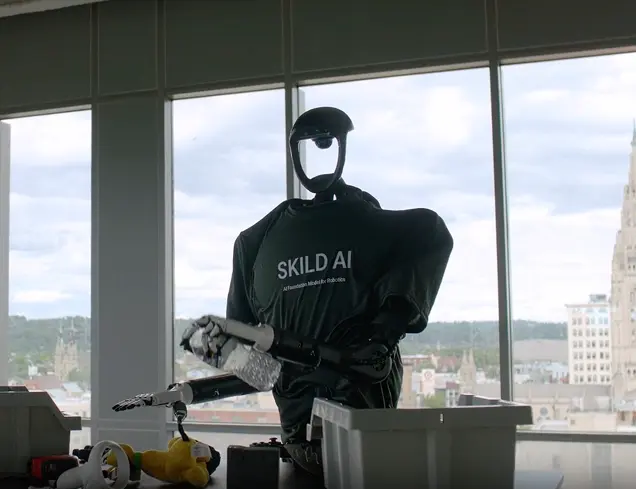
At the heart of Skild AI’s technology is the Skild Brain, which the company describes as the industry’s first unified robotics foundation model. Unlike traditional robotics AI that must be customized for each specific robot design and task, the Skild Brain is “omni-bodied”—it can control any robot without prior knowledge of their exact physical form, whether they’re quadrupeds, humanoids, tabletop arms, or mobile manipulators.
This versatility represents a radical departure from conventional robotics development, where engineers typically spend months or years training individual robots for specific tasks in controlled environments. The Skild Brain enables robots to handle everything from simple household chores like cleaning, loading dishwashers, and cooking eggs to physically demanding challenges such as navigating slippery terrain, climbing stairs, or adapting to payload changes.
“The Skild Brain can control robots it has never trained on, adapting in real time to extreme changes in form or environments. The model is forced to adapt rather than memorize—much like intelligence in nature,” said Deepak Pathak, CEO and co-founder of Skild AI. “We believe that a unified, omni-bodied brain is the fastest way to establish a continuous data flywheel where the model gets better with every single deployment, no matter what the hardware or task.”
Solving Robotics’ Data Problem
One of the biggest challenges in building a robotics foundation model is that, unlike language or video models that can train on vast amounts of internet data, there is no “internet of robotics” to draw from. Skild AI addresses this fundamental limitation through an innovative training approach: the Skild Brain learns by watching human videos on the internet and practicing in physics-based simulations.
By observing how humans move and interact with objects in millions of videos, combined with extensive practice in virtual environments that simulate real-world physics, the Skild Brain builds generalized physical intuition. This approach vastly expands the available training set compared to traditional methods that rely solely on robot-generated data from constrained laboratory settings.
The company’s breakthrough innovation is in-context learning, which allows the Skild Brain to adapt on the fly when introduced to new environments or robot bodies. When the model encounters a situation where its actions fail—such as a jammed wheel, a lost limb, increased payload, or an entirely new robot body—it adjusts behavior based on live experience without requiring retraining or fine-tuning. This resilience makes the technology practical for deployment in unpredictable, unstructured real-world environments where traditional robots struggle.
From Zero to $30 Million in Months
Skild AI isn’t just a research project—the company scaled from zero to approximately $30 million in revenue within just a few months in 2025, demonstrating real commercial traction. The company is currently deploying its technology across diverse enterprise applications, including security patrols, facility inspection, warehouses, manufacturing floors, data centers, and construction sites.
Quadruped platforms powered by Skild Brain automate inspection and surveillance tasks, while mobile manipulation systems enable enterprises to build robotics applications as easily as making an API call. This ease of integration has attracted over 200 original equipment manufacturers (OEMs) who are now engaged in development and integration of Skild AI’s technology.
The company plans to use its new capital to continue scaling model training and expanding commercial deployments. While enterprise applications are the initial focus, Skild AI has ambitious long-term plans to bring advanced robotics into consumer homes, where robots could assist with daily tasks ranging from household chores to eldercare support.
Industry Validation and Strategic Importance
“Skild AI is building foundational technology for Physical AI across robots, tasks, and environments,” said Dennis Chang, managing partner at SoftBank Investment Advisers. “We’re proud to partner with Deepak, Abhinav, and the Skild AI team to bring that shared vision into real-world applications worldwide.”
Rita Waite, partner at IQT (In-Q-Tel, a strategic investor focused on national security applications), emphasized the dual significance of the technology: “Solving intelligence for the physical world unlocks enormous commercial value and long-term strategic national importance. Skild AI is uniquely positioned to do both, and we’re excited to be working with this team as they build.”
The company was founded in 2023 by Deepak Pathak and Abhinav Gupta, who left their positions as professors at Carnegie Mellon University to commercialize over two decades of research in self-supervised and adaptive robotics. Their academic backgrounds in machine learning and robotic perception provide the scientific foundation for Skild AI’s technology.
The Broader Robotics Funding Landscape
Skild AI’s massive funding round comes during a banner year for robotics investment. Overall, robotics startups raised $13.8 billion in funding in 2025, up from $7.8 billion in 2024 and even surpassing the $13.1 billion raised during the peak venture funding year of 2021. This resurgence reflects growing confidence that robotics technology has matured enough for widespread commercial deployment.
Other companies pursuing similar universal robotics platforms include Field AI, which is developing easily adaptable robotic software, and 1X, the maker of humanoid robot Neo, which recently released a world model pursuing the same goal of learning-as-you-go capabilities.
As SoftBank CEO Masayoshi Son has repeatedly emphasized in recent years, he believes artificial intelligence for physical robots represents the next major technology platform after smartphones and cloud computing. With Skild AI’s technology now moving from concept to commercial reality, that vision appears increasingly within reach. The company’s ability to triple its valuation in seven months while generating significant revenue demonstrates that investors agree—the age of truly intelligent, adaptable robots may finally be arriving.