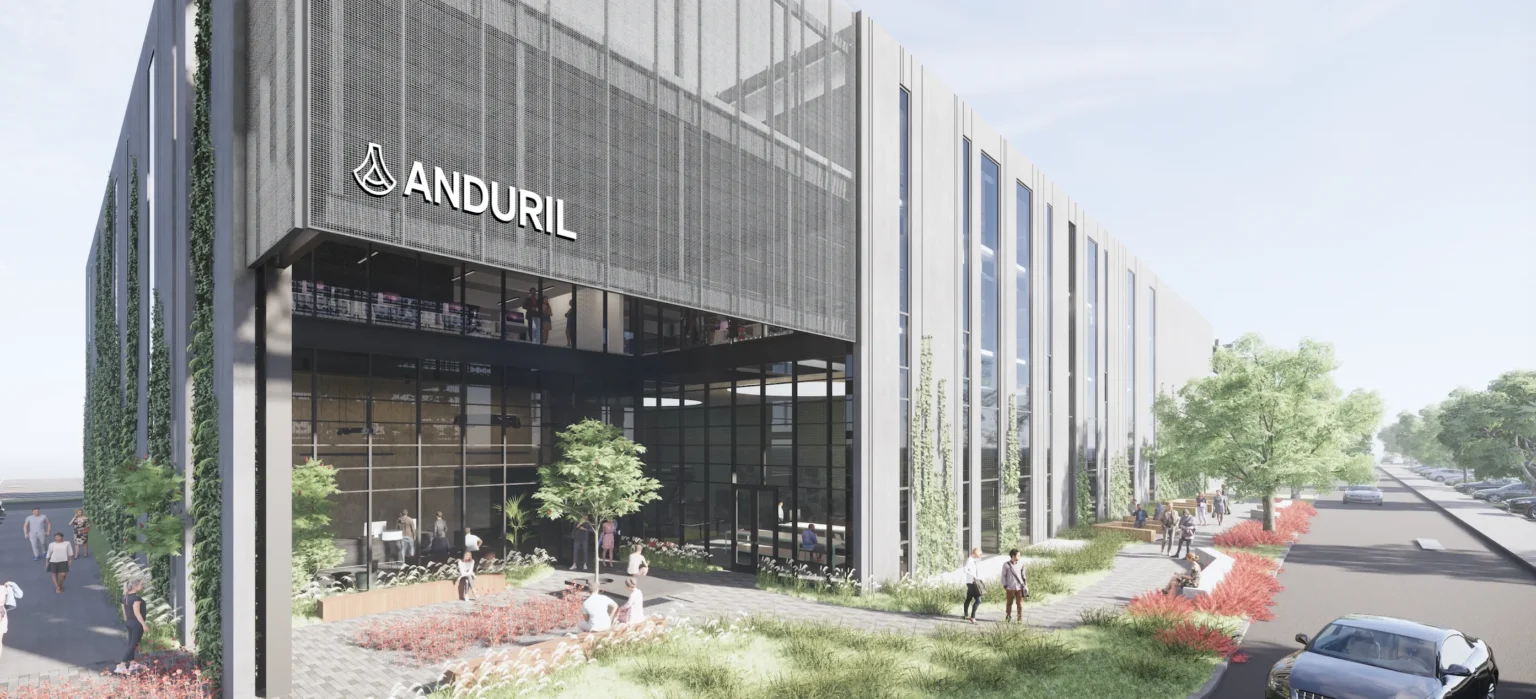
Anduril Industries, the defense technology startup founded by Oculus creator Palmer Luckey in 2017, announced plans on January 23, 2026, for a major investment in a new Long Beach, California campus that will significantly expand the company’s manufacturing capabilities for autonomous defense systems. The facility expansion reinforces Southern California’s re-emergence as a hub for aerospace and defense innovation while highlighting the defense technology sector’s evolution from niche market to major pillar of the venture capital ecosystem.
The Long Beach site will focus on advanced systems development and manufacturing, adding substantial employment to the region while providing Anduril with the physical capacity to scale production of its autonomous weapons platforms, surveillance systems, and AI-powered defense technologies. Though specific investment amounts and square footage were not immediately disclosed, sources familiar with the planning describe the campus as one of Anduril’s most significant infrastructure projects to date, comparable in scope to major facilities operated by traditional defense contractors.
Anduril’s expansion reflects broader transformations in how the United States military acquires technology. Traditional defense procurement follows extended timelines measured in decades, with requirements frozen years before delivery and limited flexibility for incorporating emerging technologies. Companies like Anduril promise a different model: rapid iteration, software-centric systems that can be updated over time, and development cycles measured in months rather than years. This “commercial technology” approach appeals to military leaders seeking to counter adversaries who may adapt faster than traditional acquisition processes allow.
The company has developed a diverse portfolio of defense products since its founding. The Anvil drone is designed for counter-unmanned aerial systems missions, autonomously detecting and neutralizing hostile drones. Lattice is an AI-powered sensor fusion system that integrates data from multiple sources to provide comprehensive battlefield awareness. The company has also developed autonomous underwater vehicles, ground robots, and surveillance towers deployed along the U.S.-Mexico border. More recently, Anduril secured contracts for collaborative autonomous aircraft that work alongside manned fighters.
Southern California’s defense and aerospace heritage provides advantages for Anduril’s expansion. The region hosts major military installations including Naval Base San Diego, Marine Corps Base Camp Pendleton, and multiple Air Force and Space Force facilities. Local universities produce aerospace engineering graduates, and the ecosystem includes suppliers, manufacturers, and service providers experienced in defense work. Long Beach specifically has deep aerospace roots as a former site for Douglas Aircraft Company, McDonnell Douglas, and Boeing commercial aircraft production before the latter’s departure in 2015.
The investment timing coincides with significantly increased interest in defense technology from venture capital investors traditionally focused on consumer internet and enterprise software. Multiple factors drive this shift: geopolitical tensions with China and Russia creating defense spending tailwinds, recognition that autonomous systems represent genuine technological disruption, demonstration that defense startups can achieve substantial valuations (Anduril itself is valued above $10 billion), and government willingness to contract with non-traditional vendors.
Major institutional investors have backed Anduril through multiple funding rounds totaling billions of dollars. This capital has funded both technology development and manufacturing infrastructure—unusual for venture-backed companies that typically avoid capital-intensive operations. Defense production, however, requires physical facilities to assemble, test, and deliver systems, making infrastructure investments unavoidable. The Long Beach campus represents Anduril’s bet that demand for its products justifies large-scale manufacturing capacity.
The facility will need to navigate challenges distinct from software operations. Defense manufacturing involves stringent quality controls, security requirements for handling classified information, export controls governing technology and data access, and regulatory compliance for everything from environmental permits to workplace safety. Successfully scaling physical production while maintaining the innovation culture of a startup requires organizational capabilities that many venture-backed companies lack.
Anduril’s products increasingly incorporate artificial intelligence as a core capability rather than a supplementary feature. Autonomous systems must perceive environments, make decisions, and execute actions with minimal human intervention—tasks where AI excels. However, deploying AI in defense applications raises questions about accountability, reliability under adversarial conditions, and the appropriate level of human oversight for lethal autonomous weapons. These ethical and operational questions attract ongoing debate among policymakers, military leaders, and ethicists.
The company’s growth also reflects changing Department of Defense acquisition strategies explicitly designed to engage startups and commercial technology companies. Programs like the Defense Innovation Unit, AFWERX (Air Force), NavalX (Navy), and Army Applications Laboratory provide pathways for non-traditional vendors to contract with military services. These organizations use streamlined procurement authorities enabling faster decisions than traditional acquisition processes. Anduril has successfully navigated these channels to secure hundreds of millions in contracts.
Competition in the defense technology sector is intensifying as success stories like Anduril attract imitators and established defense contractors develop internal innovation groups. Companies including Shield AI, Saronic, and others pursue autonomous systems markets, while traditional contractors like Lockheed Martin, Northrop Grumman, and Raytheon invest in similar capabilities. The question is whether startups’ cultural and structural advantages outweigh incumbents’ experience, existing relationships, and production infrastructure.
International competition provides additional context for Anduril’s expansion. China, Russia, Iran, and other nations actively develop autonomous weapons systems, creating pressure for U.S. military capabilities to match or exceed potential adversary technologies. Autonomous underwater vehicles, loitering munitions, and AI-powered surveillance represent areas where peer competitors have demonstrated sophisticated capabilities. Maintaining technological overmatch requires continued innovation and production capacity for advanced systems.
The Long Beach facility’s workforce requirements include specialized talent in robotics, AI, mechanical engineering, software development, manufacturing, and program management. Recruiting and retaining such employees in competitive Southern California labor markets requires competitive compensation, compelling missions, and organizational culture that attracts talented engineers. Anduril’s emphasis on cutting-edge technology and rapid development cycles helps differentiate it from traditional defense contractors sometimes perceived as bureaucratic and slow-moving.
Looking ahead, the facility’s success will depend on Anduril converting development contracts into sustained production programs generating predictable revenue. Defense procurement often includes initial “development” phases followed by larger “production” phases—but many programs never reach full-scale production due to budget constraints, requirement changes, or technical problems. Anduril’s manufacturing investment makes sense only if the company expects significant production volumes justifying the infrastructure.
The broader defense technology ecosystem’s maturation reflects recognition that software and autonomy are transforming warfare as fundamentally as previous revolutions in tanks, aircraft, and nuclear weapons. Nations that successfully field AI-powered systems at scale may gain decisive advantages in future conflicts. This strategic imperative drives both government investment in domestic capabilities and export controls limiting adversary access to key technologies.
For Long Beach specifically, Anduril’s campus brings high-quality jobs in advanced manufacturing and technology development—economic benefits that regional leaders enthusiastically support. The facility may catalyze additional aerospace investment in the area, potentially creating a cluster of defense technology companies and suppliers around Anduril’s presence. Such clustering effects often characterize successful industrial districts where proximity enables knowledge sharing, labor mobility, and supply chain efficiency.
Anduril’s expansion from a startup operating out of temporary facilities to a company building major manufacturing campuses illustrates defense technology’s evolution from niche market to significant industry sector. The Long Beach investment, expected to come online progressively through 2026 and 2027, represents both a bet on Anduril’s specific products and a broader validation that autonomous defense systems represent the future of military capability. Whether this vision proves correct will be determined by battlefield effectiveness, budget priorities, and the company’s ability to deliver on ambitious promises of rapid innovation at production scale.