If you’ve been exploring artificial intelligence, you’ve probably encountered three terms that seem to be used interchangeably: artificial intelligence, machine learning, and deep learning. Sometimes they appear to mean the same thing. Other times, they’re clearly different. News articles might describe a system as “AI-powered,” while technical documentation calls the same technology “deep learning.” This confusion isn’t just semantic, understanding the relationship between these concepts is fundamental to grasping how modern AI actually works.
In this article, we’ll untangle these terms, showing you exactly how they relate to each other, what makes each one distinct, and why the differences matter. By the end, you’ll be able to confidently understand what people mean when they use these terms and recognize which technologies power the AI applications you encounter daily.
The Big Picture: How These Concepts Nest Together
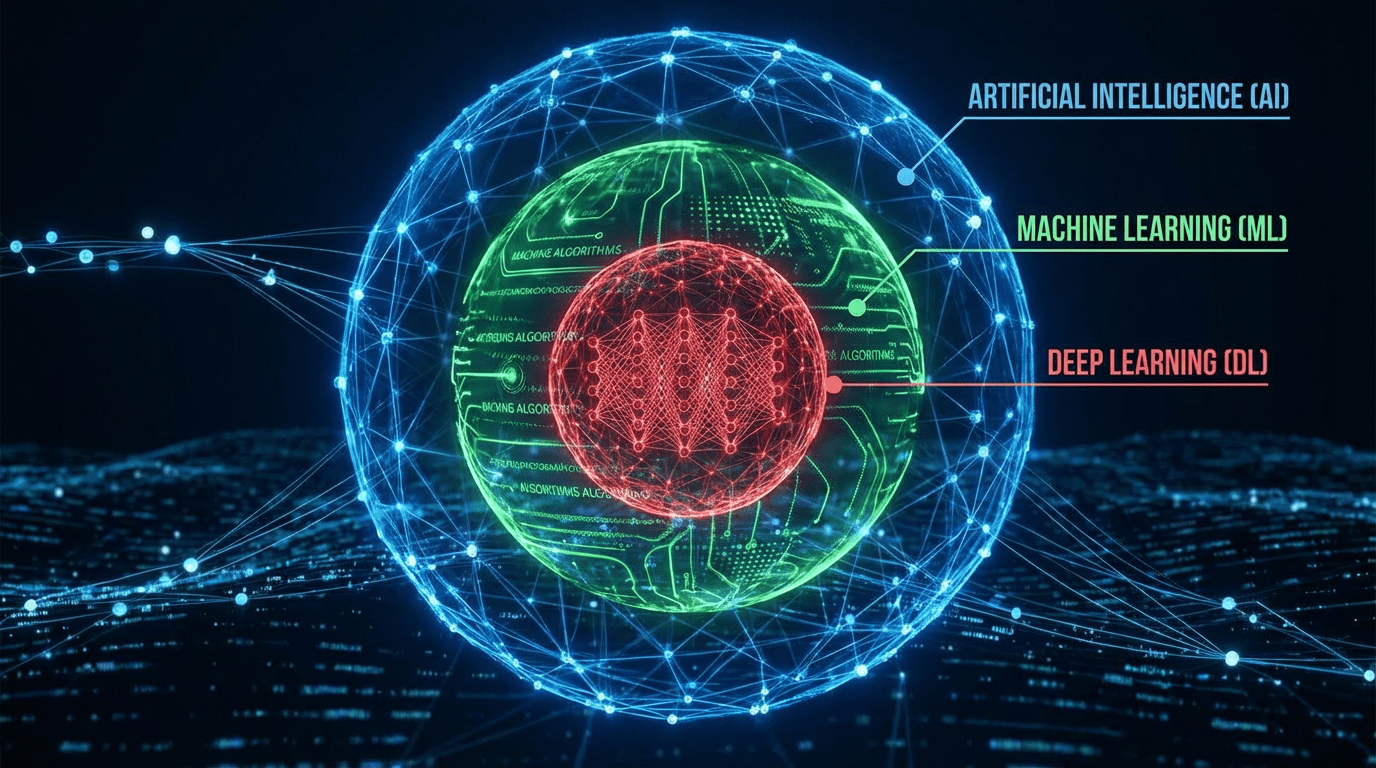
Before diving into details, let’s establish the relationship between these three concepts with a simple visual metaphor. Imagine three concentric circles, like a target at an archery range.
The outermost circle is artificial intelligence, the broadest concept, encompassing any technique that enables computers to mimic human intelligence. This includes everything from simple rule-based systems to the most sophisticated neural networks. If a computer system can perform a task that would require intelligence if a human did it, we’re in the realm of AI.
The middle circle is machine learning, a subset of AI focused specifically on systems that learn from data rather than following explicitly programmed rules. Not all AI uses machine learning (some AI systems follow hand-crafted rules), but all machine learning is a form of AI. Machine learning represents a particular approach to achieving artificial intelligence: teaching computers to learn patterns from examples.
The innermost circle is deep learning, a specialized subset of machine learning that uses neural networks with many layers to learn hierarchical representations of data. All deep learning is machine learning, and all machine learning is AI, but the reverse isn’t true. Deep learning represents a specific set of techniques within the broader machine learning toolkit.
This nested relationship is crucial to understand. When someone talks about deep learning, they’re talking about a specific approach that falls under machine learning, which in turn falls under the umbrella of artificial intelligence. Each layer adds specificity, narrowing the focus to particular methods and techniques.
Artificial Intelligence: The Broad Umbrella
Let’s start with the outermost circle: artificial intelligence itself. As we discussed in earlier articles, AI refers to computer systems designed to perform tasks that typically require human intelligence. This is an incredibly broad definition, and intentionally so.
AI includes many different approaches and philosophies. Some AI systems use carefully crafted rules written by human experts. These rule-based systems, also called symbolic AI or good old-fashioned AI (GOFAI), dominated the field for decades. If you’ve ever used a system that follows a decision tree—answering a series of yes/no questions to reach a conclusion—you’ve interacted with rule-based AI. These systems demonstrate intelligence in the sense that they solve problems and make decisions, but they don’t learn from experience.
AI also includes search algorithms that explore possible solutions to find optimal or near-optimal answers. When a GPS system calculates the best route to your destination, considering traffic, distance, and road types, it’s using AI techniques. The system demonstrates intelligence by solving a complex optimization problem, even though it’s not learning or using neural networks.
Game-playing AI can use various approaches. Some early chess programs relied primarily on searching through possible moves and evaluating positions using hand-crafted evaluation functions. This is AI, but it’s not machine learning in the modern sense. The program demonstrates intelligence through strategic thinking, even though its knowledge comes from human programmers rather than from learning patterns in data.
Expert systems, which we discussed in the history article, are another form of AI. These systems encode human expertise as a set of rules. They demonstrate intelligence by making specialized decisions and recommendations, but they don’t learn from new data without human intervention to update their rules.
Even simple techniques like spam filters based on keyword matching or recommendation systems using basic statistical correlations fall under the AI umbrella. If a system shows behavior that would require intelligence in a human—recognizing patterns, making decisions, solving problems, understanding language—it qualifies as artificial intelligence, regardless of the specific techniques it uses.
The key characteristic of AI is the end result: intelligent behavior. The methods used to achieve that behavior can vary enormously. This is why AI is such a broad field, encompassing everything from simple rule-based systems to sophisticated neural networks that can engage in natural conversation.
Machine Learning: Teaching Computers to Learn
Now let’s narrow our focus to the middle circle: machine learning. This represents a fundamental shift in how we approach artificial intelligence.
The defining characteristic of machine learning is learning from data. Instead of a human programmer explicitly coding rules for every situation, a machine learning system examines examples and discovers patterns on its own. The system improves its performance through experience, much like humans learn from practice and exposure.
To understand machine learning, imagine teaching a child to recognize different types of animals. You don’t give the child a comprehensive list of rules like “if it has four legs and fur and barks, it’s a dog.” Instead, you show the child many examples: “This is a dog. This is a cat. This is a horse.” The child gradually learns to distinguish animals by recognizing patterns in the examples they’ve seen. When they encounter a new dog they’ve never seen before, they can identify it as a dog because it shares characteristics with the dogs they’ve learned about.
Machine learning works similarly. You provide the system with training data—examples of inputs paired with desired outputs. For instance, if you’re building a spam detector, you’d provide thousands of emails, each labeled as spam or not spam. The machine learning algorithm examines these examples, identifying patterns that distinguish spam from legitimate email. Once trained, the system can classify new emails it has never seen before.
This learning-based approach offers powerful advantages over rule-based systems. First, it can handle complexity and nuance that would be nearly impossible to capture with explicit rules. How would you write rules to recognize handwritten digits when everyone writes slightly differently? A machine learning system can learn these variations from examples. Second, machine learning systems can adapt to new situations as long as those situations are similar to what they’ve seen in their training data. Third, they can discover patterns that humans might not notice or articulate.
Machine learning encompasses many different algorithms and approaches. Decision trees learn hierarchical rules from data. Support vector machines find optimal boundaries between different categories. Random forests combine multiple decision trees for better performance. K-means clustering groups similar data points together without being told what the groups should be. These algorithms vary in their mathematical foundations and the types of problems they solve best, but they all share the core principle: learning from data rather than following fixed rules.
Machine learning also divides into different paradigms based on how systems learn. In supervised learning, you provide labeled examples showing the correct answer for each input. In unsupervised learning, the system finds patterns in data without being given specific answers to learn. In reinforcement learning, the system learns by trying different actions and receiving rewards or penalties based on the results.
The crucial distinction between machine learning and other forms of AI is this learning component. If a system adjusts its behavior based on data and improves its performance through experience, it’s machine learning. If it follows fixed rules that don’t change based on data, it’s AI but not machine learning.
Deep Learning: Neural Networks Go Deep
Now we arrive at the innermost circle: deep learning. This is where things get particularly interesting and where much of the recent excitement around AI has focused.
Deep learning is a specific approach within machine learning that uses neural networks—computational models loosely inspired by how neurons in biological brains connect and process information. What makes it “deep” is that these neural networks have many layers, allowing them to learn hierarchical representations of data.
To understand what this means, let’s think about how you recognize a face. You don’t process the entire face as one unified pattern. Instead, your visual system processes information hierarchically. Low-level neurons detect simple features like edges and contrasts. Mid-level neurons combine these into more complex patterns like curves and corners. Higher-level neurons recognize facial features like eyes, noses, and mouths. Even higher levels combine these features to recognize specific faces. This hierarchical processing happens automatically and unconsciously, but it’s fundamental to how you perceive the world.
Deep learning neural networks work similarly. In a deep network for image recognition, the first layer might learn to detect edges at various angles. The second layer might combine these edges into simple shapes. The third layer might recognize textures and patterns. Later layers might identify parts of objects—wheels, windows, doors. The deepest layers combine all this information to recognize complete objects—cars, buildings, animals.
The word “deep” refers specifically to having many of these layers. A “shallow” neural network might have just two or three layers. A deep neural network might have dozens or even hundreds of layers, each building on the representations learned by previous layers. This depth allows deep learning systems to automatically learn complex, abstract representations from raw data.
This automatic feature learning is what makes deep learning so powerful. In traditional machine learning, human engineers often spent enormous effort on feature engineering—deciding which aspects of the data the system should pay attention to. For image recognition, they might manually design filters to detect specific patterns or textures. For speech recognition, they might design features based on acoustic properties. This required deep domain expertise and considerable trial and error.
Deep learning systems learn these features automatically. You provide raw data—pixels for images, sound waves for audio, words for text—and the network learns which patterns matter for the task at hand. This not only saves human effort but often results in better performance, as the network can discover useful patterns that humans might not have thought to look for.
Deep learning has proven remarkably effective across many domains. In computer vision, deep convolutional neural networks have achieved superhuman performance in recognizing objects in images. In natural language processing, deep networks can understand context and meaning in text. In speech recognition, they can transcribe spoken words with impressive accuracy. In game playing, deep reinforcement learning systems have mastered complex games like Go and StarCraft.
However, deep learning isn’t a magic solution to every problem. It requires large amounts of training data—often millions of examples. It demands substantial computational resources, particularly for training. The learned representations can be difficult to interpret, making these systems somewhat “black boxes.” And while deep learning excels at pattern recognition, it struggles with tasks requiring reasoning, common sense, or understanding of causality.
Key Differences: Side-by-Side Comparison
Let’s solidify your understanding by directly comparing these concepts across several dimensions.
Scope and Breadth:
- AI is the broadest concept, encompassing any technique for creating intelligent behavior in machines
- Machine learning is a subset of AI focused on learning from data
- Deep learning is a subset of machine learning using multi-layered neural networks
How They Work:
- AI systems might use rules, search algorithms, logic, statistical methods, or learning—any approach that produces intelligent behavior
- Machine learning systems specifically learn patterns from data, adjusting internal parameters to improve performance
- Deep learning systems learn hierarchical representations through multiple layers of neural networks
Knowledge Source:
- AI systems in general might get their knowledge from human programmers, from learning, or from a combination
- Machine learning systems derive their knowledge primarily from training data
- Deep learning systems automatically learn feature representations from raw data, requiring minimal human feature engineering
Data Requirements:
- AI systems in general have varying data needs—some need no data at all (rule-based systems), others need modest amounts
- Machine learning typically requires hundreds to thousands of training examples
- Deep learning often requires millions of training examples to perform well
Computational Demands:
- AI systems in general range from computationally trivial to demanding
- Machine learning requires moderate computational resources, particularly for training
- Deep learning demands significant computational resources, especially for training large networks
Interpretability:
- AI systems vary in interpretability—rule-based systems are highly transparent, while some learning systems are opaque
- Machine learning systems vary in interpretability depending on the algorithm—decision trees are interpretable, while ensemble methods are less so
- Deep learning systems are typically difficult to interpret, functioning as complex black boxes
Historical Development:
- AI as a field began in the 1950s, encompassing many different approaches over the decades
- Machine learning emerged as a distinct paradigm in the 1980s-1990s, though earlier work existed
- Deep learning achieved breakthrough success in the 2010s, though neural networks date back decades
Practical Examples: Seeing the Differences
Let’s make these distinctions concrete with examples showing how different AI approaches might solve the same problem.
Example 1: Email Spam Detection
A rule-based AI approach might use explicit criteria: if an email contains words like “prize,” “winner,” “click here,” and comes from an unknown sender, classify it as spam. A human programmer writes these rules based on common spam characteristics.
A traditional machine learning approach might use an algorithm like Naive Bayes or logistic regression. The system examines thousands of labeled emails, learning statistical patterns about which words and features correlate with spam. It doesn’t use predefined rules but discovers patterns in the training data.
A deep learning approach might use a neural network that processes the email text through multiple layers. Early layers might learn patterns about individual words and phrases. Deeper layers might learn about sentence structure and semantic meaning. The deepest layers classify the email based on these learned representations. This could potentially catch subtle spam characteristics that simpler methods miss.
All three are AI—they all perform an intelligent task. The machine learning and deep learning approaches involve learning from data. Only the deep learning approach uses multi-layered neural networks.
Example 2: Playing Chess
An early AI chess program might use a search algorithm to explore possible moves, evaluating positions using hand-crafted rules about piece values, board control, and strategic principles. This demonstrates intelligence through strategic thinking but doesn’t learn from experience.
A machine learning approach might learn to evaluate positions by studying thousands of games played by strong players, discovering patterns about which positions tend to lead to victory. The system improves through exposure to data rather than just following programmed rules.
A deep learning approach like AlphaZero uses deep neural networks combined with reinforcement learning. The network learns to evaluate positions and suggest moves by playing millions of games against itself, discovering strategy through trial and error. The deep networks learn complex, hierarchical representations of chess positions and strategies.
Example 3: Recognizing Handwritten Digits
A rule-based AI approach would struggle with this task. You might try to write rules about the shapes of digits, but the variety of handwriting styles makes this nearly impossible to code explicitly.
A traditional machine learning approach might first extract hand-crafted features from the images—things like the number of loops, the presence of vertical or horizontal lines, symmetry properties. Then an algorithm like a support vector machine learns to classify digits based on these features.
A deep learning approach using a convolutional neural network processes the raw pixel values directly. It automatically learns to detect relevant features at multiple scales—edges, curves, combinations of curves, and eventually complete digit shapes. This typically achieves higher accuracy than traditional machine learning and requires no manual feature engineering.
Why These Distinctions Matter
Understanding the differences between AI, machine learning, and deep learning isn’t just academic pedantry. These distinctions have practical implications for how you think about AI capabilities, limitations, and applications.
When someone claims an AI system can do something remarkable, knowing which type of AI it uses helps you evaluate that claim. A rule-based AI system has different strengths and weaknesses than a deep learning system. The former might be more interpretable and work with less data but be less flexible and harder to update. The latter might achieve better performance on complex perceptual tasks but require vast amounts of data and computational resources.
These distinctions also matter for understanding what’s possible with current technology. Deep learning has achieved remarkable results in pattern recognition tasks—identifying objects in images, transcribing speech, translating languages. But it doesn’t necessarily help with tasks requiring explicit reasoning, common sense understanding, or learning from very few examples. Knowing this helps you understand which problems current AI can and cannot solve.
From a career perspective, these distinctions matter too. Someone specializing in machine learning needs different skills than someone working in rule-based AI systems. Deep learning expertise requires understanding neural network architectures, training techniques, and the frameworks used to implement them. Traditional machine learning requires knowledge of different algorithms and when to apply each. Broader AI work might involve logic, knowledge representation, and reasoning systems.
The distinctions also inform discussions about AI ethics and safety. Different AI approaches raise different concerns. Rule-based systems are transparent but might encode human biases explicitly. Machine learning systems can perpetuate biases in training data. Deep learning systems are powerful but opaque, making it difficult to understand why they make particular decisions. Understanding these differences helps in designing appropriate safeguards and governance structures.
Common Misconceptions
Several common misconceptions arise from confusion between these terms. Let’s address them directly.
Misconception 1: “AI and machine learning are the same thing.”
Not quite. Machine learning is a subset of AI—a particular approach to creating intelligent systems. Many AI systems don’t use machine learning at all. When you use a GPS for navigation, you’re using AI (the route-finding algorithm demonstrates intelligence), but it’s typically not using machine learning.
Misconception 2: “Deep learning is always better than traditional machine learning.”
Deep learning excels at certain tasks, particularly those involving perceptual pattern recognition in large datasets. However, traditional machine learning algorithms often work better with smaller datasets, require less computational power, and are more interpretable. For many practical problems, simpler machine learning approaches are more appropriate than deep learning.
Misconception 3: “All modern AI uses deep learning.”
While deep learning dominates headlines, many AI systems use other approaches. Recommendation systems often use collaborative filtering (traditional machine learning). Fraud detection systems might use decision trees or gradient boosting (machine learning, but not deep learning). Optimization systems use search algorithms (AI, but not machine learning). The right tool depends on the specific problem.
Misconception 4: “Deep learning works just like the human brain.”
Deep learning is loosely inspired by biological neural networks, but the resemblance is superficial. Artificial neural networks are vast simplifications that capture only basic ideas about connected processing units. The brain is vastly more complex, using different mechanisms for learning, memory, and processing. Deep learning is a mathematical technique that borrows some high-level concepts from neuroscience, not a replica of brain function.
Misconception 5: “You need to understand deep learning to work with AI.”
Deep learning is important in modern AI, but it’s not the only game in town. Depending on your goals and the problems you’re solving, you might use many different AI and machine learning techniques. A solid foundation in AI concepts, traditional machine learning, and statistical reasoning often proves more valuable than deep specialization in any single technique.
Choosing the Right Approach
Understanding these distinctions helps you think about which approach suits different problems. Here’s a rough guide to when you might use each level of the hierarchy.
When to use non-learning AI approaches:
- When you have clear, well-defined rules that can be explicitly programmed
- When you need complete transparency in how decisions are made
- When you have limited or no data to learn from
- When you need deterministic, predictable behavior
- For well-structured problems like pathfinding, scheduling, or formal logic
When to use traditional machine learning:
- When you have moderate amounts of labeled training data (hundreds to thousands of examples)
- When interpretability matters and you need to understand what the system learned
- When computational resources are limited
- When you’re working with structured, tabular data
- When simpler models generalize better for your specific problem
When to use deep learning:
- When you have large amounts of training data (typically millions of examples)
- When working with unstructured data like images, audio, or raw text
- When you need to automatically learn complex feature representations
- When you have sufficient computational resources for training
- When achieving the highest possible performance is worth the computational cost and complexity
These aren’t hard rules. Many modern systems combine multiple approaches. You might use deep learning to extract features from images, then use traditional machine learning algorithms to make final decisions. You might use rule-based systems to handle certain cases and machine learning for others. The best approach depends on your specific requirements, constraints, and data.
The Evolution of Terminology
It’s worth noting that the boundaries between these terms have shifted over time, and usage isn’t always consistent. In the 1960s, much of what we now call “AI” was simply called “computing” or “programming.” The term “artificial intelligence” itself has gone through periods of being avoided (during AI winters) and enthusiastically embraced (during AI springs).
“Machine learning” as a distinct term emerged as researchers realized that learning from data represented a fundamentally different approach than rule-based systems. The term helped distinguish this paradigm from earlier AI work.
“Deep learning” became prominent in the 2010s to distinguish neural networks with many layers from earlier, simpler neural networks. The success of deep learning led to increased use of both “deep learning” and “AI” in popular discourse, sometimes with these terms used almost interchangeably despite their different meanings.
In current usage, “AI” has become the most common umbrella term in popular discourse, often used even when “machine learning” or “deep learning” would be more precise. This reflects AI’s return to mainstream consciousness after decades in the shadows. When companies talk about “AI-powered” features, they might be using any of these approaches.
Looking Forward: Convergence and Integration
As AI continues to evolve, we’re seeing increasing integration of different approaches. Modern AI systems often combine multiple techniques, each bringing different strengths to bear on complex problems.
For example, autonomous vehicles use deep learning for perceiving the environment (identifying objects, pedestrians, road signs), traditional machine learning for some decision-making tasks, rule-based systems for safety-critical behaviors that must be deterministic, and classical AI techniques like planning and search for route optimization. This hybrid approach leverages the strengths of each paradigm.
Large language models like GPT combine deep learning architecture with vast scale, showing remarkable capabilities. Yet researchers are exploring how to augment these systems with explicit reasoning capabilities, knowledge bases, and other techniques from classical AI. This convergence suggests that the future might involve even more integration of different AI approaches.
The distinctions between AI, machine learning, and deep learning remain important for understanding what systems do and how they work. However, the future of AI likely involves sophisticated combinations of multiple approaches, each contributing its strengths to create systems more capable than any single technique alone.
Conclusion: Clarity Through Distinction
You now understand the relationship between artificial intelligence, machine learning, and deep learning. AI is the broad field of creating intelligent behavior in machines. Machine learning is a subset of AI focused on learning from data. Deep learning is a subset of machine learning using multi-layered neural networks.
These aren’t just semantic distinctions. They represent different approaches with different requirements, capabilities, and limitations. A rule-based AI system, a traditional machine learning algorithm, and a deep neural network each have appropriate applications and contexts where they excel.
When you encounter these terms now, you can understand exactly what they mean. When someone says a system uses “AI,” you know that could mean many things. When they say “machine learning,” you know it learns from data. When they say “deep learning,” you know it uses neural networks with multiple layers to learn hierarchical representations.
This clarity helps you think more precisely about AI, evaluate claims more critically, and understand discussions about AI capabilities and limitations. You’re no longer confused by seemingly interchangeable terminology—you understand the actual relationships between these concepts.
As you continue learning about AI, you’ll encounter all three levels of this hierarchy. Sometimes you’ll work with simple rule-based systems. Other times you’ll use traditional machine learning algorithms. And sometimes you’ll dive into deep neural networks. Understanding how these pieces fit together gives you a solid foundation for deeper exploration of this fascinating field.
The next time you hear about an impressive AI system, you’ll know the right questions to ask: What kind of AI is it? Does it learn from data? If so, does it use deep learning or other machine learning techniques? These questions will deepen your understanding and help you appreciate both the power and the limitations of the technology shaping our world.