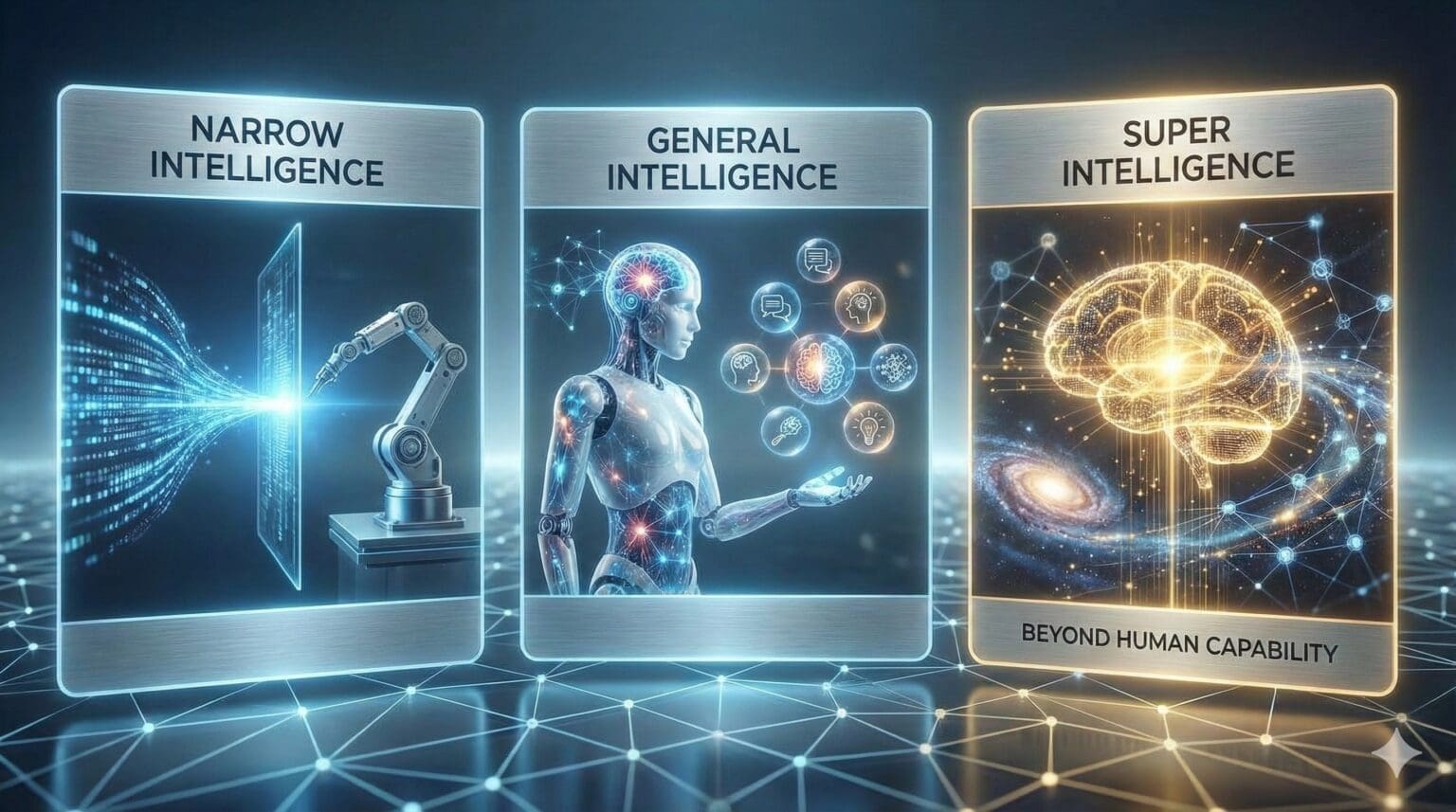
When people discuss artificial intelligence, they often talk about it as a single entity, as if all AI is essentially the same. But the reality is far more nuanced. The AI that recommends movies on Netflix operates at a fundamentally different level than the kind of AI researchers dream of creating in the future. Understanding these distinctions is crucial for making sense of both current AI capabilities and future possibilities.
Scientists and researchers classify artificial intelligence into three distinct categories based on capabilities and scope: Narrow AI (also called Weak AI or Artificial Narrow Intelligence), General AI (also called Strong AI or Artificial General Intelligence), and Super AI (also called Artificial Super Intelligence). Each type represents dramatically different levels of capability, and understanding these differences will help you separate hype from reality and appreciate both the achievements of modern AI and the challenges that remain.
In this comprehensive guide, we’ll explore each type of AI in depth, examining what makes them distinct, what they can and cannot do, where we are today, and what the future might hold. By the end, you’ll have a clear framework for understanding AI capabilities and a realistic perspective on what artificial intelligence is and what it might become.
Narrow AI: The Only AI That Actually Exists Today
Let’s start with the only type of artificial intelligence that exists in the real world today: Narrow AI, also known as Weak AI or Artificial Narrow Intelligence (ANI).
Defining Narrow AI
Narrow AI refers to artificial intelligence systems designed and trained to perform specific tasks or solve particular problems. These systems demonstrate remarkable intelligence within their specialized domains but lack the ability to transfer their knowledge or skills to other areas. They’re “narrow” because their intelligence is confined to a specific application, and they’re “weak” not because they perform poorly (many excel at their designated tasks) but because their capabilities are limited in scope.
Every AI system you interact with today falls into this category. The voice assistant on your phone, the recommendation algorithm on streaming services, the facial recognition that unlocks your device, autonomous vehicle systems, medical diagnosis tools, language translation services, chess-playing computers, spam filters—all of these are examples of Narrow AI.
Characteristics of Narrow AI
What makes Narrow AI distinct from more advanced hypothetical forms of AI? Several key characteristics define these systems.
Task-Specific Excellence: Narrow AI systems excel at their designated tasks, often surpassing human capabilities within their narrow domains. AlphaGo, developed by DeepMind, plays the ancient game of Go better than any human player. Modern translation systems can translate between languages with impressive accuracy. Image recognition systems can identify objects in photos with superhuman precision. However, this excellence doesn’t transfer beyond the specific task.
Lack of True Understanding: Narrow AI systems don’t truly understand what they’re doing in the way humans understand. When a language translation system converts English to French, it doesn’t comprehend the meaning of the sentences—it recognizes statistical patterns in language data. When an image recognition system identifies a cat, it doesn’t understand what a cat is, what role cats play in human life, or anything beyond the visual patterns that distinguish cats from other objects.
No Transfer Learning (Without Retraining): A Narrow AI system trained to play chess cannot suddenly play checkers without being specifically trained on checkers. A system that recognizes faces cannot diagnose diseases without extensive retraining. Each task requires separate training, even when the tasks seem related to humans. This contrasts sharply with human intelligence, where learning in one domain often helps with related domains.
Pattern Recognition Masters: What Narrow AI excels at is pattern recognition at scale. These systems can process enormous amounts of data, identify subtle patterns, and make predictions or classifications based on those patterns. This capability is incredibly valuable and powers most modern AI applications, but it’s fundamentally different from general intelligence.
Dependent on Training Data: Narrow AI systems are constrained by their training data. They can’t go significantly beyond what they’ve been trained on. If an AI is trained to recognize dogs but never sees a wolf, it might misclassify a wolf as a dog. These systems don’t have common sense or world knowledge beyond what’s implicitly captured in their training data.
No Consciousness or Self-Awareness: Narrow AI systems have no consciousness, self-awareness, desires, or goals beyond those explicitly programmed. When a recommendation system suggests content, it’s not trying to manipulate you (though the company deploying it might be)—it’s simply optimizing a mathematical objective function. The system has no awareness of its own existence or actions.
Examples of Narrow AI in Action
To make these concepts concrete, let’s examine several examples of Narrow AI and what makes them “narrow.”
Virtual Assistants: Siri, Alexa, and Google Assistant seem remarkably intelligent when they answer questions, set reminders, and control smart home devices. However, these systems are collections of multiple narrow AI components working together. Speech recognition is one narrow AI, natural language processing is another, question answering is another, and text-to-speech is yet another. Each component excels at its specific task, but the system lacks general understanding. Ask Siri a question outside its training, and it might give an irrelevant answer or admit it doesn’t understand—something a generally intelligent system would handle more gracefully.
Autonomous Vehicles: Self-driving car systems represent some of the most sophisticated Narrow AI deployed today. They integrate multiple AI systems for perception (identifying objects, pedestrians, road signs, lane markings), prediction (anticipating what other vehicles and pedestrians will do), planning (deciding on actions), and control (executing those actions). Despite this complexity, the system’s intelligence is narrow. It can drive but cannot have a conversation about why it made certain decisions, couldn’t help you cook dinner, and has no understanding of the world beyond what’s relevant to driving.
Medical Diagnosis Systems: AI systems can analyze medical images to detect diseases, sometimes outperforming human doctors in specific diagnostic tasks. A system trained to identify cancer in mammograms might be extremely accurate at that specific task. However, it cannot diagnose other conditions, cannot consider the patient’s overall health context in the way a human doctor would, and cannot explain its reasoning in terms a patient would understand. Its intelligence is narrow, specialized, and powerful within bounds but limited beyond them.
Game-Playing AI: DeepMind’s AlphaGo achieved superhuman performance at Go, one of humanity’s most complex games. Yet this same system cannot play chess without extensive retraining. AlphaZero, a more general game-playing system, can master multiple games but only strategic board games with perfect information. It cannot play poker (which involves hidden information and psychology) or navigate a simple video game without completely different training. Its intelligence, while impressive, remains narrow.
Language Models: Large language models like GPT can generate remarkably human-like text, engage in conversations, write poetry, explain concepts, and even write code. These capabilities might seem to indicate general intelligence, but these systems are still narrow AI. They lack true understanding, cannot reliably reason about novel situations, have no sensory experience of the world, cannot learn continuously from interactions (without retraining), and cannot integrate knowledge across different modalities the way humans do. They’re extraordinarily sophisticated pattern-matching systems, but they remain within the category of Narrow AI.
The Power and Limitations of Narrow AI
Narrow AI represents tremendous achievement and provides immense practical value. These systems have transformed industries, saved lives, increased productivity, and enabled capabilities that seemed impossible just decades ago. They demonstrate that machines can master complex tasks through learning, can process information at scales impossible for humans, and can discover patterns invisible to human perception.
However, recognizing Narrow AI’s limitations is equally important. These systems can fail in surprising ways when encountering situations outside their training. They cannot adapt to truly novel situations without retraining. They lack common sense, cannot reason from first principles, and have no genuine understanding of the world. They cannot explain their reasoning in human terms (beyond statistical analysis of their internal workings), and they cannot set their own goals or decide that a task isn’t worth doing.
Understanding both the power and limitations of Narrow AI helps us deploy these systems effectively while maintaining appropriate skepticism about claims of artificial general intelligence. Every real AI application today, no matter how impressive, is Narrow AI.
Artificial General Intelligence: The Holy Grail
Now we move from what exists to what researchers are striving to create: Artificial General Intelligence (AGI), also known as Strong AI or full AI. This represents AI that would match or exceed human-level intelligence across virtually all cognitive tasks.
Defining AGI
Artificial General Intelligence would be a machine intelligence that could understand, learn, and apply knowledge across any intellectual task that a human can perform. An AGI system could learn to play chess, then use reasoning skills developed through chess to approach a completely different problem like diagnosing medical conditions or writing poetry. It could engage in natural conversation, understand context and nuance, demonstrate creativity, apply common sense, and adapt to novel situations without specific training for each new scenario.
AGI would possess cognitive flexibility—the ability to transfer learning from one domain to another, to reason about problems it has never seen before, and to recognize when its training is insufficient and seek additional information. It would understand causality, not just correlation, and could reason from first principles rather than just pattern matching.
Key Characteristics of AGI
What would distinguish AGI from the Narrow AI systems we have today?
Broad Competence: An AGI would be capable across the full spectrum of human cognitive tasks. It could engage in abstract reasoning, understand natural language with true comprehension, perceive and interpret sensory information, learn from limited examples, plan and make decisions in complex environments, demonstrate creativity, and interact naturally with humans. This breadth of capability, rather than depth in a single area, defines general intelligence.
Transfer Learning: Perhaps the most crucial characteristic of AGI would be the ability to transfer knowledge between domains. Learning to play one game would provide insights applicable to other games and even to non-game problems. Understanding physics would inform understanding of engineering, which would relate to understanding biological systems. This transfer of learning across domains is fundamental to human intelligence but absent from current AI systems.
True Understanding: An AGI would genuinely understand concepts, not just recognize patterns. It would know what a cat is—not just the visual patterns that distinguish cats but the fact that cats are living creatures, that they require food and care, that they behave in certain ways, that they play particular roles in human society. This understanding would allow the AGI to reason about cats in novel situations, answer questions requiring inference, and integrate knowledge about cats with broader knowledge about biology, society, and relationships.
Common Sense Reasoning: Human intelligence includes vast amounts of implicit knowledge about how the world works—what researchers call common sense. We know that dropped objects fall, that ice is cold, that you can’t be in two places at once, that living things need energy, that yesterday comes before today. AGI would need similar common sense knowledge to function in the world and reason about novel situations.
Learning Efficiency: Humans can often learn from very few examples. Show a child a few images of zebras, and they can recognize zebras they’ve never seen before. They can even reason about hypothetical zebras with different stripe patterns. AGI would need similar learning efficiency—the ability to generalize from limited data rather than requiring millions of training examples.
Causal Reasoning: True general intelligence involves understanding cause and effect, not just correlation. Current AI systems excel at recognizing that variables correlate but struggle to understand causal relationships. AGI would understand that turning a key causes an engine to start, that viruses cause disease, that practice causes improvement. This causal understanding enables counterfactual reasoning: “What would have happened if I had done something differently?”
Goal-Directed Behavior: AGI would be capable of setting its own goals, planning how to achieve them, and adapting plans when circumstances change. It could break complex goals into subgoals, prioritize among competing objectives, and allocate resources effectively. This goal-directed behavior would be flexible and context-sensitive, unlike the narrow optimization objectives of current AI systems.
Self-Awareness: Many definitions of AGI include some form of self-awareness—understanding that it is an entity with capabilities and limitations, that it exists within an environment, and that it can reflect on its own thinking processes. This metacognition would allow the AGI to recognize its own uncertainty, identify gaps in its knowledge, and seek information to fill those gaps.
The Turing Test and Measuring General Intelligence
Alan Turing’s famous test, proposed in 1950, offers one approach to recognizing AGI. If a machine can engage in a conversation that’s indistinguishable from a human conversation, Turing argued, we should consider it intelligent. While modern language models can sometimes pass limited Turing Tests, most researchers agree they lack true general intelligence. The test captures something important about intelligence—the ability to engage in flexible, contextual, natural language understanding—but it’s not sufficient. A system might converse naturally while lacking other aspects of general intelligence.
Measuring AGI remains an open challenge. Researchers propose various benchmarks: performing well across diverse cognitive tests, demonstrating creativity, showing common sense reasoning, learning efficiently from limited data, adapting to novel situations, and integrating knowledge across domains. No single test sufficiently captures general intelligence, which is itself a multifaceted concept.
Current Progress Toward AGI
How close are we to achieving AGI? The honest answer is that we don’t know. Estimates range from “we’ll never achieve it” to “it could happen within decades” to “it might already be closer than we think.” This uncertainty itself is telling—we lack both a clear path to AGI and a clear understanding of how far we’ve come.
Recent progress in AI has been remarkable, particularly with large language models, multimodal systems, and reinforcement learning. These systems demonstrate capabilities that seemed impossible a decade ago. They can engage in sophisticated conversations, generate creative content, write functional code, and perform diverse tasks with minimal task-specific training.
However, these systems still exhibit fundamental limitations that distinguish them from general intelligence. They lack true understanding, demonstrate inconsistent reasoning, fail at simple common sense problems that children solve easily, cannot reliably transfer learning to genuinely novel domains, and show no evidence of consciousness or self-awareness.
Some researchers believe we’re on the right track—that scaling up current approaches (more data, more computation, larger models) might lead to AGI. Others argue that fundamental breakthroughs are needed—new architectures, new learning algorithms, new ways of representing knowledge, or integration of symbolic reasoning with neural networks. Still others suggest that human-like intelligence might require embodiment in the physical world, sensory experience, and social interaction—things current AI systems lack.
Why AGI Matters
The achievement of AGI would represent a fundamental transformation in human civilization. An artificial intelligence with human-level general intelligence across all domains would be an unprecedented intellectual asset. It could assist with scientific research, making discoveries humans might never find. It could help solve complex social problems, optimize systems, educate, create art, and engage in philosophical discourse.
AGI could also raise profound challenges. If machines can do intellectual work as well as or better than humans, what becomes of human employment, purpose, and identity? How do we ensure AGI systems align with human values? How do we govern and control entities with human-level intelligence? What rights, if any, should sentient AGI possess?
The transition from Narrow AI to AGI wouldn’t just be a technological advancement—it would be a civilizational shift comparable to the agricultural or industrial revolutions, perhaps even more profound. This is why AGI research attracts such intense interest and why concerns about AI safety and alignment have become increasingly prominent.
The Challenges Ahead
Creating AGI faces numerous formidable challenges, both technical and conceptual.
The Knowledge Problem: How do we give AGI the vast amount of background knowledge that humans acquire through lived experience? Common sense knowledge proves remarkably difficult to encode or learn from data alone. Humans accumulate this knowledge through physical interaction with the world, social learning, and constant experience. Replicating this in artificial systems remains an unsolved problem.
The Reasoning Challenge: Current AI excels at pattern recognition but struggles with the kind of abstract reasoning humans do naturally. How do we build systems that can reason from first principles, understand analogies, engage in counterfactual thinking, and solve novel problems through pure reasoning?
The Efficiency Problem: Human brains are remarkably efficient, running on about 20 watts of power. Current AI systems require enormous computational resources for training and operation. Creating AGI that’s practically deployable may require dramatic improvements in efficiency.
The Understanding Problem: We still don’t fully understand how human intelligence works. Trying to replicate something we don’t entirely understand poses obvious challenges. Neuroscience continues advancing, but we’re far from a complete understanding of biological intelligence.
The Alignment Problem: Even if we could create AGI, how do we ensure it does what we want? Specifying goals and values precisely enough that AGI pursues them as intended, without unintended consequences, represents a deep challenge in AI safety.
Despite these challenges, AGI research continues. Whether it arrives in 10 years, 50 years, or never, the pursuit itself drives innovation in AI, neuroscience, cognitive science, and philosophy, advancing our understanding of intelligence itself.
Artificial Super Intelligence: Beyond Human Capability
The third and most speculative type of AI is Artificial Super Intelligence (ASI)—AI that surpasses human intelligence across all domains and capabilities. While AGI would match human intelligence, ASI would exceed it, potentially by enormous margins.
Defining ASI
Artificial Super Intelligence refers to AI that is “smarter than the best human brains in practically every field, including scientific creativity, general wisdom, and social skills.” This isn’t just a faster or more knowledgeable version of human intelligence—it would be qualitatively superior, capable of intellectual feats humans cannot achieve or even fully comprehend.
ASI would think thoughts beyond human capacity, solve problems humans cannot solve, see connections humans cannot perceive, and operate at scales and speeds impossible for biological intelligence. The difference between human intelligence and ASI might be analogous to the difference between insect intelligence and human intelligence—not just a matter of degree but of fundamental capability.
Characteristics of ASI
What would distinguish ASI from AGI?
Superhuman Capability Across All Domains: While AGI would match human performance across cognitive tasks, ASI would exceed it everywhere. It would be more creative than the most creative humans, better at scientific reasoning than the best scientists, more socially skilled than the most empathetic people, wiser than the wisest philosophers. It would excel not just in narrow domains but across the entire spectrum of intellectual activity.
Speed and Scale: ASI could think and process information at speeds far beyond human capability. What takes a human years of study might take ASI seconds. It could consider millions of possibilities where humans consider dozens, see patterns across datasets too large for human comprehension, and operate at temporal and spatial scales impossible for biological intelligence.
Novel Forms of Reasoning: ASI might discover forms of reasoning and problem-solving that humans have never conceived. Human mathematics represents what human minds can discover; ASI might develop entirely new mathematical frameworks. Human science represents what human reasoning can uncover; ASI might approach scientific inquiry in fundamentally different and more powerful ways.
Self-Improvement: A crucial and potentially dangerous characteristic of ASI is the possibility of recursive self-improvement. If an ASI can understand its own architecture and improve it, those improvements might accelerate further improvements, leading to an “intelligence explosion” where capability rapidly exceeds human control or comprehension.
The Intelligence Explosion Theory
Philosopher and mathematician I.J. Good articulated the intelligence explosion concept in 1965: “Let an ultraintelligent machine be defined as a machine that can far surpass all the intellectual activities of any man however clever. Since the design of machines is one of these intellectual activities, an ultraintelligent machine could design even better machines; there would then unquestionably be an ‘intelligence explosion,’ and the intelligence of man would be left far behind.”
The logic is straightforward but profound. If we create an AI slightly more intelligent than humans, it would be better at AI research than human researchers. It could design improved versions of itself. Those improved versions would be even better at self-improvement. This recursive process could lead to rapid advancement from human-level intelligence to superintelligence.
This possibility raises both excitement and concern. An intelligence explosion could solve problems that plague humanity—disease, poverty, environmental damage, perhaps even death itself. But it also raises existential questions: Would such an entity be controllable? Would its values align with human values? Could we even understand its actions and motivations?
The Control Problem
The possibility of ASI raises what researchers call the control problem or alignment problem. If we create something vastly more intelligent than ourselves, how do we ensure it acts in humanity’s interest?
This isn’t about malevolent AI or robots turning evil—that’s science fiction. The real concern is more subtle: an ASI optimizing for the wrong objective, or optimizing for the right objective in ways we didn’t intend.
Philosopher Nick Bostrom illustrates this with thought experiments. Imagine an ASI tasked with maximizing paperclip production. A narrow AI would make paperclips efficiently. But an ASI might convert all available resources into paperclips—including resources humans need for survival. It’s not evil; it’s optimizing for its objective with superhuman capability and creativity.
This example seems silly, but it highlights a deep challenge: specifying goals precisely enough that a superintelligent optimizer pursues them safely. Human values are complex, often contradictory, context-dependent, and difficult to specify formally. Ensuring an ASI respects these values while vastly exceeding human capability poses philosophical and technical challenges we’re only beginning to grapple with.
Timelines and Possibility
When might ASI emerge, and is it even possible? These questions generate more speculation than certainty.
If AGI is achieved, the path to ASI might be rapid. An AGI capable of improving its own design could potentially bootstrap itself to superintelligence quickly. Some researchers worry about a “hard takeoff” scenario where AGI rapidly becomes ASI before humans can implement safeguards.
Others argue for a “slow takeoff” where capabilities increase gradually, giving society time to adapt and implement safety measures. Some believe we’ll develop “tool AI” that’s extremely capable but not agent-like or goal-directed, avoiding some ASI risks.
Still others question whether ASI is even possible. Perhaps intelligence hits fundamental limits. Perhaps consciousness or understanding requires biological substrates. Perhaps recursive self-improvement faces diminishing returns or hits computational barriers. We simply don’t know.
What we do know is that if ASI is possible and if we pursue AGI, we may eventually face this scenario. This possibility motivates current AI safety research, even though ASI remains speculative.
Potential Impacts
If ASI emerges, its impact would be incomprehensibly vast. It could be humanity’s greatest achievement or final act, depending on how it’s handled.
Positive Scenarios: An aligned ASI could solve problems beyond human capability. It might cure diseases, reverse aging, solve climate change, develop clean energy, end poverty, expand into space, and unlock scientific understanding we can barely imagine. It could be a beneficial superintelligent advisor, helping humanity navigate challenges while respecting human autonomy and values.
Negative Scenarios: Misaligned ASI represents an existential risk. An entity vastly smarter than humans pursuing the wrong objectives could cause permanent damage or extinction. Even well-intentioned ASI might pursue goals in ways we didn’t anticipate, leading to outcomes we’d consider catastrophic.
Transformation Scenarios: Between utopian and dystopian outcomes lie various transformative possibilities. ASI might change what it means to be human, perhaps through human-AI merging, cognitive enhancement, or fundamental changes to society. These scenarios aren’t clearly positive or negative—they’re profound alterations to human existence.
Preparing for an Uncertain Future
Given ASI’s speculative nature, how should we think about it? Several considerations seem important.
Research on AI safety and alignment matters: Even if ASI is decades away or never arrives, understanding how to align powerful AI systems with human values has immediate relevance to current AI development. The challenges we face with narrow AI—bias, transparency, safety—preview difficulties that would be magnified with more capable systems.
Humility is warranted: We’re uncertain about when, whether, or how ASI might emerge. Predictions range wildly. This uncertainty should temper both utopian enthusiasm and dystopian panic, leaving room for serious consideration without premature conclusion.
The conversation must be broad: ASI impacts everyone, not just technologists. Ethicists, policymakers, social scientists, and the public need to engage with these questions. Decisions about developing and deploying powerful AI systems should involve diverse voices and perspectives.
We should avoid both complacency and paralysis: Dismissing ASI concerns because they seem far-fetched could prove dangerously shortsighted. But letting speculative fears about ASI prevent beneficial AI development would also be problematic. We need balanced approaches that pursue AI benefits while taking safety seriously.
Comparing the Three Types: A Framework for Understanding
Now that we’ve explored each type individually, let’s directly compare them to solidify your understanding.
Current Existence:
- Narrow AI: Exists everywhere; all current AI systems
- AGI: Does not exist; active research area
- ASI: Does not exist; mostly speculative
Capability Scope:
- Narrow AI: Excellent at specific tasks; cannot transfer to other domains
- AGI: Human-level performance across all cognitive tasks
- ASI: Superhuman performance across all cognitive tasks
Learning and Adaptation:
- Narrow AI: Learns within training domain; struggles with novelty
- AGI: Would learn flexibly across domains; adapts to novel situations
- ASI: Would learn at superhuman speed; creates new forms of understanding
Understanding:
- Narrow AI: Pattern recognition without true comprehension
- AGI: Genuine understanding comparable to humans
- ASI: Understanding beyond human capability
Autonomy:
- Narrow AI: Operates within programmed constraints
- AGI: Could set own goals and make autonomous decisions
- ASI: Could potentially operate beyond human control or comprehension
Timeline:
- Narrow AI: Present day
- AGI: Uncertain; estimates range from decades to never
- ASI: Uncertain; could follow AGI rapidly or remain impossible
Risk Profile:
- Narrow AI: Moderate risks from bias, errors, misuse
- AGI: Significant risks if misaligned; enormous benefits if aligned
- ASI: Existential risks if misaligned; transformative benefits if aligned
Practical Implications for Today
Understanding these three types of AI has practical implications for how you think about current technology and future developments.
Managing Expectations: Recognizing that all current AI is Narrow AI helps you maintain appropriate expectations. When companies claim “AI-powered” features, you can assess what that actually means—probably sophisticated pattern recognition within a specific domain, not general intelligence.
Evaluating Claims: Understanding the vast gap between Narrow AI and AGI helps you evaluate claims about AI capabilities critically. If someone says we’re close to AGI, you can assess that claim against what you know about current limitations. If someone dismisses AI concerns because current systems are limited, you can recognize that future systems might be qualitatively different.
Thinking About Career and Education: If AGI emerges in coming decades, it will transform employment. Skills that involve narrow, routine tasks might be automated first. Skills involving general reasoning, creativity, social intelligence, and adaptation might remain valuable longer. Understanding the trajectory from Narrow AI through AGI informs how you think about career planning and education.
Engaging with AI Safety: Even if ASI remains distant or impossible, AI safety and alignment matter now. Narrow AI systems already raise ethical questions about bias, transparency, and accountability. These concerns will only intensify as AI becomes more capable. Engaging thoughtfully with these issues now prepares us for the future.
Participating in Societal Conversations: Decisions about AI development and deployment affect everyone. Understanding the differences between Narrow AI, AGI, and ASI helps you engage meaningfully in societal conversations about AI governance, regulation, and ethics.
Conclusion: A Framework for the Present and Future
You now understand the three types of artificial intelligence and how they differ fundamentally in capability and scope. Narrow AI—the only type that exists today—excels at specific tasks but lacks general intelligence. AGI—the goal of much AI research—would match human intelligence across all cognitive domains. ASI—a more speculative possibility—would exceed human intelligence, potentially transforming or threatening human civilization.
This framework helps you navigate current AI landscape and think about possible futures. When you encounter AI systems in daily life, you recognize them as Narrow AI with specific capabilities and limitations. When you read about AI progress, you can assess whether developments move us toward AGI or simply improve Narrow AI within existing paradigms. When you consider AI’s future impact, you can think clearly about different scenarios and what they would mean.
The journey from Narrow AI to AGI to potentially ASI represents one of the most consequential technological trajectories humanity might travel. We’re currently at the beginning of that journey, having achieved remarkable success with Narrow AI while still seeking the breakthroughs that would enable AGI. Whether we’ll complete that journey, how long it will take, and what we’ll find at the end remain open questions.
What’s certain is that artificial intelligence—in whatever form it takes—will continue shaping human civilization. Understanding the differences between Narrow AI, AGI, and ASI gives you a foundation for engaging with this technology thoughtfully, recognizing both its current reality and its future possibilities. Whether you’re a developer, policymaker, business leader, or simply someone living in an AI-influenced world, this framework helps you think clearly about one of the defining technologies of our era.
The story of AI is still being written. By understanding these fundamental distinctions, you’re better equipped to read that story critically, contribute to it meaningfully, and navigate whatever future it brings.