


Overview
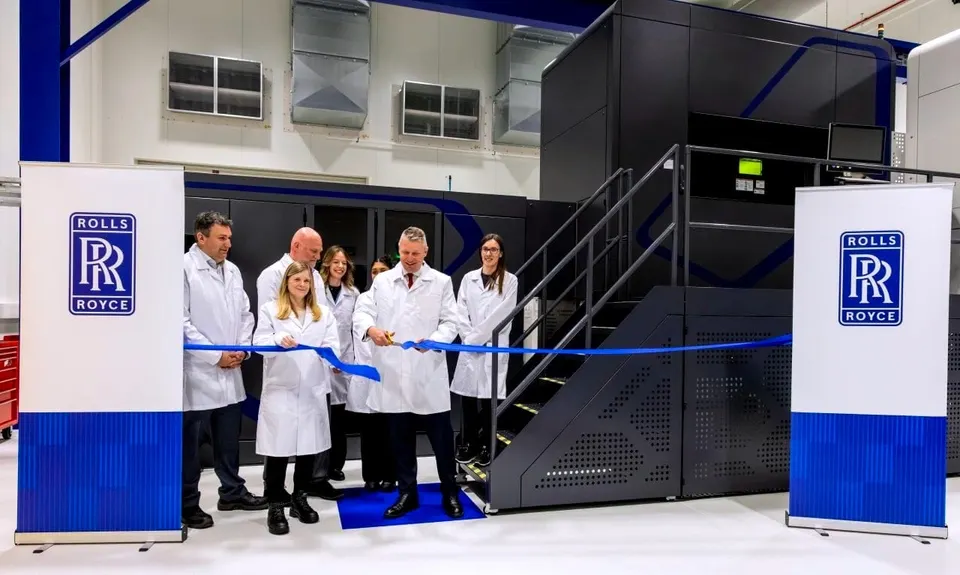
Rolls-Royce has officially opened a new Additive Manufacturing Development Cell at its Defence Assembly and Operations facility in Bristol, United Kingdom, marking one of the most significant investments in military aerospace 3D printing on British soil. The facility was made possible through direct funding from the UK Ministry of Defence and will serve as the operational centre of gravity for fabricating complex, mission-critical metal components for some of the world’s most advanced aircraft engines.
A Controlled Environment Built for Precision
The new cell is housed in a custom-built, carefully controlled 350-square-metre space where air pressure, humidity, and temperature are all continuously managed to maintain the kind of consistency that aerospace-grade metal additive manufacturing demands. Engineers who work in the cell must undergo specialised training before they can operate any of the equipment — a requirement that underscores both the technical complexity and the safety stakes of producing flight-critical parts through 3D printing.
The level of environmental control is not a design flourish but a functional necessity. Metal powder bed fusion and laser deposition processes are highly sensitive to moisture and particulate contamination. Even minor variations in atmospheric conditions can introduce micro-defects in printed parts that only become apparent under stress. By housing the AM processes in a tightly regulated environment, Rolls-Royce is removing one of the primary variables that has historically limited quality assurance in high-volume additive production.
Supporting GCAP and Future Combat Power
The development cell is directly connected to the Global Combat Air Programme — the trilateral initiative between the United Kingdom, Japan, and Italy to develop a sixth-generation combat aircraft. GCAP represents one of the most ambitious aerospace endeavours in decades, and its engine requirements demand propulsion systems that push well beyond the performance envelope of current technology. Additive manufacturing plays a central enabling role: it allows engineers to produce internal cooling passages, combustion chamber geometries, and structural components with shapes that are simply impossible to manufacture through conventional subtractive or casting methods.
Beyond GCAP, the Bristol hub serves as the power and propulsion centre for the UK’s military combat and transport aerospace sectors more broadly. 3D-printed parts from the new facility will find their way into current-generation platforms as well as future systems, speeding up innovation cycles and reducing the dependency on long lead-time traditional manufacturing routes.
Jobs, Skills, and Industrial Strategy
The opening of the AM Development Cell also represents a deliberate industrial skills investment. By requiring engineers to be trained specifically for the cell, Rolls-Royce is building a cadre of specialists in military additive manufacturing — workers whose expertise does not currently exist in sufficient quantity in the UK’s industrial labour market. The facility is expected to sustain and create jobs at the Bristol hub for the foreseeable future.
For the UK government, the investment signals continued commitment to maintaining sovereign capability in cutting-edge aerospace manufacturing at a time when global competition in defence technology has never been more intense.


