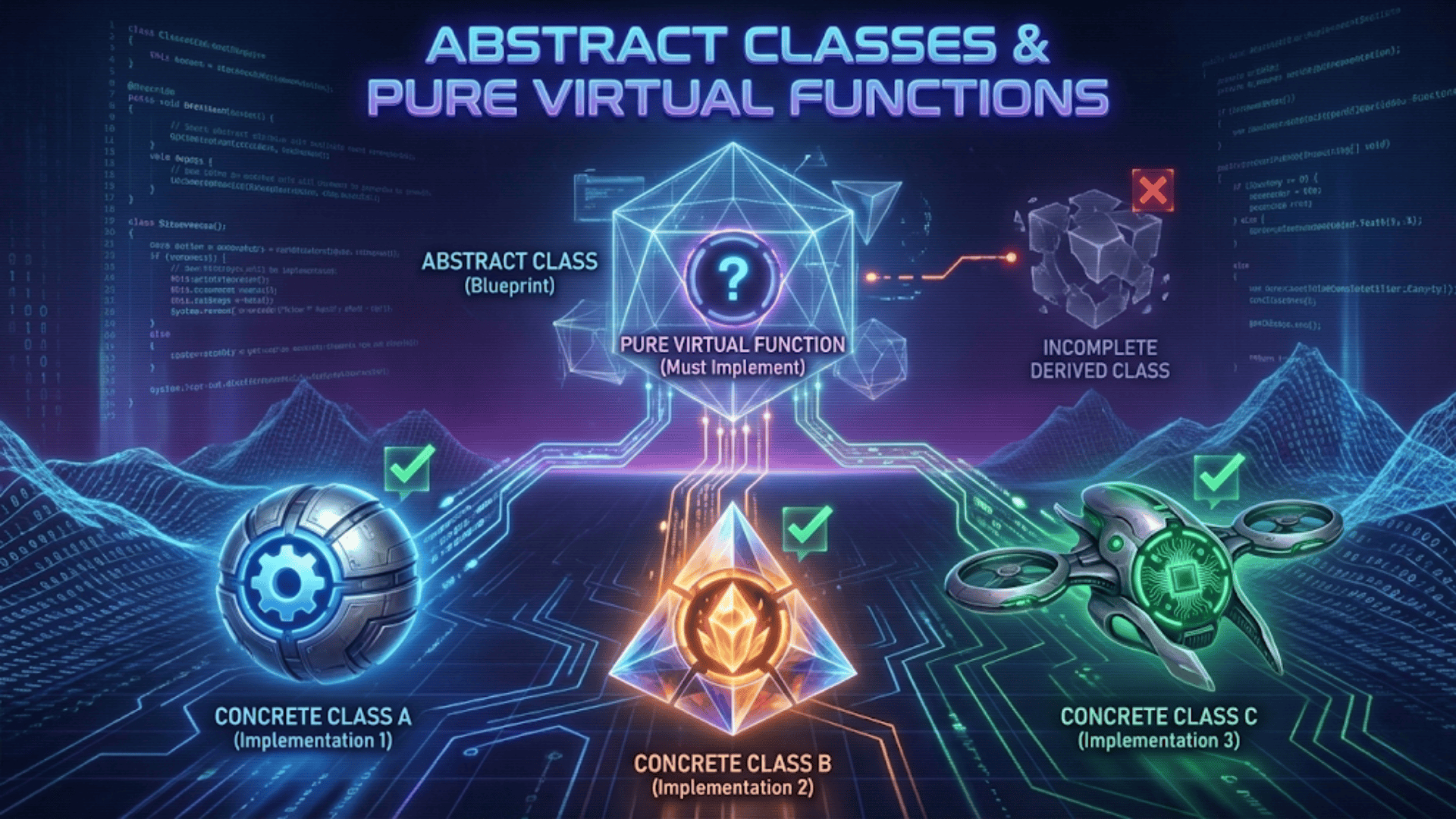

Abstract classes in C++ are classes that contain at least one pure virtual function (declared with = 0) and cannot be instantiated directly. They serve as blueprints for derived classes, defining interfaces that must be implemented while providing a common base for polymorphic behavior, enabling you to create flexible, contract-based designs in object-oriented programming.
Introduction: Building Blueprints for Your Code
Abstract classes represent one of the most powerful design tools in C++ programming. They allow you to define what a class should do without specifying how it does it, creating contracts that derived classes must fulfill. This separation of interface from implementation enables you to build flexible, maintainable systems where new functionality can be added without breaking existing code.
Think of an abstract class as a blueprint for a house. The blueprint shows that every house must have doors, windows, and a roof, but it doesn’t specify whether the doors are wooden or metal, whether the windows are single or double-pane, or whether the roof is tiled or shingled. Each actual house (derived class) must provide these features, but the implementation details are up to the builder.
In software development, abstract classes solve a fundamental problem: how do you ensure that related classes provide certain functionality while allowing flexibility in implementation? You might have different types of database connections (MySQL, PostgreSQL, MongoDB), different payment processors (credit card, PayPal, cryptocurrency), or different file formats (JSON, XML, CSV)—all requiring different implementations but sharing a common interface.
This comprehensive guide will explore abstract classes and pure virtual functions in depth, from basic concepts to advanced design patterns. You’ll learn when to use abstract classes, how to design effective interfaces, and how to leverage these features to create professional-quality C++ applications.
What Makes a Class Abstract?
A class becomes abstract when it contains at least one pure virtual function. A pure virtual function is a virtual function declared with = 0 and has no implementation in the base class.
#include <iostream>
#include <string>
using namespace std;

// This is an abstract class because it has pure virtual functions
class Shape {
protected:
    string color;

public:
    Shape(string c) : color(c) {
        cout << "Shape constructor called" << endl;
    }

    // Pure virtual functions (= 0 makes them pure)
    virtual double getArea() = 0;
    virtual double getPerimeter() = 0;

    // Regular virtual function (has implementation)
    virtual void displayColor() {
        cout << "Color: " << color << endl;
    }

    // Virtual destructor
    virtual ~Shape() {
        cout << "Shape destructor called" << endl;
    }
};

int main() {
    // Shape shape("red");  // ERROR! Cannot instantiate abstract class

    // This would generate a compiler error:
    // "cannot declare variable 'shape' to be of abstract type 'Shape'"

    return 0;
}Step-by-step explanation:
- Shape class declaration: We create a class called Shape with a protected color member
- Constructor: Even though Shape is abstract, it can have a constructor—used by derived classes
- Pure virtual functions: getArea() and getPerimeter() are declared with
= 0, making them pure virtual - No implementation: Pure virtual functions have no body in the abstract class
- Regular virtual function: displayColor() is a normal virtual function with an implementation
- Cannot instantiate: The commented line shows that trying to create a Shape object directly causes a compilation error
- Compiler protection: C++ prevents you from creating objects of abstract classes at compile time
- Virtual destructor: Even abstract classes should have virtual destructors for proper polymorphic cleanup
- Purpose: Shape defines what all shapes must have (area and perimeter) but doesn’t specify how to calculate them
Creating Concrete Classes from Abstract Bases
Concrete classes are classes that implement all pure virtual functions from their abstract base class. Once all pure virtual functions are implemented, the class becomes instantiable.
#include <iostream>
#include <string>
#include <cmath>
using namespace std;

class Shape {
protected:
    string color;

public:
    Shape(string c) : color(c) {}

    virtual double getArea() = 0;
    virtual double getPerimeter() = 0;

    virtual void displayInfo() {
        cout << "Color: " << color << endl;
        cout << "Area: " << getArea() << endl;
        cout << "Perimeter: " << getPerimeter() << endl;
    }

    virtual ~Shape() {}
};

// Concrete class - implements all pure virtual functions
class Circle : public Shape {
private:
    double radius;

public:
    Circle(string c, double r) : Shape(c), radius(r) {
        cout << "Circle created with radius " << radius << endl;
    }

    // Must implement getArea
    double getArea() override {
        return 3.14159 * radius * radius;
    }

    // Must implement getPerimeter
    double getPerimeter() override {
        return 2 * 3.14159 * radius;
    }

    ~Circle() {
        cout << "Circle destroyed" << endl;
    }
};

class Rectangle : public Shape {
private:
    double width;
    double height;

public:
    Rectangle(string c, double w, double h)
        : Shape(c), width(w), height(h) {
        cout << "Rectangle created: " << width << "x" << height << endl;
    }

    double getArea() override {
        return width * height;
    }

    double getPerimeter() override {
        return 2 * (width + height);
    }

    ~Rectangle() {
        cout << "Rectangle destroyed" << endl;
    }
};

class Triangle : public Shape {
private:
    double side1, side2, side3;

public:
    Triangle(string c, double s1, double s2, double s3)
        : Shape(c), side1(s1), side2(s2), side3(s3) {
        cout << "Triangle created with sides "
             << s1 << ", " << s2 << ", " << s3 << endl;
    }

    double getArea() override {
        // Heron's formula
        double s = (side1 + side2 + side3) / 2.0;
        return sqrt(s * (s - side1) * (s - side2) * (s - side3));
    }

    double getPerimeter() override {
        return side1 + side2 + side3;
    }

    ~Triangle() {
        cout << "Triangle destroyed" << endl;
    }
};

int main() {
    cout << "=== Creating shapes ===" << endl;

    // Can create concrete class objects
    Circle circle("red", 5.0);
    Rectangle rect("blue", 4.0, 6.0);
    Triangle tri("green", 3.0, 4.0, 5.0);

    cout << "\n=== Circle Info ===" << endl;
    circle.displayInfo();

    cout << "\n=== Rectangle Info ===" << endl;
    rect.displayInfo();

    cout << "\n=== Triangle Info ===" << endl;
    tri.displayInfo();

    cout << "\n=== Objects going out of scope ===" << endl;
    return 0;
}Step-by-step explanation:
- Abstract Shape class: Defines the interface with pure virtual getArea() and getPerimeter()
- displayInfo() implementation: The base class provides this method that calls the pure virtual functions
- Circle class: Implements both pure virtual functions, making it concrete (instantiable)
- radius member: Circle has its own data member specific to circles
- Override getArea: Provides the formula for calculating circle area (πr²)
- Override getPerimeter: Provides the formula for circle circumference (2πr)
- Rectangle class: Another concrete class implementing the same interface differently
- Rectangle calculations: Uses width × height for area, 2(w + h) for perimeter
- Triangle class: Yet another implementation with different data (three sides)
- Heron’s formula: Triangle uses a complex formula requiring all three sides
- Creating objects: In main(), we successfully create objects of all three concrete classes
- Polymorphic call: displayInfo() calls the appropriate getArea() and getPerimeter() for each shape type
- Destructor chain: When objects go out of scope, destructors are called from derived to base
Output:
=== Creating shapes ===
Circle created with radius 5
Rectangle created: 4x6
Triangle created with sides 3, 4, 5

=== Circle Info ===
Color: red
Area: 78.5397
Perimeter: 31.4159

=== Rectangle Info ===
Color: blue
Area: 24
Perimeter: 20

=== Triangle Info ===
Color: green
Area: 6
Perimeter: 12

=== Objects going out of scope ===
Triangle destroyed
Shape destructor called
Rectangle destroyed
Shape destructor called
Circle destroyed
Shape destructor calledPartially Abstract Classes: Mixing Pure and Regular Virtual Functions
A class can have both pure virtual functions (must be overridden) and regular virtual functions (optional to override), giving you fine-grained control over what derived classes must provide.
#include <iostream>
#include <string>
using namespace std;

class Employee {
protected:
    string name;
    int employeeId;
    double baseSalary;

public:
    Employee(string n, int id, double salary)
        : name(n), employeeId(id), baseSalary(salary) {}

    // Pure virtual - must be implemented by derived classes
    virtual double calculatePay() = 0;

    // Regular virtual - has default implementation, can be overridden
    virtual void clockIn() {
        cout << name << " (ID: " << employeeId << ") clocked in" << endl;
    }

    virtual void clockOut() {
        cout << name << " (ID: " << employeeId << ") clocked out" << endl;
    }

    // Non-virtual - cannot be overridden
    void displayBasicInfo() {
        cout << "Employee: " << name << endl;
        cout << "ID: " << employeeId << endl;
    }

    virtual ~Employee() {}
};

class HourlyEmployee : public Employee {
private:
    double hourlyRate;
    int hoursWorked;

public:
    HourlyEmployee(string n, int id, double rate)
        : Employee(n, id, 0), hourlyRate(rate), hoursWorked(0) {}

    void logHours(int hours) {
        hoursWorked += hours;
        cout << name << " logged " << hours << " hours" << endl;
    }

    // Must implement pure virtual function
    double calculatePay() override {
        return hourlyRate * hoursWorked;
    }

    // Can choose to override regular virtual functions
    void clockIn() override {
        Employee::clockIn();  // Call base implementation
        cout << "Starting hourly shift" << endl;
    }
};

class SalariedEmployee : public Employee {
private:
    double annualSalary;

public:
    SalariedEmployee(string n, int id, double salary)
        : Employee(n, id, salary), annualSalary(salary) {}

    // Must implement pure virtual function
    double calculatePay() override {
        return annualSalary / 12.0;  // Monthly pay
    }

    // Uses default clockIn and clockOut from base class
};

class CommissionEmployee : public Employee {
private:
    double commissionRate;
    double salesAmount;

public:
    CommissionEmployee(string n, int id, double rate)
        : Employee(n, id, 0), commissionRate(rate), salesAmount(0) {}

    void recordSale(double amount) {
        salesAmount += amount;
        cout << name << " recorded sale: $" << amount << endl;
    }

    double calculatePay() override {
        return baseSalary + (salesAmount * commissionRate);
    }

    void clockOut() override {
        Employee::clockOut();
        cout << "Total sales today: $" << salesAmount << endl;
        salesAmount = 0;  // Reset daily sales
    }
};

int main() {
    HourlyEmployee hourly("John Smith", 101, 25.0);
    SalariedEmployee salaried("Sarah Johnson", 102, 75000);
    CommissionEmployee commission("Mike Chen", 103, 0.10);
    commission.baseSalary = 30000;  // Base salary plus commission

    cout << "=== Work Day Activities ===" << endl;

    hourly.clockIn();
    hourly.logHours(8);

    salaried.clockIn();

    commission.clockIn();
    commission.recordSale(5000);
    commission.recordSale(3000);

    cout << "\n=== Pay Calculation ===" << endl;
    hourly.displayBasicInfo();
    cout << "Pay: $" << hourly.calculatePay() << endl;

    cout << endl;
    salaried.displayBasicInfo();
    cout << "Monthly Pay: $" << salaried.calculatePay() << endl;

    cout << endl;
    commission.displayBasicInfo();
    cout << "Pay: $" << commission.calculatePay() << endl;

    cout << "\n=== End of Day ===" << endl;
    hourly.clockOut();
    salaried.clockOut();
    commission.clockOut();

    return 0;
}Step-by-step explanation:
- Employee abstract class: Contains a mix of pure virtual, regular virtual, and non-virtual functions
- calculatePay() pure virtual: Every employee type must define how pay is calculated
- clockIn() and clockOut() virtual: Provide default implementations that can optionally be overridden
- displayBasicInfo() non-virtual: Cannot be overridden, ensuring consistent basic information display
- HourlyEmployee: Implements calculatePay() based on hours × rate
- HourlyEmployee overrides clockIn(): Adds custom behavior while calling base implementation
- SalariedEmployee: Simple implementation dividing annual salary by 12
- SalariedEmployee uses defaults: Doesn’t override clockIn/clockOut, uses base class versions
- CommissionEmployee: Complex calculation combining base salary and commission
- CommissionEmployee overrides clockOut(): Adds sales reporting and resets daily sales
- Polymorphic behavior: Each employee type calculates pay differently, but all use the same interface
- Flexibility: Derived classes choose which virtual functions to override based on their needs
Output:
=== Work Day Activities ===
John Smith (ID: 101) clocked in
Starting hourly shift
John Smith logged 8 hours
Sarah Johnson (ID: 102) clocked in
Mike Chen (ID: 103) clocked in
Mike Chen recorded sale: $5000
Mike Chen recorded sale: $3000

=== Pay Calculation ===
Employee: John Smith
ID: 101
Pay: $200

Employee: Sarah Johnson
ID: 102
Monthly Pay: $6250

Employee: Mike Chen
ID: 103
Pay: $30800

=== End of Day ===
John Smith (ID: 101) clocked out
Sarah Johnson (ID: 102) clocked out
Mike Chen (ID: 103) clocked out
Total sales today: $8000Interface Classes: Pure Abstract Classes
An interface in C++ is a class with only pure virtual functions and no data members (or only static const data). This creates a pure contract with no implementation details.
#include <iostream>
#include <string>
#include <vector>
using namespace std;

// Pure interface - no data members, only pure virtual functions
class IDataStore {
public:
    virtual bool save(const string& key, const string& value) = 0;
    virtual string load(const string& key) = 0;
    virtual bool remove(const string& key) = 0;
    virtual bool exists(const string& key) = 0;
    virtual vector<string> getAllKeys() = 0;
    virtual ~IDataStore() {}
};

// Concrete implementation 1: File-based storage
class FileStorage : public IDataStore {
private:
    string directory;
    vector<pair<string, string>> cache;  // Simple in-memory cache

public:
    FileStorage(string dir) : directory(dir) {
        cout << "FileStorage initialized at: " << directory << endl;
    }

    bool save(const string& key, const string& value) override {
        // Check if key exists and update or add new
        for (auto& pair : cache) {
            if (pair.first == key) {
                pair.second = value;
                cout << "[FILE] Updated: " << key << endl;
                return true;
            }
        }
        cache.push_back({key, value});
        cout << "[FILE] Saved: " << key << endl;
        return true;
    }

    string load(const string& key) override {
        for (const auto& pair : cache) {
            if (pair.first == key) {
                cout << "[FILE] Loaded: " << key << endl;
                return pair.second;
            }
        }
        cout << "[FILE] Key not found: " << key << endl;
        return "";
    }

    bool remove(const string& key) override {
        for (auto it = cache.begin(); it != cache.end(); ++it) {
            if (it->first == key) {
                cache.erase(it);
                cout << "[FILE] Removed: " << key << endl;
                return true;
            }
        }
        return false;
    }

    bool exists(const string& key) override {
        for (const auto& pair : cache) {
            if (pair.first == key) return true;
        }
        return false;
    }

    vector<string> getAllKeys() override {
        vector<string> keys;
        for (const auto& pair : cache) {
            keys.push_back(pair.first);
        }
        return keys;
    }
};

// Concrete implementation 2: In-memory storage
class MemoryStorage : public IDataStore {
private:
    vector<pair<string, string>> data;

public:
    MemoryStorage() {
        cout << "MemoryStorage initialized" << endl;
    }

    bool save(const string& key, const string& value) override {
        for (auto& pair : data) {
            if (pair.first == key) {
                pair.second = value;
                cout << "[MEMORY] Updated: " << key << endl;
                return true;
            }
        }
        data.push_back({key, value});
        cout << "[MEMORY] Saved: " << key << endl;
        return true;
    }

    string load(const string& key) override {
        for (const auto& pair : data) {
            if (pair.first == key) {
                cout << "[MEMORY] Loaded: " << key << endl;
                return pair.second;
            }
        }
        cout << "[MEMORY] Key not found: " << key << endl;
        return "";
    }

    bool remove(const string& key) override {
        for (auto it = data.begin(); it != data.end(); ++it) {
            if (it->first == key) {
                data.erase(it);
                cout << "[MEMORY] Removed: " << key << endl;
                return true;
            }
        }
        return false;
    }

    bool exists(const string& key) override {
        for (const auto& pair : data) {
            if (pair.first == key) return true;
        }
        return false;
    }

    vector<string> getAllKeys() override {
        vector<string> keys;
        for (const auto& pair : data) {
            keys.push_back(pair.first);
        }
        return keys;
    }
};

// Application class that works with any IDataStore
class Application {
private:
    IDataStore* storage;

public:
    Application(IDataStore* store) : storage(store) {}

    void run() {
        cout << "\n=== Application Running ===" << endl;

        // Save some data
        storage->save("username", "john_doe");
        storage->save("email", "john@example.com");
        storage->save("age", "30");

        // Load and display
        cout << "\nRetrieving data:" << endl;
        cout << "Username: " << storage->load("username") << endl;
        cout << "Email: " << storage->load("email") << endl;

        // Check existence
        cout << "\nChecking keys:" << endl;
        cout << "Has 'username': " << (storage->exists("username") ? "yes" : "no") << endl;
        cout << "Has 'password': " << (storage->exists("password") ? "yes" : "no") << endl;

        // List all keys
        cout << "\nAll keys:" << endl;
        vector<string> keys = storage->getAllKeys();
        for (const string& key : keys) {
            cout << "  - " << key << endl;
        }

        // Remove a key
        cout << "\nRemoving 'age':" << endl;
        storage->remove("age");

        // Verify removal
        cout << "\nAll keys after removal:" << endl;
        keys = storage->getAllKeys();
        for (const string& key : keys) {
            cout << "  - " << key << endl;
        }
    }
};

int main() {
    cout << "=== Testing with FileStorage ===" << endl;
    FileStorage fileStore("/data/storage");
    Application app1(&fileStore);
    app1.run();

    cout << "\n\n=== Testing with MemoryStorage ===" << endl;
    MemoryStorage memStore;
    Application app2(&memStore);
    app2.run();

    return 0;
}Step-by-step explanation:
- IDataStore interface: Pure abstract class with only pure virtual functions and no data members
- Interface contract: Defines five operations all data stores must provide
- No implementation: The interface has zero implementation details
- Virtual destructor: Even interfaces need virtual destructors
- FileStorage implementation: Provides file-based storage (simulated with in-memory cache for demo)
- Different internal structure: FileStorage has directory path and cache members
- MemoryStorage implementation: Completely different implementation using only memory
- Same interface: Both classes implement identical public interfaces
- Application class: Works with IDataStore pointer, doesn’t know about concrete types
- Polymorphic usage: Application calls storage methods without knowing if it’s file or memory storage
- Easy switching: In main(), we can switch between storage types by just changing which object we pass
- Dependency inversion: High-level Application depends on the IDataStore abstraction, not concrete implementations
- Testing both: We run the same Application code with both storage types to demonstrate flexibility
Output:
=== Testing with FileStorage ===
FileStorage initialized at: /data/storage

=== Application Running ===
[FILE] Saved: username
[FILE] Saved: email
[FILE] Saved: age

Retrieving data:
[FILE] Loaded: username
Username: john_doe
[FILE] Loaded: email
Email: john@example.com

Checking keys:
Has 'username': yes
Has 'password': no

All keys:
  - username
  - email
  - age

Removing 'age':
[FILE] Removed: age

All keys after removal:
  - username
  - email


=== Testing with MemoryStorage ===
MemoryStorage initialized

=== Application Running ===
[MEMORY] Saved: username
[MEMORY] Saved: email
[MEMORY] Saved: age

Retrieving data:
[MEMORY] Loaded: username
Username: john_doe
[MEMORY] Loaded: email
Email: john@example.com

Checking keys:
Has 'username': yes
Has 'password': no

All keys:
  - username
  - email
  - age

Removing 'age':
[MEMORY] Removed: age

All keys after removal:
  - username
- emailMultiple Inheritance with Abstract Classes
Abstract classes work particularly well with multiple inheritance, allowing a class to implement multiple interfaces.
#include <iostream>
#include <string>
using namespace std;

// Interface for objects that can be serialized
class ISerializable {
public:
    virtual string serialize() = 0;
    virtual void deserialize(const string& data) = 0;
    virtual ~ISerializable() {}
};

// Interface for objects that can be compared
class IComparable {
public:
    virtual bool isEqual(const IComparable* other) const = 0;
    virtual bool isLessThan(const IComparable* other) const = 0;
    virtual ~IComparable() {}
};

// Interface for objects that can be cloned
class ICloneable {
public:
    virtual ICloneable* clone() const = 0;
    virtual ~ICloneable() {}
};

// Concrete class implementing multiple interfaces
class Person : public ISerializable, public IComparable, public ICloneable {
private:
    string name;
    int age;

public:
    Person(string n = "", int a = 0) : name(n), age(a) {
        cout << "Person created: " << name << endl;
    }

    // Implement ISerializable
    string serialize() override {
        return name + "," + to_string(age);
    }

    void deserialize(const string& data) override {
        size_t commaPos = data.find(',');
        name = data.substr(0, commaPos);
        age = stoi(data.substr(commaPos + 1));
        cout << "Deserialized: " << name << ", age " << age << endl;
    }

    // Implement IComparable
    bool isEqual(const IComparable* other) const override {
        const Person* otherPerson = dynamic_cast<const Person*>(other);
        if (otherPerson) {
            return this->age == otherPerson->age;
        }
        return false;
    }

    bool isLessThan(const IComparable* other) const override {
        const Person* otherPerson = dynamic_cast<const Person*>(other);
        if (otherPerson) {
            return this->age < otherPerson->age;
        }
        return false;
    }

    // Implement ICloneable
    ICloneable* clone() const override {
        cout << "Cloning person: " << name << endl;
        return new Person(name, age);
    }

    // Helper methods
    void display() const {
        cout << "Person: " << name << ", Age: " << age << endl;
    }

    string getName() const { return name; }
    int getAge() const { return age; }

    ~Person() {
        cout << "Person destroyed: " << name << endl;
    }
};

int main() {
    cout << "=== Creating original person ===" << endl;
    Person person1("Alice", 30);

    cout << "\n=== Testing Serialization ===" << endl;
    ISerializable* serializable = &person1;
    string data = serializable->serialize();
    cout << "Serialized data: " << data << endl;

    Person person2;
    person2.deserialize(data);

    cout << "\n=== Testing Comparison ===" << endl;
    Person person3("Bob", 30);
    Person person4("Charlie", 25);

    IComparable* comp1 = &person1;
    IComparable* comp2 = &person3;
    IComparable* comp3 = &person4;

    cout << "Alice == Bob (same age): "
         << (comp1->isEqual(comp2) ? "true" : "false") << endl;
    cout << "Charlie < Alice: "
         << (comp3->isLessThan(comp1) ? "true" : "false") << endl;

    cout << "\n=== Testing Cloning ===" << endl;
    ICloneable* cloneable = &person1;
    Person* clone = dynamic_cast<Person*>(cloneable->clone());

    cout << "Original: ";
    person1.display();
    cout << "Clone: ";
    clone->display();

    cout << "\n=== Cleanup ===" << endl;
    delete clone;

    return 0;
}Step-by-step explanation:
- ISerializable interface: Defines contract for converting objects to/from strings
- IComparable interface: Defines contract for comparing objects
- ICloneable interface: Defines contract for creating copies of objects
- Three separate concerns: Each interface handles one specific capability
- Person class: Implements all three interfaces using multiple inheritance
- Multiple base classes: Person derives from ISerializable, IComparable, and ICloneable
- serialize() implementation: Converts Person data to comma-separated string
- deserialize() implementation: Parses string and reconstructs Person data
- isEqual() implementation: Compares ages using dynamic_cast to safely convert pointer types
- isLessThan() implementation: Compares ages for ordering
- clone() implementation: Creates and returns a new Person with same data
- Interface pointers: In main(), we use interface pointers to access specific capabilities
- Type safety: dynamic_cast ensures safe type conversion when comparing
- Polymorphic usage: Each interface pointer works with its specific set of methods
- Clean separation: Each interface represents a distinct behavior that can be combined as needed
Output:
=== Creating original person ===
Person created: Alice

=== Testing Serialization ===
Serialized data: Alice,30
Person created:
Deserialized: Alice, age 30

=== Testing Comparison ===
Person created: Bob
Person created: Charlie
Alice == Bob (same age): true
Charlie < Alice: true

=== Testing Cloning ===
Cloning person: Alice
Person created: Alice
Original: Person: Alice, Age: 30
Clone: Person: Alice, Age: 30

=== Cleanup ===
Person destroyed: Alice
Person destroyed: Charlie
Person destroyed: Bob
Person destroyed: Alice
Person destroyed: AliceAbstract Classes in Design Patterns: Template Method Pattern
Abstract classes are fundamental to many design patterns. The Template Method pattern uses abstract classes to define algorithm structure while letting subclasses provide specific steps.
#include <iostream>
#include <string>
#include <vector>
using namespace std;

// Abstract base class defining the template method
class DataProcessor {
protected:
    string dataSource;
    vector<string> data;

    // Pure virtual - subclasses must implement
    virtual void readData() = 0;
    virtual void processData() = 0;
    virtual void writeData() = 0;

    // Regular virtual - optional override
    virtual void validateData() {
        cout << "Validating data (default validation)..." << endl;
        if (data.empty()) {
            cout << "Warning: No data to validate!" << endl;
        }
    }

    virtual void logOperation(const string& operation) {
        cout << "[LOG] " << operation << endl;
    }

public:
    DataProcessor(string source) : dataSource(source) {}

    // Template method - defines the algorithm structure
    void process() {
        logOperation("Starting data processing");

        readData();
        validateData();
        processData();
        writeData();

        logOperation("Data processing complete");
    }

    virtual ~DataProcessor() {
        cout << "DataProcessor cleanup" << endl;
    }
};

class CSVProcessor : public DataProcessor {
public:
    CSVProcessor(string source) : DataProcessor(source) {
        cout << "CSV Processor initialized" << endl;
    }

    void readData() override {
        cout << "Reading CSV data from: " << dataSource << endl;
        // Simulate reading CSV
        data.push_back("Name,Age,City");
        data.push_back("Alice,30,NYC");
        data.push_back("Bob,25,LA");
        cout << "Read " << data.size() << " lines" << endl;
    }

    void processData() override {
        cout << "Processing CSV data..." << endl;
        cout << "Parsing comma-separated values" << endl;
        // Process each line
        for (size_t i = 1; i < data.size(); i++) {
            cout << "  Processing row " << i << ": " << data[i] << endl;
        }
    }

    void writeData() override {
        cout << "Writing CSV output to database" << endl;
        cout << "Inserted " << (data.size() - 1) << " records" << endl;
    }
};

class JSONProcessor : public DataProcessor {
public:
    JSONProcessor(string source) : DataProcessor(source) {
        cout << "JSON Processor initialized" << endl;
    }

    void readData() override {
        cout << "Reading JSON data from: " << dataSource << endl;
        // Simulate reading JSON
        data.push_back("{\"users\": [");
        data.push_back("  {\"name\": \"Alice\", \"age\": 30}");
        data.push_back("  {\"name\": \"Bob\", \"age\": 25}");
        data.push_back("]}");
        cout << "Read JSON structure" << endl;
    }

    void validateData() override {
        // Custom validation for JSON
        cout << "Validating JSON structure..." << endl;
        cout << "Checking for valid brackets and syntax" << endl;
        DataProcessor::validateData();  // Call base validation too
    }

    void processData() override {
        cout << "Processing JSON data..." << endl;
        cout << "Parsing JSON objects and arrays" << endl;
        for (const string& line : data) {
            cout << "  " << line << endl;
        }
    }

    void writeData() override {
        cout << "Writing JSON output to API" << endl;
        cout << "Posted data to REST endpoint" << endl;
    }
};

class XMLProcessor : public DataProcessor {
private:
    int recordCount;

public:
    XMLProcessor(string source) : DataProcessor(source), recordCount(0) {
        cout << "XML Processor initialized" << endl;
    }

    void readData() override {
        cout << "Reading XML data from: " << dataSource << endl;
        data.push_back("<?xml version=\"1.0\"?>");
        data.push_back("<users>");
        data.push_back("  <user name=\"Alice\" age=\"30\"/>");
        data.push_back("  <user name=\"Bob\" age=\"25\"/>");
        data.push_back("</users>");
        cout << "Read XML document" << endl;
    }

    void validateData() override {
        cout << "Validating XML structure..." << endl;
        cout << "Checking for well-formed XML" << endl;
        // Custom XML validation
        recordCount = 0;
        for (const string& line : data) {
            if (line.find("<user") != string::npos) {
                recordCount++;
            }
        }
        cout << "Found " << recordCount << " user records" << endl;
    }

    void processData() override {
        cout << "Processing XML data..." << endl;
        cout << "Parsing XML elements and attributes" << endl;
        for (const string& line : data) {
            if (line.find("<user") != string::npos) {
                cout << "  Extracting: " << line << endl;
            }
        }
    }

    void writeData() override {
        cout << "Writing XML output to file system" << endl;
        cout << "Saved " << recordCount << " records to output.xml" << endl;
    }

    void logOperation(const string& operation) override {
        cout << "[XML-LOG] " << operation << " (timestamp: 12:34:56)" << endl;
    }
};

int main() {
    cout << "=== Processing CSV File ===" << endl;
    DataProcessor* csvProcessor = new CSVProcessor("data.csv");
    csvProcessor->process();

    cout << "\n=== Processing JSON File ===" << endl;
    DataProcessor* jsonProcessor = new JSONProcessor("data.json");
    jsonProcessor->process();

    cout << "\n=== Processing XML File ===" << endl;
    DataProcessor* xmlProcessor = new XMLProcessor("data.xml");
    xmlProcessor->process();

    cout << "\n=== Cleanup ===" << endl;
    delete csvProcessor;
    delete jsonProcessor;
    delete xmlProcessor;

    return 0;
}Step-by-step explanation:
- DataProcessor abstract class: Defines the overall algorithm structure in process() method
- Template method: process() calls readData(), validateData(), processData(), and writeData() in sequence
- Pure virtual steps: readData(), processData(), and writeData() must be implemented by subclasses
- Optional override: validateData() and logOperation() have default implementations
- CSVProcessor: Implements the algorithm for CSV file processing
- Custom read: Each processor reads data in its own format
- CSVProcessor implementation: Parses comma-separated values specifically
- JSONProcessor: Different implementation for JSON format
- Override validateData: JSONProcessor adds custom JSON-specific validation
- Call base implementation: Can call DataProcessor::validateData() to include default validation
- XMLProcessor: Yet another implementation for XML format
- Multiple overrides: XMLProcessor overrides validateData() and logOperation()
- Custom logging: XMLProcessor adds timestamp to log messages
- Algorithm consistency: All processors follow the same process() flow but with different implementations
- Polymorphic execution: Through base class pointers, each processor’s specific methods are called
Output:
=== Processing CSV File ===
CSV Processor initialized
[LOG] Starting data processing
Reading CSV data from: data.csv
Read 3 lines
Validating data (default validation)...
Processing CSV data...
Parsing comma-separated values
  Processing row 1: Alice,30,NYC
  Processing row 2: Bob,25,LA
Writing CSV output to database
Inserted 2 records
[LOG] Data processing complete

=== Processing JSON File ===
JSON Processor initialized
[LOG] Starting data processing
Reading JSON data from: data.json
Read JSON structure
Validating JSON structure...
Checking for valid brackets and syntax
Validating data (default validation)...
Processing JSON data...
Parsing JSON objects and arrays
  {"users": [
    {"name": "Alice", "age": 30}
    {"name": "Bob", "age": 25}
  ]}
Writing JSON output to API
Posted data to REST endpoint
[LOG] Data processing complete

=== Processing XML File ===
XML Processor initialized
[XML-LOG] Starting data processing (timestamp: 12:34:56)
Reading XML data from: data.xml
Read XML document
Validating XML structure...
Checking for well-formed XML
Found 2 user records
Processing XML data...
Parsing XML elements and attributes
  Extracting:   <user name="Alice" age="30"/>
  Extracting:   <user name="Bob" age="25"/>
Writing XML output to file system
Saved 2 records to output.xml
[XML-LOG] Data processing complete (timestamp: 12:34:56)

=== Cleanup ===
DataProcessor cleanup
DataProcessor cleanup
DataProcessor cleanupWhen to Use Abstract Classes vs Interfaces
Understanding when to use abstract classes versus pure interfaces is crucial for good design.
#include <iostream>
#include <string>
using namespace std;

// Pure Interface - no implementation, no data
class IDrawable {
public:
    virtual void draw() = 0;
    virtual ~IDrawable() {}
};

// Pure Interface - different concern
class IMovable {
public:
    virtual void move(int x, int y) = 0;
    virtual ~IMovable() {}
};

// Abstract class - has data and some implementation
class GameObject {
protected:
    string name;
    int posX, posY;
    bool isActive;

public:
    GameObject(string n, int x, int y)
        : name(n), posX(x), posY(y), isActive(true) {
        cout << "GameObject created: " << name << endl;
    }

    // Pure virtual - must implement
    virtual void update() = 0;

    // Implemented methods
    void activate() {
        isActive = true;
        cout << name << " activated" << endl;
    }

    void deactivate() {
        isActive = false;
        cout << name << " deactivated" << endl;
    }

    void displayInfo() {
        cout << "Object: " << name
             << " at (" << posX << ", " << posY << ")"
             << " [" << (isActive ? "active" : "inactive") << "]" << endl;
    }

    virtual ~GameObject() {
        cout << "GameObject destroyed: " << name << endl;
    }
};

// Concrete class implementing interfaces and extending abstract class
class Player : public GameObject, public IDrawable, public IMovable {
private:
    int health;
    int score;

public:
    Player(string n, int x, int y)
        : GameObject(n, x, y), health(100), score(0) {
        cout << "Player initialized with 100 health" << endl;
    }

    // Implement pure virtual from GameObject
    void update() override {
        cout << "Updating player state..." << endl;
        // Game logic here
    }

    // Implement IDrawable
    void draw() override {
        cout << "Drawing player sprite at (" << posX << ", " << posY << ")" << endl;
    }

    // Implement IMovable
    void move(int x, int y) override {
        posX += x;
        posY += y;
        cout << name << " moved to (" << posX << ", " << posY << ")" << endl;
    }

    void takeDamage(int amount) {
        health -= amount;
        cout << name << " took " << amount << " damage. Health: " << health << endl;
    }

    void addScore(int points) {
        score += points;
        cout << "Score: " << score << endl;
    }
};

class Enemy : public GameObject, public IDrawable, public IMovable {
private:
    int attackPower;

public:
    Enemy(string n, int x, int y, int power)
        : GameObject(n, x, y), attackPower(power) {
        cout << "Enemy created with attack power: " << power << endl;
    }

    void update() override {
        cout << "Enemy AI: Searching for player..." << endl;
    }

    void draw() override {
        cout << "Drawing enemy sprite at (" << posX << ", " << posY << ")" << endl;
    }

    void move(int x, int y) override {
        posX += x;
        posY += y;
        cout << name << " enemy moved to (" << posX << ", " << posY << ")" << endl;
    }

    void attack() {
        cout << name << " attacks with power " << attackPower << "!" << endl;
    }
};

class Obstacle : public GameObject, public IDrawable {
private:
    bool isDestructible;

public:
    Obstacle(string n, int x, int y, bool destructible)
        : GameObject(n, x, y), isDestructible(destructible) {
        cout << "Obstacle created ("
             << (destructible ? "destructible" : "indestructible") << ")" << endl;
    }

    void update() override {
        // Obstacles don't update every frame
    }

    void draw() override {
        cout << "Drawing obstacle at (" << posX << ", " << posY << ")" << endl;
    }

    // Note: Obstacle is NOT IMovable - obstacles don't move
};

void renderAll(IDrawable* objects[], int count) {
    cout << "\n=== Rendering Frame ===" << endl;
    for (int i = 0; i < count; i++) {
        objects[i]->draw();
    }
}

void moveAll(IMovable* objects[], int count) {
    cout << "\n=== Moving All Objects ===" << endl;
    for (int i = 0; i < count; i++) {
        objects[i]->move(10, 5);
    }
}

int main() {
    cout << "=== Creating Game Objects ===" << endl;
    Player* player = new Player("Hero", 0, 0);
    Enemy* enemy = new Enemy("Goblin", 50, 30, 15);
    Obstacle* wall = new Obstacle("Wall", 25, 25, false);

    cout << "\n=== Game Loop ===" << endl;

    // Update all game objects
    cout << "\n--- Update Phase ---" << endl;
    player->update();
    enemy->update();
    wall->update();

    // Render all drawable objects
    IDrawable* drawables[3] = {player, enemy, wall};
    renderAll(drawables, 3);

    // Move movable objects (not wall)
    IMovable* movables[2] = {player, enemy};
    moveAll(movables, 2);

    // Game actions
    cout << "\n=== Game Actions ===" << endl;
    player->addScore(100);
    enemy->attack();
    player->takeDamage(15);

    // Display info
    cout << "\n=== Object Info ===" << endl;
    player->displayInfo();
    enemy->displayInfo();
    wall->displayInfo();

    cout << "\n=== Cleanup ===" << endl;
    delete player;
    delete enemy;
    delete wall;

    return 0;
}Step-by-step explanation:
- IDrawable interface: Pure interface for objects that can be drawn
- IMovable interface: Pure interface for objects that can move
- GameObject abstract class: Contains data (name, position, active state) and some implemented methods
- Mixed approach: GameObject provides common functionality, interfaces provide specific capabilities
- Player class: Inherits from GameObject and implements both interfaces
- Multiple inheritance: Player gets base functionality from GameObject plus IDrawable and IMovable contracts
- Player-specific data: Adds health and score unique to players
- Enemy class: Similar structure but with different implementation and attack power
- Obstacle class: Only implements IDrawable, NOT IMovable—obstacles don’t move
- Selective interface implementation: Classes only implement interfaces that make sense for them
- renderAll function: Works with any IDrawable object
- moveAll function: Works with any IMovable object
- GameObject methods: All classes inherit activate(), deactivate(), and displayInfo()
- Polymorphic arrays: We create arrays of interface pointers to work with specific capabilities
- Flexible design: New game objects can mix and match GameObject, IDrawable, and IMovable as needed
Output:
=== Creating Game Objects ===
GameObject created: Hero
Player initialized with 100 health
GameObject created: Goblin
Enemy created with attack power: 15
GameObject created: Wall
Obstacle created (indestructible)

=== Game Loop ===

--- Update Phase ---
Updating player state...
Enemy AI: Searching for player...

=== Rendering Frame ===
Drawing player sprite at (0, 0)
Drawing enemy sprite at (50, 30)
Drawing obstacle at (25, 25)

=== Moving All Objects ===
Hero moved to (10, 5)
Goblin enemy moved to (60, 35)

=== Game Actions ===
Score: 100
Goblin attacks with power 15!
Hero took 15 damage. Health: 85

=== Object Info ===
Object: Hero at (10, 5) [active]
Object: Goblin at (60, 35) [active]
Object: Wall at (25, 25) [active]

=== Cleanup ===
GameObject destroyed: Hero
GameObject destroyed: Goblin
GameObject destroyed: WallAbstract Classes Comparison Table
| Aspect | Abstract Classes | Pure Interfaces (All Pure Virtual) |
|---|---|---|
| Data members | Can have data members | No data members (by convention) |
| Implementation | Can have implemented methods | Only pure virtual functions |
| Constructor | Can have constructors | Can have constructors (rarely used) |
| Use case | Base functionality + contract | Pure contract/capability |
| Flexibility | Less flexible, single inheritance issues | More flexible, easy multiple inheritance |
| When to use | Related classes sharing state/behavior | Unrelated classes sharing capability |
| Example | GameObject, Vehicle, Employee | ISerializable, IDrawable, IComparable |
Common Mistakes with Abstract Classes
Mistake 1: Forgetting to Implement All Pure Virtual Functions
#include <iostream>
using namespace std;

class Base {
public:
    virtual void func1() = 0;
    virtual void func2() = 0;
    virtual void func3() = 0;
};

// This class is STILL abstract - forgot to implement func3
class StillAbstract : public Base {
public:
    void func1() override {
        cout << "func1 implemented" << endl;
    }

    void func2() override {
        cout << "func2 implemented" << endl;
    }

    // Missing func3 implementation!
};

// This class is concrete - implements all pure virtuals
class Concrete : public Base {
public:
    void func1() override {
        cout << "func1 implemented" << endl;
    }

    void func2() override {
        cout << "func2 implemented" << endl;
    }

    void func3() override {
        cout << "func3 implemented" << endl;
    }
};

int main() {
    // StillAbstract obj1;  // ERROR! Still abstract
    Concrete obj2;  // OK! All pure virtuals implemented
    obj2.func1();
    obj2.func2();
    obj2.func3();

    return 0;
}Step-by-step explanation:
- Base class: Defines three pure virtual functions
- StillAbstract class: Implements only func1 and func2
- Missing implementation: func3 is not implemented, so StillAbstract remains abstract
- Cannot instantiate: Trying to create StillAbstract objects would cause compilation error
- Concrete class: Implements all three pure virtual functions
- Fully concrete: Concrete class can be instantiated
- Successful creation: We can create and use Concrete objects
Mistake 2: Calling Pure Virtual Functions in Constructors
#include <iostream>
using namespace std;

class Bad {
public:
    Bad() {
        cout << "Bad constructor" << endl;
        initialize();  // Dangerous! Calls Base version even from Derived
    }

    virtual void initialize() = 0;

    virtual ~Bad() {}
};

class DerivedBad : public Bad {
public:
    DerivedBad() {
        cout << "DerivedBad constructor" << endl;
    }

    void initialize() override {
        cout << "DerivedBad initialize" << endl;
    }
};

// Better approach
class Good {
protected:
    Good() {
        cout << "Good constructor (doesn't call virtual functions)" << endl;
    }

    virtual void initialize() = 0;

public:
    // Factory method that creates and initializes
    static Good* create();

    virtual ~Good() {}
};

class DerivedGood : public Good {
public:
    DerivedGood() {
        cout << "DerivedGood constructor" << endl;
    }

    void initialize() override {
        cout << "DerivedGood initialize" << endl;
    }

    static DerivedGood* create() {
        DerivedGood* obj = new DerivedGood();
        obj->initialize();  // Call after construction
        return obj;
    }
};

int main() {
    cout << "=== Creating with factory pattern ===" << endl;
    DerivedGood* obj = DerivedGood::create();
    delete obj;

    return 0;
}Step-by-step explanation:
- Bad class: Calls initialize() in constructor—this is dangerous
- Constructor timing: During Base constructor, Derived parts don’t exist yet
- Virtual function behavior: In constructor, virtual functions call Base version, not Derived
- Pure virtual problem: Calling pure virtual in constructor causes undefined behavior
- Good class: Constructor doesn’t call virtual functions
- Factory method pattern: Static create() method constructs and then initializes
- Safe initialization: initialize() is called after object is fully constructed
- Proper sequence: Constructor completes first, then initialization happens
Best Practices for Abstract Classes
1. Use Abstract Classes for “Is-A” Relationships with Shared State
class Animal {  // Abstract - animals share state
protected:
    string name;
    int age;
public:
    virtual void makeSound() = 0;  // Different for each animal
};2. Use Interfaces for Capabilities
class IFlyer {  // Interface - flying is a capability
public:
    virtual void fly() = 0;
};

class IBird : public IFlyer {  // Birds can fly
    // ...
};3. Always Provide Virtual Destructors
class Base {
public:
    virtual ~Base() {}  // Virtual destructor essential
};4. Document Your Abstract Classes
/**
 * Abstract base class for all database connections.
 * Provides common connection management and requires
 * derived classes to implement query execution.
 */
class DatabaseConnection {
public:
    virtual void executeQuery(const string& sql) = 0;
};Conclusion: Building Flexible Architectures with Abstract Classes
Abstract classes and pure virtual functions are essential tools for creating flexible, maintainable C++ applications. They enable you to define contracts that derived classes must fulfill while providing common functionality and state management. This separation of interface from implementation is at the heart of good object-oriented design.
The key principles to remember:
- Abstract classes cannot be instantiated but serve as blueprints for derived classes
- Pure virtual functions (declared with = 0) must be implemented by concrete derived classes
- Abstract classes can mix pure virtual functions with implemented methods and data members
- Interfaces (pure abstract classes) define capabilities without implementation details
- Multiple inheritance works well with interfaces for composing capabilities
- Always use virtual destructors in abstract classes for proper polymorphic cleanup
- Abstract classes excel at the Template Method pattern for defining algorithm structure
When you use abstract classes effectively, you create code that is open for extension but closed for modification. New types can be added by creating new derived classes without changing existing code. This is the Open/Closed Principle in action, and it’s what makes large-scale C++ applications maintainable over time.
Abstract classes transform rigid, tightly-coupled code into flexible, loosely-coupled architectures. They’re the foundation of plugin systems, frameworks, and any design where you want to define what must be done while leaving how it’s done to specific implementations. Master abstract classes and pure virtual functions, and you’ll write C++ code that stands the test of time.