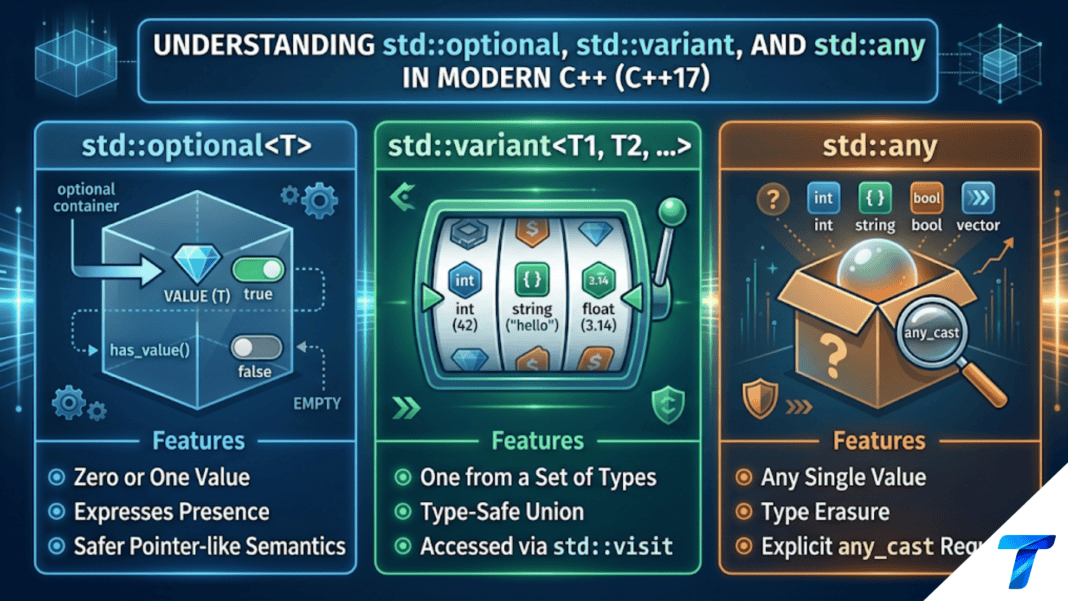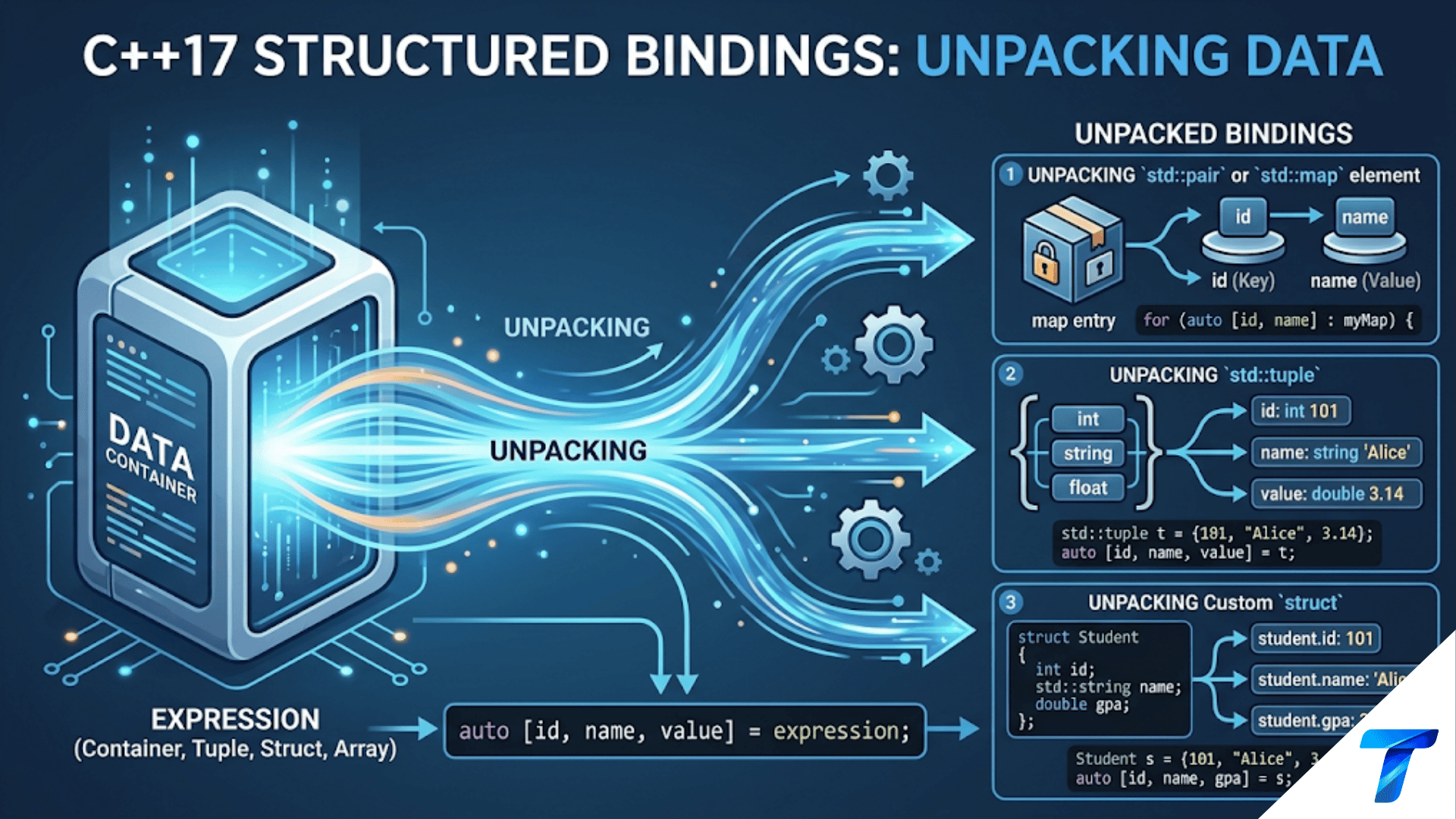

Structured bindings (C++17) let you unpack the elements of a tuple, pair, array, or struct into individual named variables in a single declaration: auto [x, y] = somePoint; or auto [key, value] = someMapEntry;. The syntax is auto [name1, name2, ...] = expression;. Structured bindings work with any type that satisfies the tuple-like protocol — including std::pair, std::tuple, std::array, plain aggregates, and any type that provides get<N>() specializations.
Introduction
Before C++17, extracting multiple values from a compound type was verbose and error-prone. To iterate over a std::map, you wrote auto it = m.begin(); it->first and it->second — or unpacked a std::pair with .first and .second. To get values from a tuple, you called std::get<0>(t), std::get<1>(t), std::get<2>(t). The member names were anonymous (first, second, 0, 1) and carried no semantic meaning about what they represented.
C++17 introduced structured bindings — a concise syntax to decompose compound types into named variables in a single declaration. auto [name, age, salary] = getEmployee() immediately tells the reader what each component represents, replaces three separate variable declarations, and works for any type that exposes its elements via the tuple protocol.
Structured bindings are not just syntactic sugar — they are a meaningful improvement to code clarity and correctness. Named variables are self-documenting. A single declaration cannot be accidentally reordered. The types are deduced automatically, eliminating the need to write std::string name = std::get<0>(t) when auto [name, ...] suffices.
This article teaches structured bindings comprehensively: the basic syntax, how they work with pairs, tuples, arrays, and structs, how to use them in range-for loops, how they interact with references and const, and how to extend them to your own types with a custom get<N>() protocol.
Basic Syntax: Pairs and Tuples
The most common use of structured bindings is unpacking std::pair and std::tuple:
#include <iostream>
#include <map>
#include <tuple>
#include <string>
using namespace std;

// Returns a pair
pair<string, int> getNameAndAge() {
    return {"Alice", 30};
}

// Returns a tuple of three values
tuple<string, int, double> getEmployee() {
    return {"Bob", 25, 75000.0};
}

// Returns a tuple with named semantics via structured binding
tuple<bool, string, int> tryParse(const string& input) {
    if (input.empty()) return {false, "Empty input", 0};
    try {
        int val = stoi(input);
        return {true, "", val};
    } catch (...) {
        return {false, "Not a number", 0};
    }
}

int main() {
    // Before C++17: verbose and semantic-free
    auto p = getNameAndAge();
    string old_name = p.first;    // What is 'first'? A name? An ID?
    int    old_age  = p.second;   // What is 'second'? An age? A count?

    // C++17 structured bindings: concise and self-documenting
    auto [name, age] = getNameAndAge();
    cout << "Name: " << name << ", Age: " << age << endl;

    // Tuples: replace std::get<N> with readable names
    auto [empName, empAge, salary] = getEmployee();
    cout << "Employee: " << empName
         << ", Age: "    << empAge
         << ", Salary: " << salary << endl;

    // In-place with literal values
    auto [x, y, z] = tuple{1.0, 2.0, 3.0};
    cout << "Point: (" << x << ", " << y << ", " << z << ")" << endl;

    // Structured binding with tryParse
    auto [ok, errorMsg, value] = tryParse("42");
    if (ok) {
        cout << "Parsed: " << value << endl;
    } else {
        cout << "Error: " << errorMsg << endl;
    }

    auto [ok2, errorMsg2, value2] = tryParse("hello");
    if (!ok2) {
        cout << "Error: " << errorMsg2 << endl;
    }

    // Map iteration: the classic use case
    cout << "\n--- Map iteration ---" << endl;
    map<string, int> scores = {
        {"Alice", 95},
        {"Bob",   87},
        {"Carol", 92}
    };

    // Before C++17:
    for (const auto& entry : scores) {
        cout << entry.first << ": " << entry.second << endl;
    }

    cout << "\n--- With structured bindings ---" << endl;
    // C++17: clear, readable, less error-prone
    for (const auto& [student, score] : scores) {
        cout << student << ": " << score << endl;
    }

    return 0;
}
Output:
Name: Alice, Age: 30
Employee: Bob, Age: 25, Salary: 75000
Point: (1, 2, 3)
Parsed: 42
Error: Not a number

--- Map iteration ---
Alice: 95
Bob: 87
Carol: 92

--- With structured bindings ---
Alice: 95
Bob: 87
Carol: 92
Step-by-step explanation:
auto [name, age] = getNameAndAge()creates two variablesname(deduced asstring) andage(deduced asint). The compiler destructures the returnedpair<string, int>into these names. The types are deduced from the pair’s element types.auto [empName, empAge, salary] = getEmployee()works identically for atuple<string, int, double>. Each name binds to the corresponding tuple element in order. The types arestring,int, anddoublerespectively.- The
tryParsepattern — returning atuple<bool, string, T>— becomes genuinely readable with structured bindings:auto [ok, errorMsg, value]clearly communicates the three-part result. Without structured bindings, you’d writeget<0>(result)to check success, which is opaque. for (const auto& [student, score] : scores)is the single most common use of structured bindings in practice. Everymapiteration becomes immediately readable —entry.firstandentry.secondare meaningless;studentandscoreare self-documenting.- The names in the structured binding are new variables — they shadow any outer variables with the same name in that scope. Each binding name must be unique within the binding.
Structured Bindings with Arrays and Aggregates
Structured bindings are not limited to std::pair and std::tuple — they work with C arrays and any aggregate struct (a struct with no user-declared constructors, no private members, and no virtual functions).
#include <iostream>
#include <array>
using namespace std;

// Plain struct (aggregate): no constructor needed
struct Point2D {
    double x, y;
};

struct Point3D {
    double x, y, z;
};

struct RGB {
    uint8_t r, g, b;
};

struct NamedRange {
    string name;
    int    low;
    int    high;
};

// Aggregate with computed property
struct BoundingBox {
    double left, top, right, bottom;

    double width()  const { return right - left; }
    double height() const { return bottom - top; }
};

Point2D getMidpoint(Point2D a, Point2D b) {
    return {(a.x + b.x) / 2, (a.y + b.y) / 2};
}

int main() {
    // C-style arrays
    cout << "=== Arrays ===" << endl;
    int arr3[3] = {10, 20, 30};
    auto [a, b, c] = arr3;
    cout << "a=" << a << " b=" << b << " c=" << c << endl;

    // std::array
    array<double, 4> quad = {1.1, 2.2, 3.3, 4.4};
    auto [q0, q1, q2, q3] = quad;
    cout << "Quadruple: " << q0 << " " << q1 << " " << q2 << " " << q3 << endl;

    // Aggregate structs: binds in declaration order
    cout << "\n=== Aggregate structs ===" << endl;
    Point2D p{3.0, 4.0};
    auto [px, py] = p;
    cout << "Point: (" << px << ", " << py << ")" << endl;

    Point3D p3{1.0, 2.0, 3.0};
    auto [x, y, z] = p3;
    cout << "3D Point: (" << x << ", " << y << ", " << z << ")" << endl;

    RGB color{255, 128, 0};
    auto [red, green, blue] = color;
    cout << "Color: rgb(" << (int)red << ", " << (int)green << ", " << (int)blue << ")" << endl;

    // Works with functions returning aggregates
    Point2D mid = getMidpoint({0.0, 0.0}, {6.0, 8.0});
    auto [mx, my] = mid;
    cout << "Midpoint: (" << mx << ", " << my << ")" << endl;

    // Structured binding in a loop over array of structs
    cout << "\n=== Iterating struct arrays ===" << endl;
    NamedRange ranges[] = {
        {"temperature", -40, 120},
        {"pressure",      0, 200},
        {"humidity",      0, 100}
    };

    for (const auto& [name, low, high] : ranges) {
        cout << name << ": [" << low << ", " << high << "]" << endl;
    }

    // BoundingBox with structured binding
    cout << "\n=== BoundingBox ===" << endl;
    BoundingBox bb{10.0, 20.0, 50.0, 80.0};
    auto [left, top, right, bottom] = bb;
    cout << "Bounds: left=" << left << " top=" << top
         << " right=" << right << " bottom=" << bottom << endl;
    cout << "Width=" << bb.width() << " Height=" << bb.height() << endl;
    // Note: width() and height() are still accessible through bb
    // The binding only captures the data members, not methods

    // Nested structs: need to bind step by step
    cout << "\n=== Nested binding ===" << endl;
    pair<Point2D, Point2D> segment{{1.0, 2.0}, {5.0, 6.0}};
    auto [start, end] = segment;            // bind the pair
    auto [sx, sy] = start;                  // then bind the struct
    auto [ex, ey] = end;
    cout << "Segment: (" << sx << "," << sy << ") to (" << ex << "," << ey << ")" << endl;

    return 0;
}
Output:
=== Arrays ===
a=10 b=20 c=30

=== Aggregate structs ===
Point: (3, 4)
3D Point: (1, 2, 3)
Color: rgb(255, 128, 0)
Midpoint: (3, 4)

=== Iterating struct arrays ===
temperature: [-40, 120]
pressure: [0, 200]
humidity: [0, 100]

=== BoundingBox ===
Bounds: left=10 top=20 right=50 bottom=80
Width=40 Height=60

=== Nested binding ===
Segment: (1,2) to (5,6)
Step-by-step explanation:
- For C arrays and
std::array, structured bindings decompose by index:auto [a, b, c] = arr3bindsatoarr3[0],btoarr3[1],ctoarr3[2]. The number of binding names must exactly match the array size. - For aggregate structs, binding is in declaration order of the non-static data members.
auto [px, py] = pgivespx = p.xandpy = p.ybecausexis declared beforeyinPoint2D. You cannot reorder the binding. for (const auto& [name, low, high] : ranges)iterates over an array ofNamedRangestructs. Each iteration destructures the struct into three named variables — the code reads like English: “for each (name, low, high) in ranges.”- Structured bindings of aggregates only bind data members, not methods.
bb.width()remains accessible throughbbafter binding — the binding capturesleft,top,right,bottombut not the computed properties. - Nested structs require step-by-step binding — there is no nested destructuring syntax like
auto [[[sx, sy], [ex, ey]]] = segment. Each level of nesting requires its own binding declaration.
References, const, and Modification
Structured bindings support the full qualifier spectrum — auto, const auto, auto&, const auto&, and auto&&:
#include <iostream>
#include <map>
#include <tuple>
using namespace std;

struct Counter {
    string name;
    int    count;
    double rate;
};

int main() {
    // --- auto: copy ---
    cout << "=== auto: copies ===" << endl;
    pair<int, int> original{10, 20};
    auto [x, y] = original;   // x and y are COPIES
    x = 999;                   // Modifying x does NOT change original
    cout << "original.first: " << original.first << endl;  // Still 10
    cout << "x: " << x << endl;                             // 999

    // --- auto&: references to original ---
    cout << "\n=== auto&: references ===" << endl;
    pair<int, int> data{100, 200};
    auto& [a, b] = data;    // a and b ARE references into data
    a = 999;                 // Modifies data.first
    b = 888;                 // Modifies data.second
    cout << "data.first:  " << data.first  << endl;  // 999
    cout << "data.second: " << data.second << endl;  // 888

    // --- const auto&: read-only references ---
    cout << "\n=== const auto&: read-only ===" << endl;
    tuple<string, int, double> emp{"Carol", 32, 90000.0};
    const auto& [empName, empAge, empSalary] = emp;
    cout << empName << ": age=" << empAge << " salary=" << empSalary << endl;
    // empName = "Dave";  // COMPILE ERROR: binding is const
    // empAge++;          // COMPILE ERROR: binding is const

    // --- Modifying a map through structured binding ---
    cout << "\n=== Modifying through structured binding ===" << endl;
    map<string, int> inventory = {{"apples", 5}, {"bananas", 3}, {"oranges", 7}};

    // Give everyone a 10% raise (multiply by 1.1, round)
    for (auto& [item, qty] : inventory) {
        cout << "Before: " << item << " = " << qty << endl;
        qty += 2;  // Modify in place through reference
    }
    cout << "\nAfter adding 2 to each:" << endl;
    for (const auto& [item, qty] : inventory) {
        cout << item << " = " << qty << endl;
    }

    // --- auto&&: forwarding reference (perfect for generic code) ---
    cout << "\n=== auto&&: forwarding reference ===" << endl;
    auto&& [fx, fy] = pair{42, 3.14};  // Binds to rvalue
    cout << "fx=" << fx << " fy=" << fy << endl;
    // For lvalues, auto&& deduces to lvalue reference
    pair<int, double> lval{1, 2.0};
    auto&& [lx, ly] = lval;  // lx and ly are lvalue refs
    lx = 99;
    cout << "lval.first after lx=99: " << lval.first << endl;

    // --- Structured binding with array of structs (modification) ---
    cout << "\n=== Modifying array of structs ===" << endl;
    Counter counters[] = {
        {"requests", 0, 0.0},
        {"errors",   0, 0.0},
        {"timeouts", 0, 0.0}
    };

    // Simulate some events
    for (auto& [name, count, rate] : counters) {
        count += 10;
        rate = count * 0.1;
    }

    for (const auto& [name, count, rate] : counters) {
        cout << name << ": count=" << count << " rate=" << rate << endl;
    }

    return 0;
}
Output:
=== auto: copies ===
original.first: 10
x: 999

=== auto&: references ===
data.first:  999
data.second: 888

=== const auto&: read-only ===
Carol: age=32 salary=90000

=== Modifying through structured binding ===
Before: apples = 5
Before: bananas = 3
Before: oranges = 7

After adding 2 to each:
apples = 7
bananas = 5
oranges = 9

=== auto&&: forwarding reference ===
fx=42 fy=3.14
lval.first after lx=99: 99

=== Modifying array of structs ===
requests: count=10 rate=1
errors: count=10 rate=1
timeouts: count=10 rate=1
Step-by-step explanation:
auto [x, y] = originalcreates copies. Modifyingxhas no effect onoriginal.first— they are independent variables. This is the same semantics asauto x = original.first.auto& [a, b] = datacreates references.ais a reference todata.first,bis a reference todata.second. Writinga = 999modifiesdata.firstdirectly. This is key for the map-modification pattern.const auto& [empName, empAge, empSalary] = empcreates const references — readable but not writable. This is the most efficient binding for read-only access: no copy, no modification risk.for (auto& [item, qty] : inventory)— note theauto&. Without the&,itemandqtywould be copies; incrementingqtywould not affect the map. The&makes them references into the map’s entries.auto&&(forwarding reference) deduces to an lvalue reference when bound to an lvalue, and to an rvalue reference when bound to an rvalue. This is useful in generic code (function templates) where you want to preserve the value category.
Structured Bindings in Algorithms and Conditionals
Structured bindings combine naturally with algorithms and control flow:
#include <iostream>
#include <map>
#include <set>
#include <vector>
#include <algorithm>
#include <tuple>
using namespace std;

int main() {
    // --- Structured binding with insert result ---
    cout << "=== map::insert and set::insert ===" << endl;
    set<int> s;

    // insert returns pair<iterator, bool>
    auto [it1, inserted1] = s.insert(42);
    cout << "Inserted 42: " << (inserted1 ? "yes" : "no")
         << ", value: " << *it1 << endl;

    auto [it2, inserted2] = s.insert(42);  // Duplicate
    cout << "Inserted 42 again: " << (inserted2 ? "yes" : "no") << endl;

    // map::emplace also returns pair<iterator, bool>
    map<string, int> m;
    auto [pos1, ok1] = m.emplace("Alice", 95);
    cout << "Emplaced Alice: " << (ok1 ? "yes" : "no")
         << ", score: " << pos1->second << endl;

    auto [pos2, ok2] = m.emplace("Alice", 100);  // Fails: key exists
    cout << "Emplaced Alice again: " << (ok2 ? "yes" : "no") << endl;

    // --- Using structured binding in if-init statement (C++17) ---
    cout << "\n=== if with structured binding (C++17) ===" << endl;
    map<string, int> grades = {{"Alice", 95}, {"Bob", 72}, {"Carol", 88}};

    if (auto [it, found] = grades.find("Bob"); it != grades.end()) {
        auto [name_unused, grade] = *it;
        cout << "Found Bob's grade: " << grade << endl;
    }

    // --- Sorting with structured bindings ---
    cout << "\n=== Sorting tuples ===" << endl;
    vector<tuple<int, string, double>> students = {
        {3, "Charlie", 3.2},
        {1, "Alice",   3.9},
        {2, "Bob",     3.5}
    };

    // Sort by GPA descending
    sort(students.begin(), students.end(),
         [](const auto& lhs, const auto& rhs) {
             const auto& [lid, lname, lgpa] = lhs;
             const auto& [rid, rname, rgpa] = rhs;
             return lgpa > rgpa;
         });

    cout << "Sorted by GPA (desc):" << endl;
    for (const auto& [id, name, gpa] : students) {
        cout << "  " << id << ". " << name << ": " << gpa << endl;
    }

    // --- Structured binding in switch (C++17) ---
    cout << "\n=== Structured binding for multi-return functions ===" << endl;
    auto parseCoord = [](const string& s) -> tuple<bool, double, double> {
        // Simplified: expect "x,y" format
        auto comma = s.find(',');
        if (comma == string::npos) return {false, 0.0, 0.0};
        try {
            double x = stod(s.substr(0, comma));
            double y = stod(s.substr(comma + 1));
            return {true, x, y};
        } catch (...) {
            return {false, 0.0, 0.0};
        }
    };

    for (const string& input : {"3.14,2.71", "bad,input", "1.0,2.0"}) {
        if (auto [valid, cx, cy] = parseCoord(input); valid) {
            cout << "  Parsed (" << cx << ", " << cy << ")" << endl;
        } else {
            cout << "  Invalid: '" << input << "'" << endl;
        }
    }

    // --- min_element / max_element with structured bindings ---
    cout << "\n=== Finding min/max in map ===" << endl;
    map<string, int> scores = {{"Alice", 95}, {"Bob", 72}, {"Carol", 88}, {"Dave", 91}};

    auto [minName, minScore] = *min_element(
        scores.begin(), scores.end(),
        [](const auto& a, const auto& b) { return a.second < b.second; }
    );
    auto [maxName, maxScore] = *max_element(
        scores.begin(), scores.end(),
        [](const auto& a, const auto& b) { return a.second < b.second; }
    );

    cout << "Lowest:  " << minName << " (" << minScore << ")" << endl;
    cout << "Highest: " << maxName << " (" << maxScore << ")" << endl;

    return 0;
}
Output:
=== map::insert and set::insert ===
Inserted 42: yes, value: 42
Inserted 42 again: no
Emplaced Alice: yes, score: 95
Emplaced Alice again: no

=== if with structured binding (C++17) ===
Found Bob's grade: 72

=== Sorting tuples ===
Sorted by GPA (desc):
  1. Alice: 3.9
  2. Bob: 3.5
  3. Charlie: 3.2

=== Structured binding for multi-return functions ===
  Parsed (3.14, 2.71)
  Invalid: 'bad,input'
  Parsed (1, 2)

=== Finding min/max in map ===
Lowest:  Bob (72)
Highest: Alice (95)
Step-by-step explanation:
auto [it, inserted] = s.insert(42)is perhaps the most important practical use of structured bindings for C++ programmers. Before C++17, you wroteauto result = s.insert(42); if (result.second)— opaque. With structured bindings,insertedclearly signals what the boolean means.if (auto [it, found] = grades.find("Bob"); it != grades.end())is a C++17 if-init statement combined with a structured binding. The binding[it, found]is scoped to the if block — it does not pollute the enclosing scope. Note:grades.findreturns a single iterator, sofoundhere is not really appropriate — the example shows the syntax pattern; typically you’d justauto it = grades.find("Bob").- In the lambda comparator
[](const auto& lhs, const auto& rhs), each parameter is atuplebound inside the lambda body withconst auto& [lid, lname, lgpa] = lhs. This makes the comparison readable — you comparelgpa > rgpainstead ofget<2>(lhs) > get<2>(rhs). if (auto [valid, cx, cy] = parseCoord(input); valid)is the canonical pattern for functions returningtuple<bool, T, U>: parse, destructure, and check validity in a single if-init statement. The binding variables are scoped to the if/else blocks.auto [minName, minScore] = *min_element(...)dereferences the iterator returned bymin_elementand immediately destructures thepair<const string, int>map entry. This replacesresult->firstandresult->secondwith meaningful names in one line.
Extending Structured Bindings to Custom Types
You can make your own types work with structured bindings by implementing the tuple-like protocol: specializations of std::tuple_size, std::tuple_element, and a get<N>() function.
#include <iostream>
#include <tuple>
#include <string>
using namespace std;

// Custom type: a 2D vector with custom structured binding support
struct Vec2 {
    double x, y;

    // We want: auto [vx, vy] = myVec2;
    // Vec2 is already an aggregate — structured bindings work automatically!
    // But let's demonstrate the protocol for a non-aggregate:
};

// Non-aggregate example: a class with private members
class Color {
    uint8_t r_, g_, b_, a_;
public:
    Color(uint8_t r, uint8_t g, uint8_t b, uint8_t a = 255)
        : r_(r), g_(g), b_(b), a_(a) {}

    uint8_t r() const { return r_; }
    uint8_t g() const { return g_; }
    uint8_t b() const { return b_; }
    uint8_t a() const { return a_; }

    // Required: get<N> as member template (or free function)
    template<size_t N>
    auto get() const {
        if constexpr (N == 0) return r_;
        else if constexpr (N == 1) return g_;
        else if constexpr (N == 2) return b_;
        else if constexpr (N == 3) return a_;
    }
};

// Required: specializations in std namespace
namespace std {
    // How many elements does Color have?
    template<>
    struct tuple_size<Color> : integral_constant<size_t, 4> {};

    // What is the type of each element?
    template<size_t N>
    struct tuple_element<N, Color> {
        using type = uint8_t;
    };
}

// Another example: named pair with semantic get<>
struct Range {
    double min_val;
    double max_val;

    double length() const { return max_val - min_val; }
    bool   contains(double v) const { return v >= min_val && v <= max_val; }

    template<size_t N>
    double get() const {
        if constexpr (N == 0) return min_val;
        else                  return max_val;
    }
};

namespace std {
    template<>
    struct tuple_size<Range> : integral_constant<size_t, 2> {};

    template<size_t N>
    struct tuple_element<N, Range> {
        using type = double;
    };
}

// A generic function that works with any 2-element bindable type
template<typename T>
void printBounds(const T& bounds) {
    const auto& [lo, hi] = bounds;
    cout << "[" << lo << ", " << hi << "]" << endl;
}

int main() {
    // Vec2: aggregate — works automatically
    cout << "=== Vec2 (aggregate, automatic) ===" << endl;
    Vec2 v{3.0, 4.0};
    auto [vx, vy] = v;
    cout << "Vec2: (" << vx << ", " << vy << ")" << endl;

    // Color: non-aggregate with custom protocol
    cout << "\n=== Color (custom protocol) ===" << endl;
    Color sky{135, 206, 235, 255};
    auto [r, g, b, a] = sky;
    cout << "Sky color: rgba("
         << (int)r << ", " << (int)g << ", "
         << (int)b << ", " << (int)a << ")" << endl;

    // Modify through reference binding (if get() returns reference)
    // Note: our get() returns by value, so auto& binding gives const-refs
    const auto& [cr, cg, cb, ca] = sky;
    cout << "Red component: " << (int)cr << endl;

    // Range: custom protocol
    cout << "\n=== Range (custom protocol) ===" << endl;
    Range temperature{-20.0, 40.0};
    auto [minT, maxT] = temperature;
    cout << "Temperature range: [" << minT << ", " << maxT << "]" << endl;
    cout << "Length: " << temperature.length() << endl;
    cout << "Contains 25°: " << (temperature.contains(25.0) ? "yes" : "no") << endl;

    // Generic function using the custom protocol
    printBounds(temperature);

    // Works with standard pair too (same 2-element protocol)
    pair<double, double> stdRange{0.0, 100.0};
    printBounds(stdRange);

    // --- Array of Colors iterated with structured binding ---
    cout << "\n=== Iterating Colors ===" << endl;
    Color palette[] = {
        {255, 0,   0,   255},  // Red
        {0,   255, 0,   255},  // Green
        {0,   0,   255, 255},  // Blue
    };
    const char* names[] = {"Red", "Green", "Blue"};
    for (int i = 0; i < 3; i++) {
        auto [pr, pg, pb, pa] = palette[i];
        cout << names[i] << ": rgba("
             << (int)pr << ", " << (int)pg << ", "
             << (int)pb << ", " << (int)pa << ")" << endl;
    }

    return 0;
}
Output:
=== Vec2 (aggregate, automatic) ===
Vec2: (3, 4)

=== Color (custom protocol) ===
Sky color: rgba(135, 206, 235, 255)
Red component: 135

=== Range (custom protocol) ===
Temperature range: [-20, 40]
Length: 60
Contains 25°: yes
[-20, 40]
[0, 100]

=== Iterating Colors ===
Red: rgba(255, 0, 0, 255)
Green: rgba(0, 255, 0, 255)
Blue: rgba(0, 0, 255, 255)
Step-by-step explanation:
- The tuple-like protocol requires three components:
std::tuple_size<T>(number of elements),std::tuple_element<N, T>(type of element N), and aget<N>()function (access element N). Implement all three and structured bindings work automatically. template<size_t N> auto get() constwithif constexpris the idiomatic way to implement the membergetfunction. Each compile-time branch returns the corresponding member — the compiler selects the correct branch forN=0,N=1, etc.- Aggregates (like
Vec2) do not need the protocol — the compiler automatically generates it from the member declarations. Only non-aggregate types (with private members, user-defined constructors, or virtual functions) need the explicit protocol. printBoundsis a template function that uses structured bindings internally. It works with any 2-element tuple-like type:Range,pair<double, double>,array<double, 2>, or any custom type with the protocol. This is a form of generic programming enabled by the uniform structured binding interface.- The specializations go in
namespace stdbecausetuple_sizeandtuple_elementare standard templates being specialized for your type. This is one of the few cases where adding tonamespace stdis explicitly permitted by the standard.
Common Patterns and Idioms
#include <iostream>
#include <map>
#include <vector>
#include <algorithm>
#include <tuple>
using namespace std;

int main() {
    // Pattern 1: Multi-return with structured binding
    auto minmax = [](const vector<int>& v) -> pair<int,int> {
        auto [mn, mx] = minmax_element(v.begin(), v.end());
        return {*mn, *mx};
    };

    vector<int> data = {5, 2, 8, 1, 9, 3};
    auto [lo, hi] = minmax(data);
    cout << "Range: [" << lo << ", " << hi << "]" << endl;

    // Pattern 2: Enumerate (index + value) using ranges or manual
    cout << "\nEnumerated:" << endl;
    vector<string> fruits = {"apple", "banana", "cherry"};
    for (size_t i = 0; i < fruits.size(); i++) {
        // Simulate enumerate with tuple
        auto [idx, fruit] = tuple{i, fruits[i]};
        cout << "  " << idx << ": " << fruit << endl;
    }

    // Pattern 3: Swap via structured binding (assign, not swap)
    cout << "\nSwap pattern:" << endl;
    int p = 10, q = 20;
    tie(p, q) = {q, p};  // std::tie assignment — slightly different but related
    cout << "p=" << p << " q=" << q << endl;

    // Pattern 4: Ignoring elements with _ (convention, not syntax)
    // C++ has no official "ignore" for structured bindings, but _ is conventional
    auto getTriple = []() { return tuple{1, 2, 3}; };
    auto [first, _, third] = getTriple();  // _ is just a variable named underscore
    cout << "first=" << first << " third=" << third << endl;

    // Pattern 5: Structured binding for algorithm results
    cout << "\nalgorithm results:" << endl;
    vector<int> nums = {1, 2, 3, 4, 5, 6, 7, 8, 9, 10};
    auto [part_it, _2] = stable_partition(nums.begin(), nums.end(),
                                           [](int n) { return n % 2 == 0; });
    cout << "Evens: ";
    for (auto it = nums.begin(); it != part_it; ++it) cout << *it << " ";
    cout << "\nOdds: ";
    for (auto it = part_it; it != nums.end(); ++it) cout << *it << " ";
    cout << endl;

    // Pattern 6: Structured binding + structured binding
    cout << "\nNested data:" << endl;
    map<string, pair<int, double>> employeeData = {
        {"Alice", {30, 95000.0}},
        {"Bob",   {25, 72000.0}},
    };

    for (const auto& [name, details] : employeeData) {
        const auto& [age, salary] = details;
        cout << name << ": age=" << age << " salary=$" << salary << endl;
    }

    return 0;
}
Output:
Range: [1, 9]

Enumerated:
  0: apple
  1: banana
  2: cherry

Swap pattern:
p=20 q=10

first=1 third=3

algorithm results:
Evens: 2 4 6 8 10
Odds: 1 3 5 7 9

Nested data:
Alice: age=30 salary=$95000
Bob: age=25 salary=$72000
Common Mistakes
Mistake 1: Wrong number of binding names.
pair<int, int> p{1, 2};
auto [a, b, c] = p;  // COMPILE ERROR: pair has 2 elements, not 3
auto [a]       = p;  // COMPILE ERROR: pair has 2 elements, not 1
auto [a, b]    = p;  // OK
Mistake 2: Forgetting & and making unintended copies.
map<string, LargeObject> m;
for (auto [key, val] : m) {  // WRONG: copies every entry — expensive!
    // val is a copy of the map value
}
for (const auto& [key, val] : m) {  // CORRECT: binds by const reference
    // val is a const reference — no copy
}
for (auto& [key, val] : m) {        // CORRECT: binds by reference for modification
    val.update();  // Modifies the map value in place
}
Mistake 3: Binding non-aggregates without the protocol.
class Widget {
    int x, y;  // private
public:
    Widget(int a, int b) : x(a), y(b) {}
};

Widget w{1, 2};
auto [a, b] = w;  // COMPILE ERROR: Widget is not an aggregate
                   // Fix: implement the tuple-like protocol (get<N>, tuple_size, tuple_element)
                   // Or: make it an aggregate (no private members, no user constructor)
Mistake 4: Expecting auto [x,y] = point to call getters.
struct Point {
    double getX() const { return x_; }
    double getY() const { return y_; }
private:
    double x_, y_;
};
Point p{};
auto [x, y] = p;  // ERROR: p is not an aggregate and has no tuple protocol
                   // Structured bindings bind to data members, NOT getters
Mistake 5: Modifying the key of a map entry.
map<string, int> m = {{"Alice", 95}};
for (auto& [key, val] : m) {
    key = "Bob";  // COMPILE ERROR: map keys are const — key is const string&
    val = 100;    // OK: values are modifiable
}
Structured Bindings Quick Reference
| Syntax | Behavior | Use when |
|---|---|---|
auto [a, b] = expr |
Copies all elements | You want independent copies |
auto& [a, b] = expr |
References to elements | You want to read or modify original |
const auto& [a, b] = expr |
Const references | Read-only access, avoid copies |
auto&& [a, b] = expr |
Forwarding references | Generic code, preserving value category |
auto [a, b, c] = tuple{...} |
Binds all 3 elements | Tuple or multi-return decomposition |
for (auto& [k, v] : map) |
Iterate and modify map values | Map modification loop |
for (const auto& [k, v] : map) |
Iterate read-only | Map read loop |
auto [it, ok] = set.insert(x) |
Insert result decomposition | Checked insertion |
if (auto [it, ok] = m.emplace(...); ok) |
if-init with binding | Inline result checking |
Conclusion
Structured bindings are one of C++17’s most immediately useful quality-of-life improvements. The syntax auto [a, b, c] = expression is concise, type-safe, and self-documenting — transforming opaque get<0>(), .first, .second accesses into meaningful names that reveal intent.
The feature works broadly: std::pair, std::tuple, std::array, C arrays, aggregate structs, and any custom type that implements the three-part tuple protocol (tuple_size, tuple_element, get<N>). The qualifier rules — auto for copies, auto& for references, const auto& for read-only references — mirror standard C++ reference semantics, making structured bindings predictable for anyone who knows C++ references.
In practice, the two most impactful uses are map iteration (for (const auto& [key, value] : map)) and multi-return functions (auto [ok, error, result] = tryOperation()). Both cases dramatically improve readability over the alternatives — .first/.second for pairs, and std::get<N>() for tuples.
Combined with C++17’s other features — if constexpr, std::optional, std::variant, class template argument deduction — structured bindings contribute to a modern C++ style that is more expressive, safer, and more readable than the C++11/14 equivalent. Any codebase targeting C++17 or later should adopt structured bindings as a standard idiom.