

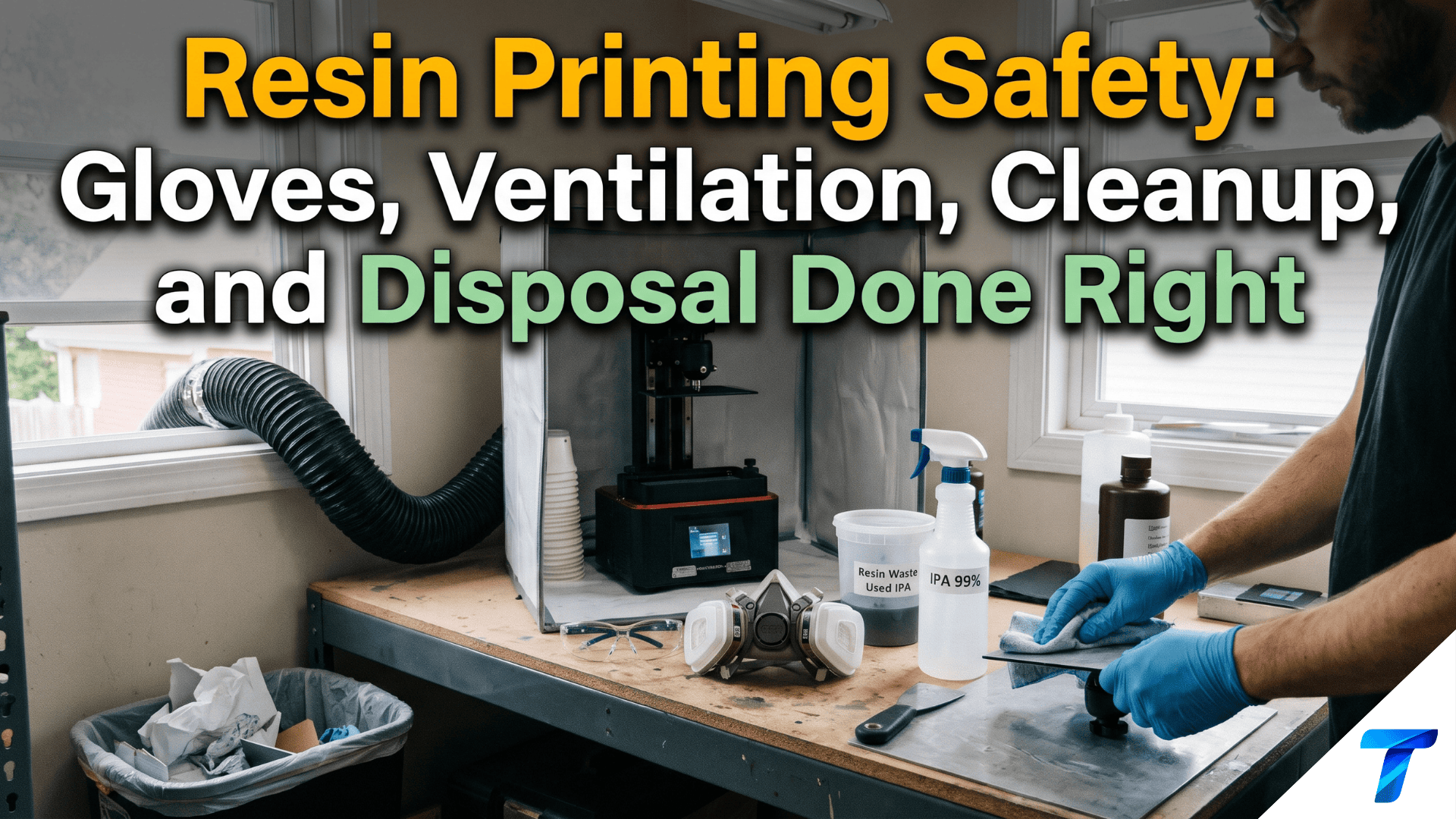

Liquid photopolymer resin is a skin sensitizer, a vapor source, and a waste stream you cannot pour down the drain. Treat it like a lab chemical and it will print beautiful parts for years. Treat it like paint and you risk a permanent allergy to acrylates, which ends many hobbyists’ careers in resin printing.
Quick Takeaways
- Wear nitrile gloves (5 mil or thicker), not latex. Change them every 15-30 minutes during active handling, or immediately after contact.
- Ventilate at the source. A vented enclosure or a window exhaust fan beats a room fan or a “carbon filter” alone.
- Cure all waste before disposal. Liquid resin, resin-contaminated IPA, and wash water become far safer once fully UV-cured into solids.
- Never wash resin off skin with IPA. Use soap and cool water.
| Hazard | Primary Risk | Main Control | Cost |
|---|---|---|---|
| Skin contact | Sensitization, dermatitis | Nitrile gloves, sleeves | Low |
| Vapors (VOCs) | Headaches, irritation | Exhaust ventilation | Low-Medium |
| IPA cleaning | Fire, vapor, eye irritation | Sealed wash station, no ignition sources | Low |
| Liquid waste | Environmental contamination | UV curing, local disposal rules | Free |
Why Resin Is Different From Filament
Filament printing mostly threatens burns and fumes at high temperatures. Resin printing involves uncured acrylate monomers and oligomers, which are skin and eye irritants. Repeated exposure can trigger sensitization, an immune response that is cumulative and permanent. Once sensitized, even trace contact can cause rashes, and the allergy may extend to dental materials, nail products, and some adhesives.
Most consumer resins are labeled “low odor,” but low odor does not mean low hazard. Your nose can fatigue within minutes. Always read the Safety Data Sheet (SDS) for your specific resin. Look at Section 2 (hazard identification), Section 8 (exposure controls), and Section 13 (disposal).
Gloves: Your First Line of Defense
Choose the Right Material
| Glove Type | Resin Protection | Verdict |
|---|---|---|
| Nitrile (5-8 mil) | Good for short contact | Best everyday choice |
| Thin nitrile (2-3 mil) | Resin can permeate within minutes | Fine for light handling, change often |
| Latex | Poor, monomers pass through readily | Avoid |
| Vinyl | Poor | Avoid |
| Butyl rubber | Excellent | Overkill, useful for large IPA tubs |
Glove Rules That Actually Work
- Double glove during plate removal and part transfer, the messiest steps.
- Inspect for tears before each session. Resin on a damaged glove sits against your skin.
- Remove gloves inside out. Peel from the cuff so the contaminated surface ends up inside the glove.
- Never touch your phone, door handles, or keyboard with gloved hands.
- Wear long sleeves or disposable sleeve covers. Wrists are the most common exposure point.
- Dispose of used gloves in a sealed bag, ideally after leaving them under UV light, since resin-coated gloves are still hazardous.
Add safety glasses or splash goggles during resin pouring and IPA washing. A single resin splash to the eye needs immediate rinsing for 15 minutes and medical attention.
Ventilation: Control Vapors Where They Start
Resin vapors come from the vat, the build plate, uncured parts, and especially your IPA wash station. The goal is to capture and exhaust them rather than dilute them in your living space.
Ventilation Options Ranked
| Setup | Effectiveness | Notes |
|---|---|---|
| Vented enclosure with exhaust to outdoors | Highest | Use a duct fan rated for 100-200 CFM, ducted through a window |
| Open window plus exhaust fan | High | Place the fan between printer and window, blowing out |
| Dedicated room with door closed and exhaust | High | Keep air pressure slightly negative |
| Carbon-filter-only recirculating tent | Moderate | Filters saturate and cannot remove all VOCs |
| Ceiling fan or desk fan | Poor | Circulates vapors, removes nothing |
Practical Placement Tips
- Print in a separate room, not where you sleep or eat. Garages and sheds work if temperatures stay in the 20-25°C (68-77°F) range. Resin viscosity and print success both depend on it.
- Keep the printer lid on during printing. Most printers include a UV-blocking cover that also contains vapor.
- Exhaust outdoors, away from neighbors’ windows and air intakes.
- Consider an organic vapor (OV) respirator with replaceable cartridges, such as a half-mask rated for organic vapors, if you cannot vent properly or if you are handling large volumes. A paper dust mask does nothing for VOCs.
Cleanup: Washing Without Contaminating Your Space
Handling Uncured Parts
- Let the plate drip over the vat for 2-5 minutes to return resin.
- Remove parts with a plastic scraper, never metal on FEP film.
- Transfer parts to a wash container immediately.
IPA Washing Done Safely
Use isopropyl alcohol at 90% or higher for best results. Run a two-bath method: a first dirty bath for bulk resin and a second cleaner bath for the final rinse. Wash times are typically 2-5 minutes per bath. Longer soaks can make some resins brittle or cloudy.
IPA safety essentials:
- IPA has a flash point near 12°C (53°F). That means it can ignite at normal room temperature if vapors meet a spark.
- Keep it away from heaters, space heaters, and power tools.
- Wash in a sealed container and keep it closed when not in use.
- If you use an ultrasonic cleaner, put IPA in an inner sealed container and water in the outer tank. Never heat IPA directly.
Water-Washable Resin Is Not Exempt
Water-washable resins are still chemically active. Wash water contains uncured resin and should not go down the drain. Treat it like contaminated IPA: collect it and cure it.
Skin Contact First Aid
- Wipe off bulk resin with a dry paper towel.
- Wash with soap and cool water for several minutes.
- Do not use IPA or solvents on skin. They strip protective oils and can carry resin deeper.
- If a rash, blistering, or swelling develops, see a doctor and bring the SDS.
Curing and Post-Processing Safety
Post-curing at 405 nm typically takes 2-60 minutes depending on resin and part thickness. Wear UV-blocking glasses if your curing station is not fully enclosed. Fully cured parts are generally safe to handle, but sanding them creates fine dust. Wet sand and wear a P100 or N95 respirator when sanding cured resin.
Disposal: Cure It, Then Contain It
Never pour liquid resin, resin-contaminated IPA, or wash water into sinks, toilets, or storm drains. Resin is toxic to aquatic life, and cured polymers can clog plumbing.
The Cure-First Method
| Waste Type | Safe Handling | Final Step |
|---|---|---|
| Leftover liquid resin | Pour into a clear container, cure under UV or direct sunlight until solid | Dispose as solid waste if local rules allow |
| Dirty IPA | Leave in a clear sealed jar in sunlight; resin clumps and settles | Filter out solids, reuse IPA until saturated, then take to hazardous waste |
| Wash water (water-washable resin) | Cure with UV, filter the solids | Dispose of solids; check local rules for the liquid |
| Gloves, paper towels, scrapers | Cure under UV where possible, bag them | Household waste if fully cured, per local rules |
| Used FEP film and resin filters | Cure and bag | Household waste if cured |
| Empty bottles | Let drips cure | Check local recycling rules |
Important: Rules vary by country, state, and municipality. Many jurisdictions treat uncured resin as hazardous waste. Contact your local hazardous waste facility if you are unsure.
Storing Used Resin and IPA
- Use labeled, sealed containers. Include contents and date.
- Store away from sunlight and heat until you are ready to cure.
- Keep out of reach of children and pets.
- Never store flammable IPA in a hot garage in direct sunlight.
Practical Examples and Real-World Setups
Hobbyist apartment setup: A tabletop printer sits in a spare bedroom on a shelf near a window. A 120 mm duct fan vents through a window panel. Nitrile gloves, safety glasses, and a sealed IPA tub live in a lidded bin. Dirty IPA cures in a clear jar on the windowsill.
Miniature painter/tabletop gaming: High-volume printing of small figures means frequent plate changes. The user wears double nitrile gloves, uses a dedicated wash-and-cure station, and sets a timer to swap gloves every 20 minutes during plate cleanup.
Dental and jewelry-adjacent prototyping: Small shops follow stricter protocols, including OV respirators, fume extraction arms, and manifest-based waste pickup. This approach is a useful model for any high-volume home shop.
Maker space or classroom: Shared environments need labeled stations, posted SDS sheets, a spill kit (absorbent pads, spare gloves, waste bags), and a “no gloves outside the resin zone” rule.
Daily Safety Checklist
- Gloves on, sleeves covered, glasses on
- Exhaust fan running before the vat is opened
- IPA containers sealed, no ignition sources nearby
- Paper towels and waste bag within reach
- Resin waste cured before disposal
- Hands washed with soap after removing gloves
Frequently Asked Questions
Can I use latex gloves for resin printing?
No. Resin monomers permeate latex quickly and can reach your skin without visible damage. Use nitrile gloves at 5 mil or thicker and change them regularly.
Is resin printing safe in a bedroom or apartment?
It is risky unless you vent vapors outdoors and keep the printer away from sleeping areas. A separate, well-ventilated room with an exhaust fan is the minimum standard. Never print where you sleep.
How do I dispose of leftover liquid resin?
Cure it first. Pour it into a clear container and expose it to UV light or sunlight until it hardens. Once fully solid, many regions allow disposal as household waste. Check your local rules, because some require hazardous waste drop-off.
Can I pour used IPA down the drain?
No. Used IPA contains dissolved resin and should not enter the water system. Cure the resin out by leaving the IPA in a sealed clear jar in sunlight, filter the solids, then reuse the IPA or take it to a hazardous waste collection point.


